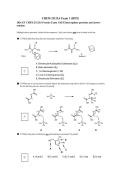
CHEM 2312LS Exam 1 (SP25)
2026 GT CHEM 2312LS Practice Exam 1 KEY|latest update questions and answer
solution
Multiple-choice questions. Select the best response. Circle your choice and write its letter in the box.
1) Which label best describes the elementary step below? [4 points]
O O O O
H3C H3C CH3
Base Base H
A. Bimolecular Nucleophilic Substitution (SN2)
B. Beta–elimination (Eβ)
E C. 1,2–Rearrangement (1,2R)
D. Loss of a leaving group (DN)
E. Bimolecular Elimination (E2)
2) Which set of curved arrows correctly depicts the elementary steps shown below? (All charges are shown,
but not all lone pairs are shown.) [4 points]
OEt OEt
N O N O
Ph Ph
O N Ph O N Ph
Ph
OEt OEt Ph
OEt OEt OEt OEt
N O N O
O N O O O N
A
OEt OEt OEt
Ph Ph Ph Ph Ph Ph Ph Ph
Ph Ph Ph Ph
A B C D
3) Which lone pairs of electrons are participating in resonance? [4 points]
CH3
D
NH2
A C
B
B A. B and C B) C and D C) B, C and D D) C only E) D only
, CHEM 2312LS Exam 1 (SP25)
4) What is the structure of the dienophile needed to prepare the following compound in a Diels-Alder
cycloaddition reaction? [4 points]
H3C CH3
N
CH3
H3C O
CH3
H CH3 H H
B H3C O
O O CH3
O
A B C D E
5) The Nitroso group (—NO) is an ortho/para director. However, nitrosobenzene reacts more slowly than
benzene with sulfuric acid and sulfur trioxide. Which statement best explains this apparent discrepency? [4
points]
O O O
N N N
H2SO4, SO3
Slower
SO3H HO3S
H2SO4, SO3
Faster SO3H
A. The species that reacts with SO3H+ is protonated nitrosobenzene, not
nitrosobenzene itself.
B B. The nitroso group is electron donating by resonance but electron withdrawing
by induction.
C. Steric hindrance in nitrosobenzene prevents substitution at the meta position
D. The nitrosogroup forms a lewis acid-base complex with SO3
E. There is no discrepancy; ortho/para directing groups are typically
deactivating toward electrophilic aromatic substitution
2026 GT CHEM 2312LS Practice Exam 1 KEY|latest update questions and answer
solution
Multiple-choice questions. Select the best response. Circle your choice and write its letter in the box.
1) Which label best describes the elementary step below? [4 points]
O O O O
H3C H3C CH3
Base Base H
A. Bimolecular Nucleophilic Substitution (SN2)
B. Beta–elimination (Eβ)
E C. 1,2–Rearrangement (1,2R)
D. Loss of a leaving group (DN)
E. Bimolecular Elimination (E2)
2) Which set of curved arrows correctly depicts the elementary steps shown below? (All charges are shown,
but not all lone pairs are shown.) [4 points]
OEt OEt
N O N O
Ph Ph
O N Ph O N Ph
Ph
OEt OEt Ph
OEt OEt OEt OEt
N O N O
O N O O O N
A
OEt OEt OEt
Ph Ph Ph Ph Ph Ph Ph Ph
Ph Ph Ph Ph
A B C D
3) Which lone pairs of electrons are participating in resonance? [4 points]
CH3
D
NH2
A C
B
B A. B and C B) C and D C) B, C and D D) C only E) D only
, CHEM 2312LS Exam 1 (SP25)
4) What is the structure of the dienophile needed to prepare the following compound in a Diels-Alder
cycloaddition reaction? [4 points]
H3C CH3
N
CH3
H3C O
CH3
H CH3 H H
B H3C O
O O CH3
O
A B C D E
5) The Nitroso group (—NO) is an ortho/para director. However, nitrosobenzene reacts more slowly than
benzene with sulfuric acid and sulfur trioxide. Which statement best explains this apparent discrepency? [4
points]
O O O
N N N
H2SO4, SO3
Slower
SO3H HO3S
H2SO4, SO3
Faster SO3H
A. The species that reacts with SO3H+ is protonated nitrosobenzene, not
nitrosobenzene itself.
B B. The nitroso group is electron donating by resonance but electron withdrawing
by induction.
C. Steric hindrance in nitrosobenzene prevents substitution at the meta position
D. The nitrosogroup forms a lewis acid-base complex with SO3
E. There is no discrepancy; ortho/para directing groups are typically
deactivating toward electrophilic aromatic substitution