

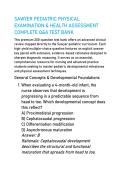
SAWYER PEDIATRIC PHYSICAL
EXAMINATION & HEALTH ASSESSMENT
COMPLETE Q&A TEST BANK
This premium 200-question test bank offers an advanced clinical
review mapped directly to the Sawyer pediatric curriculum. Each
high-yield multiple-choice question features an explicit answer
key paired with extensive, evidence-based rationales designed to
sharpen diagnostic reasoning. It serves as an essential,
comprehensive resource for nursing and advanced practice
students seeking to master pediatric developmental milestones
and physical assessment techniques.
General Concepts & Developmental Foundations
1. When evaluating a 4-month-old infant, the
nurse observes that development is
progressing in a predictable sequence from
head to toe. Which developmental concept does
this reflect?
A) Proximodistal progression
B) Cephalocaudal progression
C) Differentiation modification
D) Asynchronous maturation
Answer: B
Rationale: Cephalocaudal development
describes the structural and functional
maturation that spreads from head to toe,
, meaning control of the head and neck is
achieved before trunk or lower extremity
control.
2. During a routine well-child exam, a mother
asks why frequent developmental screenings
are necessary during the first two years of life.
Which response provides the most accurate
clinical reasoning?
A) Growth parameters are directly proportional
to behavioral metrics.
B) Early identification of deficits allows for
timely intervention during high-plasticity
developmental windows.
C) The trajectory of early childhood milestones
is completely unpredictable and volatile.
D) Formal standardized screening replaces the
need for subjective parental reporting.
Answer: B
Rationale: Early neurodevelopmental screening
aims to uncover subtle delays when the central
nervous system retains optimal plasticity,
ensuring that early therapeutic intervention
yields maximum functional benefit.
,3. According to Erik Erikson’s psychosocial
framework, a 14-month-old toddler who
exhibits distress upon maternal separation but
explores the environment when comforted is
navigating which stage?
A) Initiative vs. Guilt
B) Autonomy vs. Shame and Doubt
C) Trust vs. Mistrust
D) Identity vs. Role Confusion
Answer: C
Rationale: During infancy up to roughly 18
months, the primary conflict is trust versus
mistrust. Resolving this allows infants to
establish a secure attachment base to
confidently explore their surroundings.
4. An advanced practice nurse prepares to assess
a 3-year-old child. Which approach minimizes
emotional trauma and maximizes clinical
cooperation?
A) Perform the invasive ear and throat
examinations first to establish authority.
B) Conduct the examination strictly from a
head-to-toe sequence regardless of behavior.
C) Use play, allow the child to touch unheated
, instruments, and defer invasive steps to the
end.
D) Ask the parent to leave the room to limit
attention-seeking behavior.
Answer: C
Rationale: Atraumatic pediatric assessment
relies on altering sequences based on
compliance. Leaving distressing techniques
(like otoscopy and oral inspection) until last
keeps the child calm for cardiac and abdominal
assessments.
5. When assessing an adolescent patient, which
strategy should the practitioner prioritize to
establish a strong therapeutic alliance and
capture an accurate history?
A) Interview the adolescent solely in the
presence of both parents to verify history.
B) Provide a private environment for the
interview while clearly explaining confidentiality
boundaries.
C) Avoid asking sensitive questions regarding
substance use or sexual health.
D) Use advanced technical medical terminology
to elevate professionalism.
EXAMINATION & HEALTH ASSESSMENT
COMPLETE Q&A TEST BANK
This premium 200-question test bank offers an advanced clinical
review mapped directly to the Sawyer pediatric curriculum. Each
high-yield multiple-choice question features an explicit answer
key paired with extensive, evidence-based rationales designed to
sharpen diagnostic reasoning. It serves as an essential,
comprehensive resource for nursing and advanced practice
students seeking to master pediatric developmental milestones
and physical assessment techniques.
General Concepts & Developmental Foundations
1. When evaluating a 4-month-old infant, the
nurse observes that development is
progressing in a predictable sequence from
head to toe. Which developmental concept does
this reflect?
A) Proximodistal progression
B) Cephalocaudal progression
C) Differentiation modification
D) Asynchronous maturation
Answer: B
Rationale: Cephalocaudal development
describes the structural and functional
maturation that spreads from head to toe,
, meaning control of the head and neck is
achieved before trunk or lower extremity
control.
2. During a routine well-child exam, a mother
asks why frequent developmental screenings
are necessary during the first two years of life.
Which response provides the most accurate
clinical reasoning?
A) Growth parameters are directly proportional
to behavioral metrics.
B) Early identification of deficits allows for
timely intervention during high-plasticity
developmental windows.
C) The trajectory of early childhood milestones
is completely unpredictable and volatile.
D) Formal standardized screening replaces the
need for subjective parental reporting.
Answer: B
Rationale: Early neurodevelopmental screening
aims to uncover subtle delays when the central
nervous system retains optimal plasticity,
ensuring that early therapeutic intervention
yields maximum functional benefit.
,3. According to Erik Erikson’s psychosocial
framework, a 14-month-old toddler who
exhibits distress upon maternal separation but
explores the environment when comforted is
navigating which stage?
A) Initiative vs. Guilt
B) Autonomy vs. Shame and Doubt
C) Trust vs. Mistrust
D) Identity vs. Role Confusion
Answer: C
Rationale: During infancy up to roughly 18
months, the primary conflict is trust versus
mistrust. Resolving this allows infants to
establish a secure attachment base to
confidently explore their surroundings.
4. An advanced practice nurse prepares to assess
a 3-year-old child. Which approach minimizes
emotional trauma and maximizes clinical
cooperation?
A) Perform the invasive ear and throat
examinations first to establish authority.
B) Conduct the examination strictly from a
head-to-toe sequence regardless of behavior.
C) Use play, allow the child to touch unheated
, instruments, and defer invasive steps to the
end.
D) Ask the parent to leave the room to limit
attention-seeking behavior.
Answer: C
Rationale: Atraumatic pediatric assessment
relies on altering sequences based on
compliance. Leaving distressing techniques
(like otoscopy and oral inspection) until last
keeps the child calm for cardiac and abdominal
assessments.
5. When assessing an adolescent patient, which
strategy should the practitioner prioritize to
establish a strong therapeutic alliance and
capture an accurate history?
A) Interview the adolescent solely in the
presence of both parents to verify history.
B) Provide a private environment for the
interview while clearly explaining confidentiality
boundaries.
C) Avoid asking sensitive questions regarding
substance use or sexual health.
D) Use advanced technical medical terminology
to elevate professionalism.


