

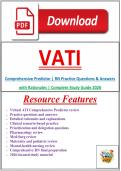
VATI
Comprehensive Predictor | RN Practice Questions & Answers
with Rationales | Complete Study Guide 2026
Resource Features
• Virtual ATI Comprehensive Predictor review
• Practice questions and answers
• Detailed rationales and explanations
• Clinical scenario-based practice
• Prioritization and delegation questions
• Pharmacology review
• Med-Surg review
• Maternity and pediatric review
• Mental-health nursing review
• Comprehensive RN final preparation
• 2026-focused study material
,Virtual ATI Comprehensive Predictor | RN Practice
Questions & Answers with Rationales | Complete
Study Guide 2026
1. A nurse is responsible for providing clear directions when a task is
initially delegated and for periodic reassessment and evaluation of
the outcome of the task. Which statement best describes the RN's role
in delegation?
A) RNs may only delegate to other RNs
B) RNs must delegate tasks so they can complete higher-level tasks
C) RNs should delegate all patient care tasks to APs
D) RNs are not responsible for outcomes after delegation
Answer: B
Rationale: RNs must delegate tasks so that they can complete higher-level
tasks. RNs may delegate to other RNs, PNs, or APs. The RN remains
responsible for providing clear directions initially and for periodic
reassessment and evaluation of outcomes.
2. When determining whether to delegate a task, which factor should
the RN consider FIRST?
A) The delegatee's personal preferences
B) The predictability of outcome
,C) The time of day
D) The delegatee's years of experience
Answer: B
Rationale: The predictability of outcome is a key consideration: Is this
routine or new? Is there potential for complications? This helps determine if
the task is appropriate for delegation.
3. A PN can delegate tasks to which of the following?
A) RNs only
B) Other PNs or APs
C) Physicians only
D) No one, PNs cannot delegate
Answer: B
Rationale: PNs may delegate to other PNs or APs. RNs may delegate to
other RNs, PNs, or APs.
4. Which of the following tasks is appropriate to delegate to an AP
(Assistive Personnel)?
A) Tracheostomy care
B) Administering medications
C) Ambulating a stable client
D) Suctioning
Answer: C
Rationale: APs are appropriate for ADLs including bathing, grooming,
, dressing, toileting, ambulating, feeding, positioning, routine tasks, bed
making, specimen collection, I&Os, and vital signs for stable clients.
5. A nurse is determining if a task can be delegated to a PN. Which
factor should be considered?
A) Whether the task requires the nursing process
B) The cost of the procedure
C) The client's insurance coverage
D) The nurse's personal comfort with the task
Answer: A
Rationale: The complexity of care includes whether the task requires
problem solving, the nursing process, assessment skills, or judgment. This
helps determine if delegation to a PN is appropriate.
Concepts of Management
6. A nurse manager is planning staffing for the unit. This action
represents which concept of management?
A) Organizing
B) Directing
C) Staffing
D) Controlling
Answer: C
Rationale: Staffing refers to ensuring adequate staffing and appropriate
staffing mix for the unit.
Comprehensive Predictor | RN Practice Questions & Answers
with Rationales | Complete Study Guide 2026
Resource Features
• Virtual ATI Comprehensive Predictor review
• Practice questions and answers
• Detailed rationales and explanations
• Clinical scenario-based practice
• Prioritization and delegation questions
• Pharmacology review
• Med-Surg review
• Maternity and pediatric review
• Mental-health nursing review
• Comprehensive RN final preparation
• 2026-focused study material
,Virtual ATI Comprehensive Predictor | RN Practice
Questions & Answers with Rationales | Complete
Study Guide 2026
1. A nurse is responsible for providing clear directions when a task is
initially delegated and for periodic reassessment and evaluation of
the outcome of the task. Which statement best describes the RN's role
in delegation?
A) RNs may only delegate to other RNs
B) RNs must delegate tasks so they can complete higher-level tasks
C) RNs should delegate all patient care tasks to APs
D) RNs are not responsible for outcomes after delegation
Answer: B
Rationale: RNs must delegate tasks so that they can complete higher-level
tasks. RNs may delegate to other RNs, PNs, or APs. The RN remains
responsible for providing clear directions initially and for periodic
reassessment and evaluation of outcomes.
2. When determining whether to delegate a task, which factor should
the RN consider FIRST?
A) The delegatee's personal preferences
B) The predictability of outcome
,C) The time of day
D) The delegatee's years of experience
Answer: B
Rationale: The predictability of outcome is a key consideration: Is this
routine or new? Is there potential for complications? This helps determine if
the task is appropriate for delegation.
3. A PN can delegate tasks to which of the following?
A) RNs only
B) Other PNs or APs
C) Physicians only
D) No one, PNs cannot delegate
Answer: B
Rationale: PNs may delegate to other PNs or APs. RNs may delegate to
other RNs, PNs, or APs.
4. Which of the following tasks is appropriate to delegate to an AP
(Assistive Personnel)?
A) Tracheostomy care
B) Administering medications
C) Ambulating a stable client
D) Suctioning
Answer: C
Rationale: APs are appropriate for ADLs including bathing, grooming,
, dressing, toileting, ambulating, feeding, positioning, routine tasks, bed
making, specimen collection, I&Os, and vital signs for stable clients.
5. A nurse is determining if a task can be delegated to a PN. Which
factor should be considered?
A) Whether the task requires the nursing process
B) The cost of the procedure
C) The client's insurance coverage
D) The nurse's personal comfort with the task
Answer: A
Rationale: The complexity of care includes whether the task requires
problem solving, the nursing process, assessment skills, or judgment. This
helps determine if delegation to a PN is appropriate.
Concepts of Management
6. A nurse manager is planning staffing for the unit. This action
represents which concept of management?
A) Organizing
B) Directing
C) Staffing
D) Controlling
Answer: C
Rationale: Staffing refers to ensuring adequate staffing and appropriate
staffing mix for the unit.


