

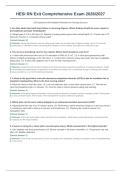
HESI RN Exit Comprehensive Exam 2026/2027
150 Questions with Detailed Rationales for Nursing Success
1. An older adult client with heart failure is receiving Digoxin. Which finding should the nurse report to
the healthcare provider immediately?
A. Weight gain of 1 lb in 24 hours | B. Reports of seeing yellow-green halos around lights | C. A heart rate of 72
beats per minute | D. Increased urinary output
Correct Answer: B
Rationale: Visual disturbances, such as yellow-green halos, are a classic sign of digoxin toxicity. HR of 72 is normal;
weight gain of >3lb/week is more concerning than 1lb/day in some contexts, but halos are a direct toxic sign.
2. The nurse is prioritizing care for four clients. Which client should be seen first?
A. A client with pneumonia who has an O2 saturation of 90% on 2L NC. | B. A client post-gastrectomy with
200mL of bright red drainage in the NG tube. | C. A client with a fracture whose leg is pale and has no palpable
pedal pulse. | D. A client with diabetes who is due for their morning insulin.
Correct Answer: C
Rationale: A pale limb with no pulse indicates acute limb ischemia/compartment syndrome, a surgical emergency. Bright
red drainage post-gastrectomy is expected to be small/old, but 'bright red' is concerning, though a missing pulse always
takes precedence as a limb-threatening emergency.
3. A client in the psychiatric unit with obsessive-compulsive disorder (OCD) is late for breakfast due to
ritualistic handwashing. What is the best nursing action?
A. Allow the client to finish the ritual. | B. Lock the bathroom door so the client cannot wash. | C. Remind the
client that breakfast ends in 5 minutes. | D. Give the client a choice between eating and washing.
Correct Answer: A
Rationale: In the early stages of treatment, clients should be allowed to complete rituals to manage anxiety. Forcing them
to stop can lead to panic level anxiety. Time management should be addressed gradually.
4. Which task can the nurse safely delegate to an unlicensed assistive personnel (UAP)?
A. Adjusting the flow rate of an IV infusion pump. | B. Performing a sterile dressing change on a post-op wound. |
C. Assisting a client with a history of seizures to the bathroom. | D. Checking the residual volume of a
nasogastric tube.
Correct Answer: C
Rationale: UAPs can assist stable clients with ADLs like ambulation. Sterile tasks, pump adjustments, and assessment
(residual) are RN responsibilities.
5. A nurse is caring for a client with a cervical spine injury. Which assessment is the highest priority?
A. Skin integrity over bony prominences | B. Muscle strength in the lower extremities | C. Respiratory rate and
effort | D. Bladder distention
Correct Answer: C
Rationale: Injury to the cervical spine (C3-C5) can paralyze the diaphragm, leading to respiratory arrest. Airway/Breathing
is the priority.
,6. A client is 6 hours post-cardiac catheterization. Which finding requires immediate intervention?
A. The client reports mild discomfort at the insertion site. | B. The client's affected extremity is cool and dusky. |
C. There is a small amount of dried blood on the dressing. | D. The client's blood pressure is 130/82.
Correct Answer: B
Rationale: A cool, dusky extremity indicates arterial occlusion or hematoma blocking distal flow. This is a neurovascular
emergency.
7. The nurse notes late decelerations on the fetal monitor of a client in labor. What is the first action?
A. Administer IV Pitocin. | B. Position the client on her left side. | C. Notify the healthcare provider. | D. Prepare
for a C-section.
Correct Answer: B
Rationale: Late decelerations indicate uteroplacental insufficiency. The first action is to improve placental blood flow by
turning the client to the left side.
8. A client is admitted with a diagnosis of pheochromocytoma. Which vital sign is most important to
monitor?
A. Heart rate | B. Temperature | C. Blood pressure | D. Respiratory rate
Correct Answer: C
Rationale: Pheochromocytoma is a catecholamine-secreting tumor that causes severe, life-threatening hypertension.
9. What is the priority intervention for a client experiencing an anaphylactic reaction to an IV antibiotic?
A. Administer Epinephrine SC or IM. | B. Stop the antibiotic infusion. | C. Apply high-flow oxygen. | D. Administer
Diphenhydramine.
Correct Answer: B
Rationale: The very first step is to remove the allergen/stop the infusion. Epinephrine follows immediately after.
10. A client with Addison's disease is admitted in crisis. Which lab finding is expected?
A. Hyperglycemia and Hypernatremia | B. Hypoglycemia and Hyponatremia | C. Hypokalemia and
Hypercalcemia | D. Hypernatremia and Hypokalemia
Correct Answer: B
Rationale: Addisonian crisis involves low cortisol (hypoglycemia) and low aldosterone (sodium loss/hyponatremia and
potassium retention/hyperkalemia).
11. RN Exit Q11: Standard PPE for TB?
A. N95 Respirator | B. Surgical mask | C. Monitor vitals | D. Document findings
Correct Answer: A
Rationale: Airborne precautions require a fitted N95 mask.
12. RN Exit Q12: Magnesium Sulfate toxicity?
A. Absent reflexes | B. Hyperreflexia | C. Monitor vitals | D. Document findings
Correct Answer: A
Rationale: Loss of DTRs is an early sign of toxicity.
13. RN Exit Q13: ABG for COPD patient?
A. Resp Acidosis | B. Resp Alkalosis | C. Monitor vitals | D. Document findings
Correct Answer: A
Rationale: Retention of CO2 leads to acidosis.
, 14. RN Exit Q14: Priority for Myasthenia Gravis?
A. Aspiration/Airway | B. Joint pain | C. Monitor vitals | D. Document findings
Correct Answer: A
Rationale: Muscle weakness affects swallowing and breathing.
15. RN Exit Q15: Sign of Pyloric Stenosis?
A. Olive-shaped mass in RUQ | B. Sausage-shaped mass in RLQ | C. Monitor vitals | D. Document findings
Correct Answer: A
Rationale: Olive-shaped mass and projectile vomiting are hallmarks.
16. RN Exit Q16: Lithium therapeutic range?
A. 0.6 - 1.2 mEq/L | B. 2.0 - 3.5 mEq/L | C. Monitor vitals | D. Document findings
Correct Answer: A
Rationale: Range is narrow; levels above 1.5 are toxic.
17. RN Exit Q17: Triage: Black Tag meaning?
A. Life threatening | B. Deceased or non-salvageable | C. Monitor vitals | D. Document findings
Correct Answer: B
Rationale: In mass casualty, resources are not used for those unlikely to survive.
18. RN Exit Q18: Warfarin Antidote?
A. Vitamin K | B. Protamine Sulfate | C. Monitor vitals | D. Document findings
Correct Answer: A
Rationale: Vitamin K is for Warfarin; Protamine is for Heparin.
19. RN Exit Q19: Sign of Hypocalcemia?
A. Trousseau's sign | B. Negative Chvostek's | C. Monitor vitals | D. Document findings
Correct Answer: A
Rationale: Carpal spasm with BP cuff inflation (Trousseau) and facial twitch (Chvostek).
20. RN Exit Q20: Position after Liver Biopsy?
A. Right side-lying | B. Supine | C. Monitor vitals | D. Document findings
Correct Answer: A
Rationale: To apply pressure to the biopsy site to prevent hemorrhage.
21. RN Exit Q21: Pneumothorax: Chest tube bubbling?
A. Constant in water seal | B. Intermittent in water seal | C. Monitor vitals | D. Document findings
Correct Answer: B
Rationale: Constant bubbling indicates a leak; intermittent is normal as air leaves pleural space.
22. RN Exit Q22: Autonomic Dysreflexia trigger?
A. Bladder distention | B. Low blood sugar | C. Monitor vitals | D. Document findings
Correct Answer: A
Rationale: Full bladder or fecal impaction are common triggers.
150 Questions with Detailed Rationales for Nursing Success
1. An older adult client with heart failure is receiving Digoxin. Which finding should the nurse report to
the healthcare provider immediately?
A. Weight gain of 1 lb in 24 hours | B. Reports of seeing yellow-green halos around lights | C. A heart rate of 72
beats per minute | D. Increased urinary output
Correct Answer: B
Rationale: Visual disturbances, such as yellow-green halos, are a classic sign of digoxin toxicity. HR of 72 is normal;
weight gain of >3lb/week is more concerning than 1lb/day in some contexts, but halos are a direct toxic sign.
2. The nurse is prioritizing care for four clients. Which client should be seen first?
A. A client with pneumonia who has an O2 saturation of 90% on 2L NC. | B. A client post-gastrectomy with
200mL of bright red drainage in the NG tube. | C. A client with a fracture whose leg is pale and has no palpable
pedal pulse. | D. A client with diabetes who is due for their morning insulin.
Correct Answer: C
Rationale: A pale limb with no pulse indicates acute limb ischemia/compartment syndrome, a surgical emergency. Bright
red drainage post-gastrectomy is expected to be small/old, but 'bright red' is concerning, though a missing pulse always
takes precedence as a limb-threatening emergency.
3. A client in the psychiatric unit with obsessive-compulsive disorder (OCD) is late for breakfast due to
ritualistic handwashing. What is the best nursing action?
A. Allow the client to finish the ritual. | B. Lock the bathroom door so the client cannot wash. | C. Remind the
client that breakfast ends in 5 minutes. | D. Give the client a choice between eating and washing.
Correct Answer: A
Rationale: In the early stages of treatment, clients should be allowed to complete rituals to manage anxiety. Forcing them
to stop can lead to panic level anxiety. Time management should be addressed gradually.
4. Which task can the nurse safely delegate to an unlicensed assistive personnel (UAP)?
A. Adjusting the flow rate of an IV infusion pump. | B. Performing a sterile dressing change on a post-op wound. |
C. Assisting a client with a history of seizures to the bathroom. | D. Checking the residual volume of a
nasogastric tube.
Correct Answer: C
Rationale: UAPs can assist stable clients with ADLs like ambulation. Sterile tasks, pump adjustments, and assessment
(residual) are RN responsibilities.
5. A nurse is caring for a client with a cervical spine injury. Which assessment is the highest priority?
A. Skin integrity over bony prominences | B. Muscle strength in the lower extremities | C. Respiratory rate and
effort | D. Bladder distention
Correct Answer: C
Rationale: Injury to the cervical spine (C3-C5) can paralyze the diaphragm, leading to respiratory arrest. Airway/Breathing
is the priority.
,6. A client is 6 hours post-cardiac catheterization. Which finding requires immediate intervention?
A. The client reports mild discomfort at the insertion site. | B. The client's affected extremity is cool and dusky. |
C. There is a small amount of dried blood on the dressing. | D. The client's blood pressure is 130/82.
Correct Answer: B
Rationale: A cool, dusky extremity indicates arterial occlusion or hematoma blocking distal flow. This is a neurovascular
emergency.
7. The nurse notes late decelerations on the fetal monitor of a client in labor. What is the first action?
A. Administer IV Pitocin. | B. Position the client on her left side. | C. Notify the healthcare provider. | D. Prepare
for a C-section.
Correct Answer: B
Rationale: Late decelerations indicate uteroplacental insufficiency. The first action is to improve placental blood flow by
turning the client to the left side.
8. A client is admitted with a diagnosis of pheochromocytoma. Which vital sign is most important to
monitor?
A. Heart rate | B. Temperature | C. Blood pressure | D. Respiratory rate
Correct Answer: C
Rationale: Pheochromocytoma is a catecholamine-secreting tumor that causes severe, life-threatening hypertension.
9. What is the priority intervention for a client experiencing an anaphylactic reaction to an IV antibiotic?
A. Administer Epinephrine SC or IM. | B. Stop the antibiotic infusion. | C. Apply high-flow oxygen. | D. Administer
Diphenhydramine.
Correct Answer: B
Rationale: The very first step is to remove the allergen/stop the infusion. Epinephrine follows immediately after.
10. A client with Addison's disease is admitted in crisis. Which lab finding is expected?
A. Hyperglycemia and Hypernatremia | B. Hypoglycemia and Hyponatremia | C. Hypokalemia and
Hypercalcemia | D. Hypernatremia and Hypokalemia
Correct Answer: B
Rationale: Addisonian crisis involves low cortisol (hypoglycemia) and low aldosterone (sodium loss/hyponatremia and
potassium retention/hyperkalemia).
11. RN Exit Q11: Standard PPE for TB?
A. N95 Respirator | B. Surgical mask | C. Monitor vitals | D. Document findings
Correct Answer: A
Rationale: Airborne precautions require a fitted N95 mask.
12. RN Exit Q12: Magnesium Sulfate toxicity?
A. Absent reflexes | B. Hyperreflexia | C. Monitor vitals | D. Document findings
Correct Answer: A
Rationale: Loss of DTRs is an early sign of toxicity.
13. RN Exit Q13: ABG for COPD patient?
A. Resp Acidosis | B. Resp Alkalosis | C. Monitor vitals | D. Document findings
Correct Answer: A
Rationale: Retention of CO2 leads to acidosis.
, 14. RN Exit Q14: Priority for Myasthenia Gravis?
A. Aspiration/Airway | B. Joint pain | C. Monitor vitals | D. Document findings
Correct Answer: A
Rationale: Muscle weakness affects swallowing and breathing.
15. RN Exit Q15: Sign of Pyloric Stenosis?
A. Olive-shaped mass in RUQ | B. Sausage-shaped mass in RLQ | C. Monitor vitals | D. Document findings
Correct Answer: A
Rationale: Olive-shaped mass and projectile vomiting are hallmarks.
16. RN Exit Q16: Lithium therapeutic range?
A. 0.6 - 1.2 mEq/L | B. 2.0 - 3.5 mEq/L | C. Monitor vitals | D. Document findings
Correct Answer: A
Rationale: Range is narrow; levels above 1.5 are toxic.
17. RN Exit Q17: Triage: Black Tag meaning?
A. Life threatening | B. Deceased or non-salvageable | C. Monitor vitals | D. Document findings
Correct Answer: B
Rationale: In mass casualty, resources are not used for those unlikely to survive.
18. RN Exit Q18: Warfarin Antidote?
A. Vitamin K | B. Protamine Sulfate | C. Monitor vitals | D. Document findings
Correct Answer: A
Rationale: Vitamin K is for Warfarin; Protamine is for Heparin.
19. RN Exit Q19: Sign of Hypocalcemia?
A. Trousseau's sign | B. Negative Chvostek's | C. Monitor vitals | D. Document findings
Correct Answer: A
Rationale: Carpal spasm with BP cuff inflation (Trousseau) and facial twitch (Chvostek).
20. RN Exit Q20: Position after Liver Biopsy?
A. Right side-lying | B. Supine | C. Monitor vitals | D. Document findings
Correct Answer: A
Rationale: To apply pressure to the biopsy site to prevent hemorrhage.
21. RN Exit Q21: Pneumothorax: Chest tube bubbling?
A. Constant in water seal | B. Intermittent in water seal | C. Monitor vitals | D. Document findings
Correct Answer: B
Rationale: Constant bubbling indicates a leak; intermittent is normal as air leaves pleural space.
22. RN Exit Q22: Autonomic Dysreflexia trigger?
A. Bladder distention | B. Low blood sugar | C. Monitor vitals | D. Document findings
Correct Answer: A
Rationale: Full bladder or fecal impaction are common triggers.


