

BSN EXAM 1 STUDY GUIDE & PRACTICE TEST (FALL 2026)
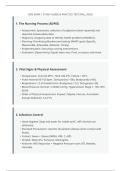
1. The Nursing Process (ADPIE)
• Assessment: Systematic collection of subjective (client-reported) and
objective (measurable) data.
• Diagnosis: Analyzing data to identify health problems (NANDA-I).
• Planning: Prioritizing (Maslow) and setting SMART goals (Specific,
Measurable, Attainable, Relevant, Timely).
• Implementation: Executing nursing interventions.
• Evaluation: Determining if goals were met; if not, re-assess and revise.
2. Vital Signs & Physical Assessment
• Temperature: Oral (36-38°C / 96.8-100.4°F). Febrile > 38°C.
• Pulse: Normal 60-100 bpm. Tachycardia (>100), Bradycardia (<60).
• Respirations: 12-20 breaths/min. Bradypnea (<12), Tachypnea (>20).
• Blood Pressure: Normal <120/80 mmHg. Hypertension Stage 1: 130-139 /
80-89.
• Order of Physical Assessment: Inspect, Palpate, Percuss, Auscultate
(Except Abdomen: I-A-P-P).
3. Infection Control
• Hand Hygiene: Soap and water for visible soil/C. diff; Alcohol-rub
otherwise.
• Standard Precautions: Used for all patients (Gloves when contact with
fluids).
• Contact: Gown + Gloves (MRSA, VRE, C. diff).
• Droplet: Mask (Flu, Pertussis, Meningitis).
• Airborne: N95 Respirator + Negative Pressure room (TB, Measles,
Varicella).
, 100 Practice Questions
1. A client is admitted with suspected Tuberculosis. Which type of precautions
should the nurse implement?
A. Contact
B. Droplet
C. Airborne
D. Standard
Correct Answer: C
Rationale: Tuberculosis is transmitted via small droplets that remain suspended in the
air, requiring Airborne precautions (N95 mask and negative pressure room).
2. Which of the following is a SMART goal for a client with impaired mobility?
A. Client will walk more today.
B. Client will ambulate 50 feet with a walker by the end of shift.
C. Client's strength will improve.
D. Nurse will assist client to the chair twice daily.
Correct Answer: B
Rationale: Option B is Specific, Measurable, Attainable, Relevant, and Timely (SMART).
Option D is a nursing intervention, not a client goal.
3. Study Guide Practice Question 3: Which nursing action best demonstrates
the 'Evaluation' phase of the nursing process?
A. Evaluation action
B. Implementation action
C. Planning action
D. Assessment action
Correct Answer: A
Rationale: Evaluation involves comparing the client's current status (BP measurement)
with the expected outcome to see if the intervention worked.
, 4. Study Guide Practice Question 4: Which nursing action best demonstrates
the 'Evaluation' phase of the nursing process?
A. Evaluation action
B. Implementation action
C. Planning action
D. Assessment action
Correct Answer: A
Rationale: Evaluation involves comparing the client's current status (BP measurement)
with the expected outcome to see if the intervention worked.
5. Study Guide Practice Question 5: Which nursing action best demonstrates
the 'Evaluation' phase of the nursing process?
A. Evaluation action
B. Implementation action
C. Planning action
D. Assessment action
Correct Answer: A
Rationale: Evaluation involves comparing the client's current status (BP measurement)
with the expected outcome to see if the intervention worked.
6. Study Guide Practice Question 6: Which nursing action best demonstrates
the 'Evaluation' phase of the nursing process?
A. Evaluation action
B. Implementation action
C. Planning action
D. Assessment action
Correct Answer: A
Rationale: Evaluation involves comparing the client's current status (BP measurement)
with the expected outcome to see if the intervention worked.
7. Study Guide Practice Question 7: Which nursing action best demonstrates
the 'Evaluation' phase of the nursing process?
A. Evaluation action
B. Implementation action
C. Planning action
D. Assessment action
Correct Answer: A
Rationale: Evaluation involves comparing the client's current status (BP measurement)
with the expected outcome to see if the intervention worked.
1. The Nursing Process (ADPIE)
• Assessment: Systematic collection of subjective (client-reported) and
objective (measurable) data.
• Diagnosis: Analyzing data to identify health problems (NANDA-I).
• Planning: Prioritizing (Maslow) and setting SMART goals (Specific,
Measurable, Attainable, Relevant, Timely).
• Implementation: Executing nursing interventions.
• Evaluation: Determining if goals were met; if not, re-assess and revise.
2. Vital Signs & Physical Assessment
• Temperature: Oral (36-38°C / 96.8-100.4°F). Febrile > 38°C.
• Pulse: Normal 60-100 bpm. Tachycardia (>100), Bradycardia (<60).
• Respirations: 12-20 breaths/min. Bradypnea (<12), Tachypnea (>20).
• Blood Pressure: Normal <120/80 mmHg. Hypertension Stage 1: 130-139 /
80-89.
• Order of Physical Assessment: Inspect, Palpate, Percuss, Auscultate
(Except Abdomen: I-A-P-P).
3. Infection Control
• Hand Hygiene: Soap and water for visible soil/C. diff; Alcohol-rub
otherwise.
• Standard Precautions: Used for all patients (Gloves when contact with
fluids).
• Contact: Gown + Gloves (MRSA, VRE, C. diff).
• Droplet: Mask (Flu, Pertussis, Meningitis).
• Airborne: N95 Respirator + Negative Pressure room (TB, Measles,
Varicella).
, 100 Practice Questions
1. A client is admitted with suspected Tuberculosis. Which type of precautions
should the nurse implement?
A. Contact
B. Droplet
C. Airborne
D. Standard
Correct Answer: C
Rationale: Tuberculosis is transmitted via small droplets that remain suspended in the
air, requiring Airborne precautions (N95 mask and negative pressure room).
2. Which of the following is a SMART goal for a client with impaired mobility?
A. Client will walk more today.
B. Client will ambulate 50 feet with a walker by the end of shift.
C. Client's strength will improve.
D. Nurse will assist client to the chair twice daily.
Correct Answer: B
Rationale: Option B is Specific, Measurable, Attainable, Relevant, and Timely (SMART).
Option D is a nursing intervention, not a client goal.
3. Study Guide Practice Question 3: Which nursing action best demonstrates
the 'Evaluation' phase of the nursing process?
A. Evaluation action
B. Implementation action
C. Planning action
D. Assessment action
Correct Answer: A
Rationale: Evaluation involves comparing the client's current status (BP measurement)
with the expected outcome to see if the intervention worked.
, 4. Study Guide Practice Question 4: Which nursing action best demonstrates
the 'Evaluation' phase of the nursing process?
A. Evaluation action
B. Implementation action
C. Planning action
D. Assessment action
Correct Answer: A
Rationale: Evaluation involves comparing the client's current status (BP measurement)
with the expected outcome to see if the intervention worked.
5. Study Guide Practice Question 5: Which nursing action best demonstrates
the 'Evaluation' phase of the nursing process?
A. Evaluation action
B. Implementation action
C. Planning action
D. Assessment action
Correct Answer: A
Rationale: Evaluation involves comparing the client's current status (BP measurement)
with the expected outcome to see if the intervention worked.
6. Study Guide Practice Question 6: Which nursing action best demonstrates
the 'Evaluation' phase of the nursing process?
A. Evaluation action
B. Implementation action
C. Planning action
D. Assessment action
Correct Answer: A
Rationale: Evaluation involves comparing the client's current status (BP measurement)
with the expected outcome to see if the intervention worked.
7. Study Guide Practice Question 7: Which nursing action best demonstrates
the 'Evaluation' phase of the nursing process?
A. Evaluation action
B. Implementation action
C. Planning action
D. Assessment action
Correct Answer: A
Rationale: Evaluation involves comparing the client's current status (BP measurement)
with the expected outcome to see if the intervention worked.


