

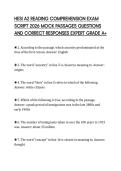
HESI A2 READING COMPREHENSION EXAM
SCRIPT 2026 MOCK PASSAGES QUESTIONS
AND CORRECT RESPONSES EXPERT GRADE A+
◉ 2. According to the passage, which ancestry predominated at the
time of the first census. Answer: English
◉ 2. The word "ancestry" in line 5 is closest in meaning to. Answer:
origins
◉ 4. The word "their" in line 5 refers to which of the following.
Answer: white citizens
◉ 5. Which of the following is true, according to the passage.
Answer: a peak period of immigration was in the late 1800s and
early 1900s
◉ 6. The number of immigrants taken in over the 100 years to 1915
was. Answer: about 35 million
◉ 7. The word "concept" in line 16 is closest in meaning to. Answer:
thought
, ◉ 8. The word "virtually" in line 21 is closest in meaning to. Answer:
effectively
◉ 9. Which of the following is NOT true about immigrants. Answer:
during the 1900s immigrants numbered 1 percent of the total
population
◉ 10. Which of the following can be inferred from the passage.
Answer: preserving a developing "American" culture was a major
factor leading to the introduction of the quota system
◉ Frank Lloyd Wright. Answer: Considered the most influential
architect of his time, Frank Lloyd Wright (1867-1959) was born in
the small rural community of Richland Center, Wisconsin. He
entered the University of Wisconsin at the age of 15 as a special
student, studying engineering because the school had no course in
architecture. At the age of 20 he then went to work as a
draughtsman in Chicago in order to learn the traditional, classical
language of architecture. After marrying into a wealthy business
family at the age of 21, Wright set up house in an exclusive
neighborhood in Chicago, and after a few years of working for a few
architectural firms, set up his own architectural office.
For twenty years he brought up a family of six children upstairs and
ran a thriving architectural practice of twelve or so draughts men
downstairs. Here, in an idyllic American suburb, with giant oaks,
sprawling lawns, and no fences, Wright built some sixty rambling
homes by the year 1900. He became the leader of a style known as
SCRIPT 2026 MOCK PASSAGES QUESTIONS
AND CORRECT RESPONSES EXPERT GRADE A+
◉ 2. According to the passage, which ancestry predominated at the
time of the first census. Answer: English
◉ 2. The word "ancestry" in line 5 is closest in meaning to. Answer:
origins
◉ 4. The word "their" in line 5 refers to which of the following.
Answer: white citizens
◉ 5. Which of the following is true, according to the passage.
Answer: a peak period of immigration was in the late 1800s and
early 1900s
◉ 6. The number of immigrants taken in over the 100 years to 1915
was. Answer: about 35 million
◉ 7. The word "concept" in line 16 is closest in meaning to. Answer:
thought
, ◉ 8. The word "virtually" in line 21 is closest in meaning to. Answer:
effectively
◉ 9. Which of the following is NOT true about immigrants. Answer:
during the 1900s immigrants numbered 1 percent of the total
population
◉ 10. Which of the following can be inferred from the passage.
Answer: preserving a developing "American" culture was a major
factor leading to the introduction of the quota system
◉ Frank Lloyd Wright. Answer: Considered the most influential
architect of his time, Frank Lloyd Wright (1867-1959) was born in
the small rural community of Richland Center, Wisconsin. He
entered the University of Wisconsin at the age of 15 as a special
student, studying engineering because the school had no course in
architecture. At the age of 20 he then went to work as a
draughtsman in Chicago in order to learn the traditional, classical
language of architecture. After marrying into a wealthy business
family at the age of 21, Wright set up house in an exclusive
neighborhood in Chicago, and after a few years of working for a few
architectural firms, set up his own architectural office.
For twenty years he brought up a family of six children upstairs and
ran a thriving architectural practice of twelve or so draughts men
downstairs. Here, in an idyllic American suburb, with giant oaks,
sprawling lawns, and no fences, Wright built some sixty rambling
homes by the year 1900. He became the leader of a style known as


