
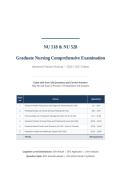
NU 518 & NU 528
Graduate Nursing Comprehensive Examination
Advanced Practice Nursing — Edition
Exam with Over 150 Questions and Correct Answers
New NU 528 Exam 2 Practice Test Questions and Answers
Secti
Focus Questions
on
1 Advanced Health Assessment and Diagnostic Reasoning (NU 518) Q1 – Q40
2 Pathophysiology and Clinical Decision-Making (NU 518) Q41 – Q70
3 Pharmacology and Therapeutic Management (NU 518 & NU 528) Q71 – Q100
4 Advanced Practice Nursing Roles and Professional Issues (NU 528) Q101 – Q125
5 Evidence-Based Practice and Research (NU 528 – Exam 2 Practice) Q126 – Q140
6 Population Health and Healthcare Systems (NU 528) Q141 – Q150
TOTAL 150 Questions
Cognitive Level Distribution: 25% Recall | 55% Application | 20% Analysis
Question Style: 80% Scenario-Based | 20% Direct Recall / Synthesis
,NU 518 & NU 528 — Graduate Nursing Comprehensive Examination 150-Question Comprehensive Exam
Format: Multiple Choice, 4 Options (A–D), One Correct Answer
Page 2
,NU 518 & NU 528 — Graduate Nursing Comprehensive Examination 150-Question Comprehensive Exam
Section 1: Advanced Health Assessment and Diagnostic Reasoning
Questions Q1 – Q40 • NU 518 Focus — Comprehensive health assessment, advanced diagnostic
reasoning, and clinical decision-making across the lifespan.
Q1: A 62-year-old male presents with new-onset exertional chest pressure radiating to the left arm,
diaphoresis, and dyspnea on climbing one flight of stairs. Vital signs: BP 148/92, HR 96, RR 22, SpO2
96% on room air. Which element of the history carries the highest pretest probability weighting for
stable ischemic heart disease per the Diamond-Forrester/updated CAD consortium model?
A. Male sex assigned at birth and age > 60 years
B. Radiation of pain to the left arm and associated diaphoresis
C. Pain that is relieved within 5 minutes of rest [CORRECT]
D. Presence of hypertension on the current vital sign measurement
Correct Answer: C — Pain that is relieved within 5 minutes of rest
Rationale: In the validated Diamond-Forrester and updated CAD consortium pretest probability models,
the three determinants of pretest probability are age, sex, and the character of the chest pain syndrome
(typical, atypical, or nonanginal). Typical angina is defined by three features: substernal discomfort of
characteristic quality and duration, provoked by exertion or emotional stress, and relieved by rest or
nitroglycerin within minutes. Option A identifies risk factors that modify probability but are not primary
model inputs. Option B describes associated symptoms that heighten suspicion but are not part of the
formal definition. Option D is a risk factor, not an angina-defining criterion, and the relief-with-rest feature
in option C is the single most discriminating anginal feature.
Q2: A 55-year-old female with a 30 pack-year smoking history reports progressive hoarseness for 6
weeks following an upper respiratory infection. She has no neck masses, no hemoptysis, and denies
reflux symptoms. Which finding on flexible laryngoscopy would most strongly shift the differential
toward a neoplastic rather than infectious or inflammatory cause?
A. Bilateral erythema and edema of the true vocal cords with preserved mobility
B. Unilateral, irregular, exophytic lesion on the anterior commissure with impaired cord
mobility [CORRECT]
C. Bilateral whitish plaques on the buccal mucosa that scrape off with mild bleeding
D. Hyperemic, edematous arytenoids with interarytenoid pachydermia suggesting
laryngopharyngeal reflux
Correct Answer: B — Unilateral, irregular, exophytic lesion on the anterior commissure with
impai...
Rationale: Unilateral, irregular, exophytic lesions with impaired vocal cord mobility are highly suspicious
for laryngeal squamous cell carcinoma, particularly in a smoker with persistent hoarseness beyond 2
weeks. Bilateral erythema with preserved mobility (option A) suggests acute or chronic laryngitis. Oral
candidiasis (option C) scrapes off and is unrelated to hoarseness. Laryngopharyngeal reflux (option D)
typically presents with bilateral posterior commissure changes and reflux symptoms. Persistent
Page 3
, NU 518 & NU 528 — Graduate Nursing Comprehensive Examination 150-Question Comprehensive Exam
hoarseness beyond 2 weeks in a smoker mandates visualization of the larynx and consideration of
referral for biopsy.
Q3: A 38-year-old male presents with acute onset of severe vertigo, nausea, vomiting, and gait
instability that began 1 hour ago. He denies tinnitus or hearing loss. On examination, horizontal
nystagmus with the fast phase beating away from the affected side and a positive head impulse test are
noted. Which additional bedside test would best differentiate acute vestibular neuritis from a
posterior circulation stroke (vestibular pseudoneuritis)?
A. Romberg test with eyes open and closed
B. HINTS examination evaluating for direction-changing nystagmus, gaze-evoked
nystagmus, and skew deviation [CORRECT]
C. Dix-Hallpike maneuver performed bilaterally
D. Fukuda stepping test for 50 steps with eyes closed
Correct Answer: B — HINTS examination evaluating for direction-changing nystagmus,
gaze-evoked ny...
Rationale: The HINTS (Head Impulse, Nystagmus, Test of Skew) examination is the most sensitive
bedside tool for differentiating central (stroke) from peripheral (vestibular neuritis) causes of acute
vestibular syndrome, with sensitivity exceeding 95% in the first 24-48 hours, exceeding even early MRI.
A central pattern is indicated by normal head impulse test, direction-changing or gaze-evoked
nystagmus, or presence of skew deviation. The Dix-Hallpike maneuver (option C) is used for BPPV,
which presents with episodic positional vertigo. Romberg and Fukuda tests are nonspecific for gait
instability and do not reliably distinguish central from peripheral lesions.
Q4: A 72-year-old female is brought by her daughter for evaluation of progressive memory decline
over 8 months. Mini-Cog score is 2/5 with abnormal clock drawing. She is independent in basic ADLs
but requires reminders for medications and bill paying. Which feature best differentiates mild
neurocognitive disorder from major neurocognitive disorder (dementia) at this visit?
A. The presence of objective cognitive decline on testing with preserved independence in
IADLs [CORRECT]
B. The Mini-Cog score below 3/5 indicating cognitive impairment
C. The duration of symptoms exceeding 6 months
D. The presence of executive dysfunction on clock drawing
Correct Answer: A — The presence of objective cognitive decline on testing with preserved
indepen...
Rationale: Per DSM-5 and NIA-AA criteria, the distinction between mild and major neurocognitive
disorder rests on the preservation of independence in everyday activities (IADLs and basic ADLs). Mild
neurocognitive disorder requires evidence of modest cognitive decline from a previous level of
performance in one or more domains with preservation of independence. Major neurocognitive disorder
requires significant cognitive decline that interferes with independence. The Mini-Cog score (option B)
confirms impairment but does not grade severity. Duration (option C) and clock-drawing abnormalities
(option D) are seen in both conditions and do not differentiate them.
Page 4
Graduate Nursing Comprehensive Examination
Advanced Practice Nursing — Edition
Exam with Over 150 Questions and Correct Answers
New NU 528 Exam 2 Practice Test Questions and Answers
Secti
Focus Questions
on
1 Advanced Health Assessment and Diagnostic Reasoning (NU 518) Q1 – Q40
2 Pathophysiology and Clinical Decision-Making (NU 518) Q41 – Q70
3 Pharmacology and Therapeutic Management (NU 518 & NU 528) Q71 – Q100
4 Advanced Practice Nursing Roles and Professional Issues (NU 528) Q101 – Q125
5 Evidence-Based Practice and Research (NU 528 – Exam 2 Practice) Q126 – Q140
6 Population Health and Healthcare Systems (NU 528) Q141 – Q150
TOTAL 150 Questions
Cognitive Level Distribution: 25% Recall | 55% Application | 20% Analysis
Question Style: 80% Scenario-Based | 20% Direct Recall / Synthesis
,NU 518 & NU 528 — Graduate Nursing Comprehensive Examination 150-Question Comprehensive Exam
Format: Multiple Choice, 4 Options (A–D), One Correct Answer
Page 2
,NU 518 & NU 528 — Graduate Nursing Comprehensive Examination 150-Question Comprehensive Exam
Section 1: Advanced Health Assessment and Diagnostic Reasoning
Questions Q1 – Q40 • NU 518 Focus — Comprehensive health assessment, advanced diagnostic
reasoning, and clinical decision-making across the lifespan.
Q1: A 62-year-old male presents with new-onset exertional chest pressure radiating to the left arm,
diaphoresis, and dyspnea on climbing one flight of stairs. Vital signs: BP 148/92, HR 96, RR 22, SpO2
96% on room air. Which element of the history carries the highest pretest probability weighting for
stable ischemic heart disease per the Diamond-Forrester/updated CAD consortium model?
A. Male sex assigned at birth and age > 60 years
B. Radiation of pain to the left arm and associated diaphoresis
C. Pain that is relieved within 5 minutes of rest [CORRECT]
D. Presence of hypertension on the current vital sign measurement
Correct Answer: C — Pain that is relieved within 5 minutes of rest
Rationale: In the validated Diamond-Forrester and updated CAD consortium pretest probability models,
the three determinants of pretest probability are age, sex, and the character of the chest pain syndrome
(typical, atypical, or nonanginal). Typical angina is defined by three features: substernal discomfort of
characteristic quality and duration, provoked by exertion or emotional stress, and relieved by rest or
nitroglycerin within minutes. Option A identifies risk factors that modify probability but are not primary
model inputs. Option B describes associated symptoms that heighten suspicion but are not part of the
formal definition. Option D is a risk factor, not an angina-defining criterion, and the relief-with-rest feature
in option C is the single most discriminating anginal feature.
Q2: A 55-year-old female with a 30 pack-year smoking history reports progressive hoarseness for 6
weeks following an upper respiratory infection. She has no neck masses, no hemoptysis, and denies
reflux symptoms. Which finding on flexible laryngoscopy would most strongly shift the differential
toward a neoplastic rather than infectious or inflammatory cause?
A. Bilateral erythema and edema of the true vocal cords with preserved mobility
B. Unilateral, irregular, exophytic lesion on the anterior commissure with impaired cord
mobility [CORRECT]
C. Bilateral whitish plaques on the buccal mucosa that scrape off with mild bleeding
D. Hyperemic, edematous arytenoids with interarytenoid pachydermia suggesting
laryngopharyngeal reflux
Correct Answer: B — Unilateral, irregular, exophytic lesion on the anterior commissure with
impai...
Rationale: Unilateral, irregular, exophytic lesions with impaired vocal cord mobility are highly suspicious
for laryngeal squamous cell carcinoma, particularly in a smoker with persistent hoarseness beyond 2
weeks. Bilateral erythema with preserved mobility (option A) suggests acute or chronic laryngitis. Oral
candidiasis (option C) scrapes off and is unrelated to hoarseness. Laryngopharyngeal reflux (option D)
typically presents with bilateral posterior commissure changes and reflux symptoms. Persistent
Page 3
, NU 518 & NU 528 — Graduate Nursing Comprehensive Examination 150-Question Comprehensive Exam
hoarseness beyond 2 weeks in a smoker mandates visualization of the larynx and consideration of
referral for biopsy.
Q3: A 38-year-old male presents with acute onset of severe vertigo, nausea, vomiting, and gait
instability that began 1 hour ago. He denies tinnitus or hearing loss. On examination, horizontal
nystagmus with the fast phase beating away from the affected side and a positive head impulse test are
noted. Which additional bedside test would best differentiate acute vestibular neuritis from a
posterior circulation stroke (vestibular pseudoneuritis)?
A. Romberg test with eyes open and closed
B. HINTS examination evaluating for direction-changing nystagmus, gaze-evoked
nystagmus, and skew deviation [CORRECT]
C. Dix-Hallpike maneuver performed bilaterally
D. Fukuda stepping test for 50 steps with eyes closed
Correct Answer: B — HINTS examination evaluating for direction-changing nystagmus,
gaze-evoked ny...
Rationale: The HINTS (Head Impulse, Nystagmus, Test of Skew) examination is the most sensitive
bedside tool for differentiating central (stroke) from peripheral (vestibular neuritis) causes of acute
vestibular syndrome, with sensitivity exceeding 95% in the first 24-48 hours, exceeding even early MRI.
A central pattern is indicated by normal head impulse test, direction-changing or gaze-evoked
nystagmus, or presence of skew deviation. The Dix-Hallpike maneuver (option C) is used for BPPV,
which presents with episodic positional vertigo. Romberg and Fukuda tests are nonspecific for gait
instability and do not reliably distinguish central from peripheral lesions.
Q4: A 72-year-old female is brought by her daughter for evaluation of progressive memory decline
over 8 months. Mini-Cog score is 2/5 with abnormal clock drawing. She is independent in basic ADLs
but requires reminders for medications and bill paying. Which feature best differentiates mild
neurocognitive disorder from major neurocognitive disorder (dementia) at this visit?
A. The presence of objective cognitive decline on testing with preserved independence in
IADLs [CORRECT]
B. The Mini-Cog score below 3/5 indicating cognitive impairment
C. The duration of symptoms exceeding 6 months
D. The presence of executive dysfunction on clock drawing
Correct Answer: A — The presence of objective cognitive decline on testing with preserved
indepen...
Rationale: Per DSM-5 and NIA-AA criteria, the distinction between mild and major neurocognitive
disorder rests on the preservation of independence in everyday activities (IADLs and basic ADLs). Mild
neurocognitive disorder requires evidence of modest cognitive decline from a previous level of
performance in one or more domains with preservation of independence. Major neurocognitive disorder
requires significant cognitive decline that interferes with independence. The Mini-Cog score (option B)
confirms impairment but does not grade severity. Duration (option C) and clock-drawing abnormalities
(option D) are seen in both conditions and do not differentiate them.
Page 4


