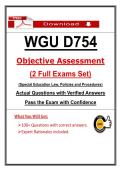
WGU D754
Objective Assessment
(2 Full Exams Set)
(Special Education Law, Policies and Procedures)
Actual Questions with Verified Answers
Pass the Exam with Confidence
What You Will Get:
➢100+ Questions with correct answers.
➢Expert Rationales included.
, DIGITAL STUDY RESOURCE PREVIEW
Preview Pages Below
Get the Complete PDF After Purchase
If you require further clarification or in need of any study resources, feel
free to Message me.
,Table of Contents
D754 OA EXAM SET 1 ............................................................ 2
D754 OA EXAM SET 2 .......................................................... 29
D754 OA EXAM SET 1
1. Which of the following is a key principle of non-biased multi-disciplinary
evaluation in special education, as outlined by the Individuals with Disabilities
Education Act (IDEA)?
A. Administering assessment instruments in the student's home language or primary
mode of communication to avoid bias
B. Using only one standardized assessment for every student
C. Testing students only in English regardless of language background
D. Relying only on teacher opinion to determine eligibility
Correct Answer:
A. Administering assessment instruments in the student's home language or
primary mode of communication to avoid bias
Rationale:
IDEA requires assessments to be valid, reliable, and administered in the language or
communication mode most likely to yield accurate information.
2. How does Section 504 of the Rehabilitation Act of 1973 define physical or
mental impairments?
A. Any condition that substantially limits one or more major life activities
B. Any academic weakness that results in low grades
C. Any disability that automatically requires an IEP
D. Any condition requiring placement outside general education
,Correct Answer:
A. Any condition that substantially limits one or more major life activities
Rationale:
Section 504 protects students with physical or mental impairments that substantially
limit major life activities such as learning, walking, seeing, hearing, concentrating, or
caring for oneself.
3. Which is an example of a reasonable accommodation under Section 504 for a
student with exceptionalities?
A. Provide study guide or teacher notes
B. Remove all academic expectations
C. Excuse the student from all assessments
D. Place the student automatically in special education
Correct Answer:
A. Provide study guide or teacher notes
Rationale:
A reasonable accommodation provides access without changing the essential
curriculum expectations. Study guides or teacher notes help the student access
instruction while maintaining academic standards.
4. Which of the following statements correctly distinguishes between the
Individuals with Disabilities Education Act (IDEA) and Section 504 of the
Rehabilitation Act of 1973?
A. IDEA provides an Individualized Education Program (IEP) for eligible students, while
Section 504 offers accommodations to ensure access to the general education
curriculum for a broader range of exceptionalities.
B. IDEA applies only to college students, while Section 504 applies only to preschool
students.
C. Section 504 requires an IEP for every student, while IDEA only provides informal
supports.
D. IDEA and Section 504 are identical laws with the same eligibility requirements.
Correct Answer:
A. IDEA provides an Individualized Education Program (IEP) for eligible students,
while Section 504 offers accommodations to ensure access to the general
education curriculum for a broader range of exceptionalities.
,Rationale:
IDEA provides special education and related services through an IEP for students who
meet disability and educational-need criteria. Section 504 is broader and focuses on
equal access through accommodations.
5. six elements of what ADA covers.
Correct Answer:
Communication systems
transportation
gateway testing
private entities
employment
housing
Rationale:
The Americans with Disabilities Act broadly prohibits discrimination and requires
accessibility across public and private areas, including communication, transportation,
employment, testing, and housing-related access.
6. three main pillars of ADA.
Correct Answer:
Prohibit discrimination
remove barriers
provide access
Rationale:
The ADA is designed to prevent discrimination, remove physical and systemic barriers,
and ensure individuals with disabilities can access public and private services.
7. Which of the following statements about the Child Find mandate under the
Individuals with Disabilities Education Act (IDEA) is true?
,A. Child Find is a requirement that schools identify, locate, and evaluate all children with
disabilities from birth to age 21, including those who are homeschooled, unhoused, or in
private schools.
B. Child Find applies only to students already enrolled in public school special education
programs.
C. Child Find requires schools to wait until parents request testing before identifying
students.
D. Child Find only applies after students fail multiple grade levels.
Correct Answer:
A. Child Find is a requirement that schools identify, locate, and evaluate all
children with disabilities from birth to age 21, including those who are
homeschooled, unhoused, or in private schools.
Rationale:
Child Find is an affirmative obligation under IDEA. Schools must actively identify and
evaluate children who may need special education, not wait passively for failure or
parent requests.
8. What is a key component of the Child Find process that ensures early
identification of students' needs?
A. Implementing universal screening
B. Waiting until a student fails the grade
C. Requiring parents to pay for testing
D. Refusing evaluation until high school
Correct Answer:
A. Implementing universal screening
Rationale:
Universal screening helps schools identify academic, behavioral, or developmental
concerns early so that interventions or evaluations can begin promptly.
9. What is the primary focus of tiered support in a multi-tiered support system,
MTSS?
A. Offering targeted teaching to help students practice academic or behavioral skills
B. Removing students from school when they struggle
C. Replacing special education evaluations entirely
D. Providing identical instruction to all students regardless of need
, D754 OA EXAM SET 2
1. What does the Americans with Disabilities Act do?
A. It provides funding only for private schools.
B. It ensures access for people with impairments and exceptionalities.
C. It requires all students to receive special education services.
D. It replaces the Individuals with Disabilities Education Act.
Correct Answer: B. It ensures access for people with impairments and
exceptionalities.
Expert Rationale:
The Americans with Disabilities Act protects individuals with disabilities from
discrimination and requires reasonable access in public settings, employment,
transportation, and services. It supports equal participation for individuals with
impairments and exceptionalities.
2. What is considered a reasonable accommodation under Section 504?
A. Accessible elevators
B. Shortened school year
C. Removal from general education
D. Automatic placement in special education
Correct Answer: A. Accessible elevators
Expert Rationale:
Section 504 requires schools to provide reasonable accommodations that allow
students with disabilities equal access to education. Accessible elevators are an
example of a physical accommodation that supports access.
3. What is one of the four steps in the Multi-Tiered System of Supports (MTSS) to
help students before they are referred for special education?
,A. Suspension
B. Screening
C. Expulsion
D. Grade retention
Correct Answer: B. Screening
Expert Rationale:
Screening is an early MTSS step used to identify students who may need additional
academic or behavioral support. It helps schools intervene before referring a student for
special education evaluation.
4. What characterizes Tier 1 in the Multi-Tiered System of Supports (MTSS)?
A. Intensive support
B. Special education placement only
C. Universal support
D. One-to-one therapy
Correct Answer: C. Universal support
Expert Rationale:
Tier 1 includes high-quality instruction and supports provided to all students in the
general education setting. It is the universal level of support within MTSS.
5. Which tier within the Multi-Tiered System of Supports (MTSS) is characterized
by intensive support?
A. Tier 1
B. Tier 2
C. Tier 3
D. Universal tier
Correct Answer: C. Tier 3
Expert Rationale:
Tier 3 provides the most intensive and individualized interventions. Students receiving
Tier 3 support usually need frequent monitoring and targeted assistance.
6. What is one relevant case law result for special education evaluations?
,A. Parents cannot challenge evaluation results.
B. A single test cannot be used to determine eligibility for special education.
C. Only IQ scores determine special education eligibility.
D. Schools may evaluate students without consent.
Correct Answer: B. A single test cannot be used to determine eligibility for special
education.
Expert Rationale:
Special education eligibility must be based on multiple sources of data. Using only one
test may create bias and does not provide a complete picture of the student’s needs.
7. What is one of the optional positions for a Multi-Disciplinary Team (MDT)?
A. Physical therapist
B. Bus driver
C. Cafeteria manager
D. School board president
Correct Answer: A. Physical therapist
Expert Rationale:
A physical therapist may be included on an MDT when the student’s needs involve
motor development, mobility, or physical access. Optional members are added based
on the student’s individual needs.
8. Which role does the special education teacher have on the Multi-Disciplinary
Team (MDT)?
A. Making legal decisions for the parents
B. Watching for bias that may affect assessments and answering parents’ questions
C. Replacing the school psychologist
D. Deciding eligibility alone
Correct Answer: B. Watching for bias that may affect assessments and answering
parents’ questions
Expert Rationale:
The special education teacher contributes expertise about disability, instruction,
accommodations, and assessment concerns. The teacher also helps ensure that
evaluation procedures are fair and understandable to the family.
, WGU D754
Objective Assessment
(2 Full Exams Set)
(Special Education Law, Policies and Procedures)
Actual Questions with Verified Answers
Pass the Exam with Confidence
What You Will Get:
➢100+ Questions with correct answers.
➢Expert Rationales included.
Objective Assessment
(2 Full Exams Set)
(Special Education Law, Policies and Procedures)
Actual Questions with Verified Answers
Pass the Exam with Confidence
What You Will Get:
➢100+ Questions with correct answers.
➢Expert Rationales included.
, DIGITAL STUDY RESOURCE PREVIEW
Preview Pages Below
Get the Complete PDF After Purchase
If you require further clarification or in need of any study resources, feel
free to Message me.
,Table of Contents
D754 OA EXAM SET 1 ............................................................ 2
D754 OA EXAM SET 2 .......................................................... 29
D754 OA EXAM SET 1
1. Which of the following is a key principle of non-biased multi-disciplinary
evaluation in special education, as outlined by the Individuals with Disabilities
Education Act (IDEA)?
A. Administering assessment instruments in the student's home language or primary
mode of communication to avoid bias
B. Using only one standardized assessment for every student
C. Testing students only in English regardless of language background
D. Relying only on teacher opinion to determine eligibility
Correct Answer:
A. Administering assessment instruments in the student's home language or
primary mode of communication to avoid bias
Rationale:
IDEA requires assessments to be valid, reliable, and administered in the language or
communication mode most likely to yield accurate information.
2. How does Section 504 of the Rehabilitation Act of 1973 define physical or
mental impairments?
A. Any condition that substantially limits one or more major life activities
B. Any academic weakness that results in low grades
C. Any disability that automatically requires an IEP
D. Any condition requiring placement outside general education
,Correct Answer:
A. Any condition that substantially limits one or more major life activities
Rationale:
Section 504 protects students with physical or mental impairments that substantially
limit major life activities such as learning, walking, seeing, hearing, concentrating, or
caring for oneself.
3. Which is an example of a reasonable accommodation under Section 504 for a
student with exceptionalities?
A. Provide study guide or teacher notes
B. Remove all academic expectations
C. Excuse the student from all assessments
D. Place the student automatically in special education
Correct Answer:
A. Provide study guide or teacher notes
Rationale:
A reasonable accommodation provides access without changing the essential
curriculum expectations. Study guides or teacher notes help the student access
instruction while maintaining academic standards.
4. Which of the following statements correctly distinguishes between the
Individuals with Disabilities Education Act (IDEA) and Section 504 of the
Rehabilitation Act of 1973?
A. IDEA provides an Individualized Education Program (IEP) for eligible students, while
Section 504 offers accommodations to ensure access to the general education
curriculum for a broader range of exceptionalities.
B. IDEA applies only to college students, while Section 504 applies only to preschool
students.
C. Section 504 requires an IEP for every student, while IDEA only provides informal
supports.
D. IDEA and Section 504 are identical laws with the same eligibility requirements.
Correct Answer:
A. IDEA provides an Individualized Education Program (IEP) for eligible students,
while Section 504 offers accommodations to ensure access to the general
education curriculum for a broader range of exceptionalities.
,Rationale:
IDEA provides special education and related services through an IEP for students who
meet disability and educational-need criteria. Section 504 is broader and focuses on
equal access through accommodations.
5. six elements of what ADA covers.
Correct Answer:
Communication systems
transportation
gateway testing
private entities
employment
housing
Rationale:
The Americans with Disabilities Act broadly prohibits discrimination and requires
accessibility across public and private areas, including communication, transportation,
employment, testing, and housing-related access.
6. three main pillars of ADA.
Correct Answer:
Prohibit discrimination
remove barriers
provide access
Rationale:
The ADA is designed to prevent discrimination, remove physical and systemic barriers,
and ensure individuals with disabilities can access public and private services.
7. Which of the following statements about the Child Find mandate under the
Individuals with Disabilities Education Act (IDEA) is true?
,A. Child Find is a requirement that schools identify, locate, and evaluate all children with
disabilities from birth to age 21, including those who are homeschooled, unhoused, or in
private schools.
B. Child Find applies only to students already enrolled in public school special education
programs.
C. Child Find requires schools to wait until parents request testing before identifying
students.
D. Child Find only applies after students fail multiple grade levels.
Correct Answer:
A. Child Find is a requirement that schools identify, locate, and evaluate all
children with disabilities from birth to age 21, including those who are
homeschooled, unhoused, or in private schools.
Rationale:
Child Find is an affirmative obligation under IDEA. Schools must actively identify and
evaluate children who may need special education, not wait passively for failure or
parent requests.
8. What is a key component of the Child Find process that ensures early
identification of students' needs?
A. Implementing universal screening
B. Waiting until a student fails the grade
C. Requiring parents to pay for testing
D. Refusing evaluation until high school
Correct Answer:
A. Implementing universal screening
Rationale:
Universal screening helps schools identify academic, behavioral, or developmental
concerns early so that interventions or evaluations can begin promptly.
9. What is the primary focus of tiered support in a multi-tiered support system,
MTSS?
A. Offering targeted teaching to help students practice academic or behavioral skills
B. Removing students from school when they struggle
C. Replacing special education evaluations entirely
D. Providing identical instruction to all students regardless of need
, D754 OA EXAM SET 2
1. What does the Americans with Disabilities Act do?
A. It provides funding only for private schools.
B. It ensures access for people with impairments and exceptionalities.
C. It requires all students to receive special education services.
D. It replaces the Individuals with Disabilities Education Act.
Correct Answer: B. It ensures access for people with impairments and
exceptionalities.
Expert Rationale:
The Americans with Disabilities Act protects individuals with disabilities from
discrimination and requires reasonable access in public settings, employment,
transportation, and services. It supports equal participation for individuals with
impairments and exceptionalities.
2. What is considered a reasonable accommodation under Section 504?
A. Accessible elevators
B. Shortened school year
C. Removal from general education
D. Automatic placement in special education
Correct Answer: A. Accessible elevators
Expert Rationale:
Section 504 requires schools to provide reasonable accommodations that allow
students with disabilities equal access to education. Accessible elevators are an
example of a physical accommodation that supports access.
3. What is one of the four steps in the Multi-Tiered System of Supports (MTSS) to
help students before they are referred for special education?
,A. Suspension
B. Screening
C. Expulsion
D. Grade retention
Correct Answer: B. Screening
Expert Rationale:
Screening is an early MTSS step used to identify students who may need additional
academic or behavioral support. It helps schools intervene before referring a student for
special education evaluation.
4. What characterizes Tier 1 in the Multi-Tiered System of Supports (MTSS)?
A. Intensive support
B. Special education placement only
C. Universal support
D. One-to-one therapy
Correct Answer: C. Universal support
Expert Rationale:
Tier 1 includes high-quality instruction and supports provided to all students in the
general education setting. It is the universal level of support within MTSS.
5. Which tier within the Multi-Tiered System of Supports (MTSS) is characterized
by intensive support?
A. Tier 1
B. Tier 2
C. Tier 3
D. Universal tier
Correct Answer: C. Tier 3
Expert Rationale:
Tier 3 provides the most intensive and individualized interventions. Students receiving
Tier 3 support usually need frequent monitoring and targeted assistance.
6. What is one relevant case law result for special education evaluations?
,A. Parents cannot challenge evaluation results.
B. A single test cannot be used to determine eligibility for special education.
C. Only IQ scores determine special education eligibility.
D. Schools may evaluate students without consent.
Correct Answer: B. A single test cannot be used to determine eligibility for special
education.
Expert Rationale:
Special education eligibility must be based on multiple sources of data. Using only one
test may create bias and does not provide a complete picture of the student’s needs.
7. What is one of the optional positions for a Multi-Disciplinary Team (MDT)?
A. Physical therapist
B. Bus driver
C. Cafeteria manager
D. School board president
Correct Answer: A. Physical therapist
Expert Rationale:
A physical therapist may be included on an MDT when the student’s needs involve
motor development, mobility, or physical access. Optional members are added based
on the student’s individual needs.
8. Which role does the special education teacher have on the Multi-Disciplinary
Team (MDT)?
A. Making legal decisions for the parents
B. Watching for bias that may affect assessments and answering parents’ questions
C. Replacing the school psychologist
D. Deciding eligibility alone
Correct Answer: B. Watching for bias that may affect assessments and answering
parents’ questions
Expert Rationale:
The special education teacher contributes expertise about disability, instruction,
accommodations, and assessment concerns. The teacher also helps ensure that
evaluation procedures are fair and understandable to the family.
, WGU D754
Objective Assessment
(2 Full Exams Set)
(Special Education Law, Policies and Procedures)
Actual Questions with Verified Answers
Pass the Exam with Confidence
What You Will Get:
➢100+ Questions with correct answers.
➢Expert Rationales included.