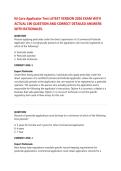
NJ Core Applicator Test LATEST VERSION 2026 EXAM WITH
ACTUAL 190 QUESTION AND CORRECT DETAILED ANSWERS
WITH RATIONALES.
QUESTION
Persons applying pesticides under the direct supervision of a Commercial Pesticide
Applicator who is not physically present on the application site must be registered as
which of the following?
A. Pesticide dealer
B. Pesticide operator
C. Pesticide technician
CORRECT ANS: B
Expert Rationale
Under New Jersey pesticide regulations, individuals who apply pesticides under the
direct supervision of a certified Commercial Pesticide Applicator, where the supervisor is
not physically present at the application site, are required to be registered as a pesticide
operator. The operator is the person who actually performs the application and is
responsible for following the applicator's instructions. Option A is incorrect; a dealer is a
business that sells pesticides. Option C is incorrect; technician is not the specific
regulatory term used in New Jersey for this role.
QUESTION
Records of pesticide applications must be kept for a minimum of which of the following
time periods?
A. 5 years for termite and 3 years for other Commercial Applicators
B. 4 years
C. 1 Year
CORRECT ANS: A
Expert Rationale
New Jersey state regulations mandate specific record-keeping requirements for
pesticide applications. Commercial applicators must retain application records for a
,minimum of 5 years for termite-related treatments and 3 years for all other types of
applications. These records are essential for regulatory compliance, environmental
monitoring, and liability purposes. Options B and C are incorrect; they do not reflect the
specific timeframes required by New Jersey law.
QUESTION
An inventory list of pesticides likely to be in storage must be which of the following?
A. Kept in the storage area
B. Updated every 2 years
C. Forwarded to the local fire department
CORRECT ANS: C
Expert Rationale
To ensure public safety and facilitate emergency response, New Jersey regulations
require that an inventory list of pesticides stored at a facility be forwarded to the local
fire department. This provides first responders with critical information about potential
hazards in the event of a fire or other emergency. Option A is incorrect; while keeping a
list in the storage area is prudent, the regulatory requirement is to provide it to the fire
department. Option B is incorrect; the inventory must be updated more frequently than
every 2 years to remain accurate.
QUESTION
What is the full name and acronym of the federal agency mandated to regulate
pesticides?
CORRECT ANS: Environmental Protection Agency - EPA
Expert Rationale
The Environmental Protection Agency (EPA) is the federal agency responsible for
regulating pesticides in the United States. Under the authority of the Federal Insecticide,
Fungicide, and Rodenticide Act (FIFRA), the EPA registers pesticides, sets tolerances, and
enforces regulations to protect human health and the environment.
,QUESTION
What is the full name and acronym for the law the EPA uses to manage pesticides?
CORRECT ANS: Federal Insecticide, Fungicide and Rodenticide Act - FIFRA
Expert Rationale
The Federal Insecticide, Fungicide, and Rodenticide Act (FIFRA) is the primary federal law
that governs the registration, distribution, sale, and use of pesticides in the United
States. It provides the EPA with the authority to regulate pesticides and enforce
compliance.
QUESTION
What are regulations?
CORRECT ANS: Regulations are interpretations of the law and have the force of law.
Expert Rationale
Regulations are rules and guidelines issued by administrative agencies (such as the EPA
or state departments of agriculture) that interpret and implement laws. Once
promulgated through a formal process, regulations have the force of law and are legally
binding. They provide specific details on how the law should be applied and enforced.
QUESTION
Define Reentry Time.
CORRECT ANS: Reentry Time is the time immediately following application of a
pesticide to a treated area when unprotected workers may not enter.
Expert Rationale
Reentry time is the period immediately following a pesticide application during which
entry into the treated area is restricted for unprotected workers. This time is established
to protect agricultural and other workers from exposure to potentially harmful pesticide
, residues. The specific reentry interval is typically stated on the pesticide label or
determined by regulatory authorities.
QUESTION
Which federal agency sets food tolerances for pesticides, and which federal agency
enforces these tolerances?
CORRECT ANS: EPA Sets food Tolerances; FDA enforces food tolerances
Expert Rationale
The Environmental Protection Agency (EPA) is responsible for establishing tolerance
levels for pesticide residues on food. These tolerances are the maximum legal limits of
pesticide residues allowed on food commodities. The Food and Drug Administration
(FDA) is the agency responsible for enforcing these tolerances by testing food products
to ensure they comply with the established limits.
QUESTION
FIFRA allows states to establish standards. What kind of standards?
CORRECT ANS: More strict
Expert Rationale
Under FIFRA, states are permitted to establish pesticide regulations that are more
stringent than federal regulations. This means a state can impose stricter requirements
for pesticide registration, application, training, or record-keeping, but they cannot have
less strict standards than the federal government.
QUESTION
What is the purpose of the tolerance program?
CORRECT ANS: The Tolerance program is to ensure that US consumers are not exposed
to unsafe food pesticide residue levels.
ACTUAL 190 QUESTION AND CORRECT DETAILED ANSWERS
WITH RATIONALES.
QUESTION
Persons applying pesticides under the direct supervision of a Commercial Pesticide
Applicator who is not physically present on the application site must be registered as
which of the following?
A. Pesticide dealer
B. Pesticide operator
C. Pesticide technician
CORRECT ANS: B
Expert Rationale
Under New Jersey pesticide regulations, individuals who apply pesticides under the
direct supervision of a certified Commercial Pesticide Applicator, where the supervisor is
not physically present at the application site, are required to be registered as a pesticide
operator. The operator is the person who actually performs the application and is
responsible for following the applicator's instructions. Option A is incorrect; a dealer is a
business that sells pesticides. Option C is incorrect; technician is not the specific
regulatory term used in New Jersey for this role.
QUESTION
Records of pesticide applications must be kept for a minimum of which of the following
time periods?
A. 5 years for termite and 3 years for other Commercial Applicators
B. 4 years
C. 1 Year
CORRECT ANS: A
Expert Rationale
New Jersey state regulations mandate specific record-keeping requirements for
pesticide applications. Commercial applicators must retain application records for a
,minimum of 5 years for termite-related treatments and 3 years for all other types of
applications. These records are essential for regulatory compliance, environmental
monitoring, and liability purposes. Options B and C are incorrect; they do not reflect the
specific timeframes required by New Jersey law.
QUESTION
An inventory list of pesticides likely to be in storage must be which of the following?
A. Kept in the storage area
B. Updated every 2 years
C. Forwarded to the local fire department
CORRECT ANS: C
Expert Rationale
To ensure public safety and facilitate emergency response, New Jersey regulations
require that an inventory list of pesticides stored at a facility be forwarded to the local
fire department. This provides first responders with critical information about potential
hazards in the event of a fire or other emergency. Option A is incorrect; while keeping a
list in the storage area is prudent, the regulatory requirement is to provide it to the fire
department. Option B is incorrect; the inventory must be updated more frequently than
every 2 years to remain accurate.
QUESTION
What is the full name and acronym of the federal agency mandated to regulate
pesticides?
CORRECT ANS: Environmental Protection Agency - EPA
Expert Rationale
The Environmental Protection Agency (EPA) is the federal agency responsible for
regulating pesticides in the United States. Under the authority of the Federal Insecticide,
Fungicide, and Rodenticide Act (FIFRA), the EPA registers pesticides, sets tolerances, and
enforces regulations to protect human health and the environment.
,QUESTION
What is the full name and acronym for the law the EPA uses to manage pesticides?
CORRECT ANS: Federal Insecticide, Fungicide and Rodenticide Act - FIFRA
Expert Rationale
The Federal Insecticide, Fungicide, and Rodenticide Act (FIFRA) is the primary federal law
that governs the registration, distribution, sale, and use of pesticides in the United
States. It provides the EPA with the authority to regulate pesticides and enforce
compliance.
QUESTION
What are regulations?
CORRECT ANS: Regulations are interpretations of the law and have the force of law.
Expert Rationale
Regulations are rules and guidelines issued by administrative agencies (such as the EPA
or state departments of agriculture) that interpret and implement laws. Once
promulgated through a formal process, regulations have the force of law and are legally
binding. They provide specific details on how the law should be applied and enforced.
QUESTION
Define Reentry Time.
CORRECT ANS: Reentry Time is the time immediately following application of a
pesticide to a treated area when unprotected workers may not enter.
Expert Rationale
Reentry time is the period immediately following a pesticide application during which
entry into the treated area is restricted for unprotected workers. This time is established
to protect agricultural and other workers from exposure to potentially harmful pesticide
, residues. The specific reentry interval is typically stated on the pesticide label or
determined by regulatory authorities.
QUESTION
Which federal agency sets food tolerances for pesticides, and which federal agency
enforces these tolerances?
CORRECT ANS: EPA Sets food Tolerances; FDA enforces food tolerances
Expert Rationale
The Environmental Protection Agency (EPA) is responsible for establishing tolerance
levels for pesticide residues on food. These tolerances are the maximum legal limits of
pesticide residues allowed on food commodities. The Food and Drug Administration
(FDA) is the agency responsible for enforcing these tolerances by testing food products
to ensure they comply with the established limits.
QUESTION
FIFRA allows states to establish standards. What kind of standards?
CORRECT ANS: More strict
Expert Rationale
Under FIFRA, states are permitted to establish pesticide regulations that are more
stringent than federal regulations. This means a state can impose stricter requirements
for pesticide registration, application, training, or record-keeping, but they cannot have
less strict standards than the federal government.
QUESTION
What is the purpose of the tolerance program?
CORRECT ANS: The Tolerance program is to ensure that US consumers are not exposed
to unsafe food pesticide residue levels.