

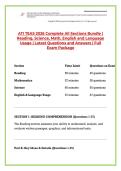
ATI TEAS 2026 Complete All Sections Bundle |
Reading, Science, Math, English and Language
Usage | Latest Questions and Answers | Full
Exam Package
Section Time Limit Questions on Exam
Reading 55 minutes 45 questions
Mathematics 57 minutes 38 questions
Science 60 minutes 50 questions
English & Language Usage 37 minutes 37 questions
SECTION 1: READING COMPREHENSION (Questions 1-75)
The Reading section assesses your ability to understand, analyze, and
evaluate written passages, graphics, and informational texts.
Part A: Key Ideas & Details (Questions 1-35)
,Q001: Primary vs. Secondary Sources
Which of the following is an example of a primary source for a research
paper on the history of vaccination?
A. A 2023 textbook chapter on the development of vaccines
B. A peer-reviewed journal article analyzing Edward Jenner's work
C. Edward Jenner's original 1796 notes on smallpox inoculation
D. A Wikipedia entry about the smallpox vaccine
Correct Answer: C
Rationale: Primary sources are original materials created at the time of
an event. Jenner's original notes are a primary source. Textbooks,
journal articles analyzing work, and Wikipedia entries are secondary
sources that interpret or summarize primary information.
Q002: Text Structure - Cause & Effect
Read the sentence:
"The patient's oxygen saturation dropped to 82%, so the nurse
immediately applied supplemental oxygen."
The relationship between the two clauses is:
A. Chronological
B. Cause and effect
,C. Compare and contrast
D. Problem and solution
Correct Answer: B
Rationale: The drop in oxygen saturation (cause) led to the application
of oxygen (effect). This is a direct cause-and-effect relationship
indicated by the transition word "so".
Q003: Text Structure - Compare & Contrast
In which text structure would an author most likely use words like
"similarly," "on the other hand," and "whereas"?
A. Sequential
B. Descriptive
C. Compare and contrast
D. Chronological
Correct Answer: C
Rationale: Compare-and-contrast texts use transitional words that
highlight similarities and differences between two or more subjects.
"Similarly" signals similarity; "on the other hand" and "whereas" signal
difference.
, Q004: Medical Terminology - Prefix Meaning
The prefix "brady-" in the term "bradycardia" means:
A. Fast
B. Slow
C. Heart
D. Irregular
Correct Answer: B
Rationale: The prefix "brady-" means slow. Bradycardia is a slow heart
rate (typically under 60 bpm in adults). The root "cardia" refers to the
heart. The opposite prefix is "tachy-" meaning fast.
Q005: Fact vs. Opinion
Which of the following statements is an opinion rather than a fact?
A. The normal adult body temperature is approximately 98.6°F (37°C).
B. Influenza is caused by a virus.
C. Nursing is the most trusted profession.
D. The heart has four chambers.
Correct Answer: C
Rationale: "Most trusted" is subjective and cannot be verified as fact.
The other options are objectively verifiable statements that can be
proven or disproven.
Reading, Science, Math, English and Language
Usage | Latest Questions and Answers | Full
Exam Package
Section Time Limit Questions on Exam
Reading 55 minutes 45 questions
Mathematics 57 minutes 38 questions
Science 60 minutes 50 questions
English & Language Usage 37 minutes 37 questions
SECTION 1: READING COMPREHENSION (Questions 1-75)
The Reading section assesses your ability to understand, analyze, and
evaluate written passages, graphics, and informational texts.
Part A: Key Ideas & Details (Questions 1-35)
,Q001: Primary vs. Secondary Sources
Which of the following is an example of a primary source for a research
paper on the history of vaccination?
A. A 2023 textbook chapter on the development of vaccines
B. A peer-reviewed journal article analyzing Edward Jenner's work
C. Edward Jenner's original 1796 notes on smallpox inoculation
D. A Wikipedia entry about the smallpox vaccine
Correct Answer: C
Rationale: Primary sources are original materials created at the time of
an event. Jenner's original notes are a primary source. Textbooks,
journal articles analyzing work, and Wikipedia entries are secondary
sources that interpret or summarize primary information.
Q002: Text Structure - Cause & Effect
Read the sentence:
"The patient's oxygen saturation dropped to 82%, so the nurse
immediately applied supplemental oxygen."
The relationship between the two clauses is:
A. Chronological
B. Cause and effect
,C. Compare and contrast
D. Problem and solution
Correct Answer: B
Rationale: The drop in oxygen saturation (cause) led to the application
of oxygen (effect). This is a direct cause-and-effect relationship
indicated by the transition word "so".
Q003: Text Structure - Compare & Contrast
In which text structure would an author most likely use words like
"similarly," "on the other hand," and "whereas"?
A. Sequential
B. Descriptive
C. Compare and contrast
D. Chronological
Correct Answer: C
Rationale: Compare-and-contrast texts use transitional words that
highlight similarities and differences between two or more subjects.
"Similarly" signals similarity; "on the other hand" and "whereas" signal
difference.
, Q004: Medical Terminology - Prefix Meaning
The prefix "brady-" in the term "bradycardia" means:
A. Fast
B. Slow
C. Heart
D. Irregular
Correct Answer: B
Rationale: The prefix "brady-" means slow. Bradycardia is a slow heart
rate (typically under 60 bpm in adults). The root "cardia" refers to the
heart. The opposite prefix is "tachy-" meaning fast.
Q005: Fact vs. Opinion
Which of the following statements is an opinion rather than a fact?
A. The normal adult body temperature is approximately 98.6°F (37°C).
B. Influenza is caused by a virus.
C. Nursing is the most trusted profession.
D. The heart has four chambers.
Correct Answer: C
Rationale: "Most trusted" is subjective and cannot be verified as fact.
The other options are objectively verifiable statements that can be
proven or disproven.


