

Written by students who passed Immediately available after payment Read online or as PDF Wrong document? Swap it for free 4.6 TrustPilot
logo-home
Document preview thumbnail
Preview 2 out of 9 pages
Exam (elaborations)

Hondros BIO 117 Final Exam 2026/2027 | 70+ Questions & Correct Answers | Anatomy, Physiology, Cardiovascular, Endocrine, Respiratory & Renal Systems | Hondros College of Nursing

Document preview thumbnail
Preview 2 out of 9 pages

This Hondros BIO 117 Final Exam 2026/2027 study guide contains 70+ exam-style questions and answers across 9 pages, providing a concentrated review of biology, anatomy, and human physiology concepts presented in the uploaded material. Major topics include osmosis and diffusion, cardiovascular physiology, endocrine hormones, respiratory physiology, nervous system function, renal physiology, digestion, immunity, blood and hematology, acid-base balance, reproductive physiology, and basic biochemistry. The question-and-answer format is designed for rapid recall and final-exam review. The cardiovascular and hematology section reviews the first and second heart sounds, cardiac output, heart rate, stroke volume, heart valves, pulmonary circulation, blood pressure, plasma proteins, red blood cells, platelets, basophils, hemoglobin, blood groups, and ABO/Rh antigens. Students review the relationship between the QRS complex and ventricular activity, the role of the pulmonary vein in transporting oxygenated blood, and the aorta as the major vessel carrying oxygenated blood into systemic circulation. The endocrine system is another major focus. Questions address growth hormone, prolactin, follicle-stimulating hormone (FSH), insulin, aldosterone, calcitonin, antidiuretic hormone (ADH), thyroid-stimulating hormone (TSH), adrenocorticotropic hormone (ACTH), oxytocin, cortisol, and erythropoietin. The material connects these hormones with functions such as growth, lactation, reproduction, glucose regulation, sodium and water balance, calcium homeostasis, red blood cell production, thyroid activity, adrenal function, and uterine contraction. The guide also provides targeted coverage of the respiratory system and acid-base physiology. Students review the laryngopharynx, bronchioles, alveoli, diaphragm, pulmonary circulation, oxygen transport, metabolic alkalosis compensation, normal blood pH, acidosis, carbon dioxide transport, and respiratory control by the medulla oblongata. Questions connect hypoventilation with compensation for metabolic alkalosis and identify the alveoli as the primary location for oxygen and carbon dioxide exchange. The nervous system and homeostasis content includes the medulla oblongata, cerebellum, hypothalamus, sensory neurons, autonomic nervous system, sympathetic responses, and cranial nerve X. The material emphasizes the hypothalamus in maintaining homeostasis, the cerebellum in coordinating motor activity, and the medulla in cardiovascular and respiratory regulation. It also identifies the vagus nerve as a major parasympathetic cranial nerve and reviews sympathetic effects such as pupil and bronchiole dilation. Digestive and metabolic concepts include bile, gallbladder function, pepsin, trypsin, salivary amylase, carbohydrates, monosaccharides, disaccharides, polysaccharides, glucose, and water- versus fat-soluble vitamins. The document reviews carbohydrates as a major fuel source and distinguishes vitamins C and B as water-soluble from vitamins A, D, E, and K as fat-soluble. Renal concepts include tubular reabsorption, ADH-mediated water retention, and aldosterone-associated sodium reabsorption. Additional questions cover immunity, tissues, fluid balance, reproduction and musculoskeletal anatomy. Topics include lymphocytes, passive immunity through breastfeeding, phagocytosis, extracellular fluids, edema, smooth muscle, tendons and ligaments, fertilization in the fallopian tube, ejaculatory ducts, and female and male reproductive hormone functions. Together, these subjects provide broad review of the interconnected organ-system concepts represented in BIO 117. Relevant students: This resource is particularly relevant for Hondros College of Nursing BIO 117 students, nursing students preparing for a BIO 117 final exam, practical nursing students, associate degree nursing students, anatomy and physiology students, introductory human biology students, and learners reviewing cardiovascular, endocrine, respiratory, renal, digestive, nervous, reproductive and immune system physiology. Source and accuracy note: The uploaded document identifies the course as Hondros BIO 117 and labels the material as a 2026/2027 Final Exam study resource. The descriptions above preserve the terminology and answers supplied by the document; they do not independently validate each clinical or biological statement. Keywords Hondros BIO 117, BIO 117 Final Exam, Hondros BIO 117 Final Exam, BIO 117 exam 2026, BIO 117 exam 2027, BIO 117 questions and answers, Hondros biology exam, Hondros College of Nursing, BIO 117 study guide, BIO 117 exam prep, anatomy and physiology, human biology, cardiovascular system, cardiac output, heart sounds, blood circulation, hematology, endocrine system, endocrine hormones, growth hormone, FSH, insulin, aldosterone, ADH, TSH, ACTH, respiratory system, acid base balance, metabolic alkalosis, blood pH, nervous system, medulla oblongata, cerebellum, hypothalamus, cranial nerve X, renal system, kidney reabsorption, digestive system, bile, digestive enzymes, carbohydrates, immune system, passive immunity, blood types, osmosis and diffusion, reproductive system, nursing biology, final exam review

Content preview

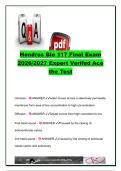
Hondros Bio 117 Final Exam
2026/2027 Expert Verifed Ace
the Test


Osmosis - ANSWER ✔✔water moves across a selectively permeable

membrane form area of low concentration to high concentration


Diffusion - ANSWER ✔✔Solute moves from high concretion to low


First heart sound - ANSWER ✔✔Caused by the closing of

artioventricular valves


2nd heart sound - ANSWER ✔✔caused by the closing of semilunar

valves (aortic and pulmonary

, Cardiac output - ANSWER ✔✔the amount of blood pumped by each

ventricle in 1 minute


Heart Rate - ANSWER ✔✔number of time the heart beats each

minute


Stroke Rate - ANSWER ✔✔amount of blood pumped by the ventricle

per beat


Growth Hormone - ANSWER ✔✔stimulates the growth of bone,

cartilage, and skeletal muscle; stimulates the synthesis of glucose during

periods of fasting


Prolactin (PRL) - ANSWER ✔✔lactogenic hormone promotes milk

production in women


FSH - ANSWER ✔✔triggers gametes maturation/release (sperm and

egg) and in females the ovarian follicles development, subsequently the

developing ovarian follicle produces the ovarian hormone Estrogen in

females


a defense mechanism in our body is - ANSWER ✔✔lymphocytes


Example of a solvent - ANSWER ✔✔Water

Document information

Uploaded on
August 21, 2026
Number of pages
9
Written in
2026/2027
Type
Exam (elaborations)
Contains
Questions & answers
$18.99

Wrong document? Swap it for free Within 14 days of purchase and before downloading, you can choose a different document. You can simply spend the amount again.
Written by students who passed
Immediately available after payment
Read online or as PDF

Seller avatar
Reputation scores are based on the amount of documents a seller has sold for a fee and the reviews they have received for those documents. There are three levels: Bronze, Silver and Gold. The better the reputation, the more your can rely on the quality of the sellers work.
JOSHCLAY
3.5
(83)
Sold
390
Followers
16
Items
20497
Last sold
1 day ago


Why students choose Stuvia

Created by fellow students, verified by reviews

Quality you can trust: written by students who passed their tests and reviewed by others who've used these notes.

Didn't get what you expected? Choose another document

No worries! You can instantly pick a different document that better fits what you're looking for.

Pay as you like, start learning right away

No subscription, no commitments. Pay the way you're used to via credit card and download your PDF document instantly.

Student with book image

“Bought, downloaded, and aced it. It really can be that simple.”

Alisha Student

Working on your references?

Create accurate citations in APA, MLA and Harvard with our free citation generator.

Working on your references?

Frequently asked questions

