Louisiana Post One Exam actual questions and answers
with complete solutions verified latest update 2026/2027
Terms in this set (226)
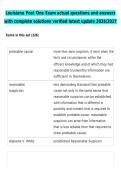
probable cause more than bare suspicion. it exist when the
facts and circumstances within the
officers knowledge and of which they had
reasonable trustworthy information are
sufficient in themselves
reasonable less demanding standard than probable
suspicion cause not only in the same sense that
reasonable suspicion can be established
with information that is different in
quantity and content that is required to
establish probable cause. reasonable
suspicion can arise from information
that is less reliable than that required to
show probable cause.
Alabama V. White established Reasonable Suspicion
,Man of reasonable the average man of the street, who
caution under the same circumstances, would
believe that the person being arrested
had committed the offense or that the
items to be seized would be found in
a specific place
Illinois V. Gates established Totality of circumstances (
the test that if a neutral and detached
magistrate determines that, based on
informants information and all other
available facts, there is probable cause
to believe that an arrest or search is
justified.
probable cause the level of certainty needed in order for
a police officer to make an arrest
reasonable suspicion the level of certainty needed in order
for a police officer to conduct a stop
and frisk
Aguilar V. Texas Established a two prong test for
determining probable cause on the basis
of information obtained from an
informant :
, 1. Reliability of the informant
2. Reliability of the informants information
Spinelli V. United established an officer may use credible
States 1969 hearsay to establish probable cause, but
an affidavit based on an informants tip
must satisfy the two-pronged Aguilar
Test
Illinois V. Gates established that totality of the
circumstance replaced "separate and
independent" as the standard of
probable cause in the Aguilar test.
Draper V. U.S. 1959 established that information from an
informant plus corroboration satisfied
Probable Cause
New York Vs. Quarless established the public safety doctrine
and affirmed reasonable suspicion for
the detention of a person matching the
description of a suspect located nearby
the scene of the crime within
minutes of it
with complete solutions verified latest update 2026/2027
Terms in this set (226)
probable cause more than bare suspicion. it exist when the
facts and circumstances within the
officers knowledge and of which they had
reasonable trustworthy information are
sufficient in themselves
reasonable less demanding standard than probable
suspicion cause not only in the same sense that
reasonable suspicion can be established
with information that is different in
quantity and content that is required to
establish probable cause. reasonable
suspicion can arise from information
that is less reliable than that required to
show probable cause.
Alabama V. White established Reasonable Suspicion
,Man of reasonable the average man of the street, who
caution under the same circumstances, would
believe that the person being arrested
had committed the offense or that the
items to be seized would be found in
a specific place
Illinois V. Gates established Totality of circumstances (
the test that if a neutral and detached
magistrate determines that, based on
informants information and all other
available facts, there is probable cause
to believe that an arrest or search is
justified.
probable cause the level of certainty needed in order for
a police officer to make an arrest
reasonable suspicion the level of certainty needed in order
for a police officer to conduct a stop
and frisk
Aguilar V. Texas Established a two prong test for
determining probable cause on the basis
of information obtained from an
informant :
, 1. Reliability of the informant
2. Reliability of the informants information
Spinelli V. United established an officer may use credible
States 1969 hearsay to establish probable cause, but
an affidavit based on an informants tip
must satisfy the two-pronged Aguilar
Test
Illinois V. Gates established that totality of the
circumstance replaced "separate and
independent" as the standard of
probable cause in the Aguilar test.
Draper V. U.S. 1959 established that information from an
informant plus corroboration satisfied
Probable Cause
New York Vs. Quarless established the public safety doctrine
and affirmed reasonable suspicion for
the detention of a person matching the
description of a suspect located nearby
the scene of the crime within
minutes of it