

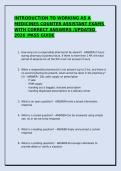
INTRODUCTION TO WORKING AS A
MEDICINES COUNTER ASSISTANT EXAMS
WITH CORRECT ANSWERS /UPDATED
2026 /PASS GUIDE
1. How long can a responsible pharmacist be absent? - ANSWER-2 hours
during pharmacy business hours. If there is more then 1 RP, the total
period of absense for all the RPs must not exceed 2 hours
2. When a responsible pharmacist is not present (up to 2 hrs, and there is
no second pharmacist present, what cannot be done in the pharmacy?
(5) - ANSWER-- GSL sale/ supply on prescription
- P sale
- POM supply
- handing out a bagged, checked prescription
- handing dispensed prescriptions to a delivery driver
3. What is an open question? - ANSWER-Invite a broad information
response
4. What is a closed question? - ANSWER-Can be answered using simple
yes, no or do not know response
5. What is a leading question? - ANSWER-Imply and prompt a certain
response
6. What is a probing question? - ANSWER-Encourage individuals to
provide detail or clarify a situation
, 7. What is GPhC's standard 1? - ANSWER-Pharmacy professionals must
provide personal-centred care. Person centred-care recognises that
people are all different. To provide the best care, pharmacy teams
need to understand what is important to the individual person and to
adapt the. Are to meet their needs. Care of the personal should the
pharmacy team's first priority.
8. What is The Equality Act 2010? - ANSWER-This act prohibits
discrimination against people because they have a 'protected
characteristic'. Discrimination means treating someone 'less
favourably' than someone else, because of characteristics such as age,
gender reassignment, disability etc.
9. What is discrimination by perception and association? - ANSWER-
Discrimination by perception- someone thinks they have a disability
10. Discrimination by association- they are connected to someone
with a disability
11. What are the 6 main sections of the PIL (patient information
leaflet) issued by the Medicines and Healthcare Regulatory Agency
(MHRA)? - ANSWER-1. Identification of the medicine
12. 2. Therapeutic indications (what it is used for)
13. 3. Information necessary before taking the medicine
14. 4. Dosage
15. 5. Description of side effects
16. 6. Additional information (eg storage info, excipient details)
17. How do herbal remedies need to be registered to be sold to the
public? - ANSWER-As conventional medicines (GSL, or POM) or be
registered under the Traditional Herbal Medicines Registration Scheme
(THR)
18. What needs to be shown to be registered under the THR? -
ANSWER-Quality and safety of the herbal product but the
manufacturer does not have to prove it will work for the condition it
MEDICINES COUNTER ASSISTANT EXAMS
WITH CORRECT ANSWERS /UPDATED
2026 /PASS GUIDE
1. How long can a responsible pharmacist be absent? - ANSWER-2 hours
during pharmacy business hours. If there is more then 1 RP, the total
period of absense for all the RPs must not exceed 2 hours
2. When a responsible pharmacist is not present (up to 2 hrs, and there is
no second pharmacist present, what cannot be done in the pharmacy?
(5) - ANSWER-- GSL sale/ supply on prescription
- P sale
- POM supply
- handing out a bagged, checked prescription
- handing dispensed prescriptions to a delivery driver
3. What is an open question? - ANSWER-Invite a broad information
response
4. What is a closed question? - ANSWER-Can be answered using simple
yes, no or do not know response
5. What is a leading question? - ANSWER-Imply and prompt a certain
response
6. What is a probing question? - ANSWER-Encourage individuals to
provide detail or clarify a situation
, 7. What is GPhC's standard 1? - ANSWER-Pharmacy professionals must
provide personal-centred care. Person centred-care recognises that
people are all different. To provide the best care, pharmacy teams
need to understand what is important to the individual person and to
adapt the. Are to meet their needs. Care of the personal should the
pharmacy team's first priority.
8. What is The Equality Act 2010? - ANSWER-This act prohibits
discrimination against people because they have a 'protected
characteristic'. Discrimination means treating someone 'less
favourably' than someone else, because of characteristics such as age,
gender reassignment, disability etc.
9. What is discrimination by perception and association? - ANSWER-
Discrimination by perception- someone thinks they have a disability
10. Discrimination by association- they are connected to someone
with a disability
11. What are the 6 main sections of the PIL (patient information
leaflet) issued by the Medicines and Healthcare Regulatory Agency
(MHRA)? - ANSWER-1. Identification of the medicine
12. 2. Therapeutic indications (what it is used for)
13. 3. Information necessary before taking the medicine
14. 4. Dosage
15. 5. Description of side effects
16. 6. Additional information (eg storage info, excipient details)
17. How do herbal remedies need to be registered to be sold to the
public? - ANSWER-As conventional medicines (GSL, or POM) or be
registered under the Traditional Herbal Medicines Registration Scheme
(THR)
18. What needs to be shown to be registered under the THR? -
ANSWER-Quality and safety of the herbal product but the
manufacturer does not have to prove it will work for the condition it


