

Army Training, Leadership, and Operations: Key Regulations and Concept
Study online at https://quizlet.com/_husj18
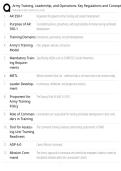
1. AR 350-1 Regulation that governs Army Training and Leader Development.
2. Purpose of AR To establish policies, procedures, and responsibilities for Army training and leader
350-1 development.
3. Training Domains Institutional, operational, and self-development.
4. Army's Training Plan, prepare, execute, and assess.
Model
5. Mandatory Train- Specified by HQDA, such as SHARP, EO, Suicide Prevention.
ing Require-
ments
6. METL Mission Essential Task List - collective tasks a unit must train to be mission ready.
7. Leader Develop- A continuous, deliberate, and progressive process.
ment
8. Proponent for The Deputy Chief of Staff, G-3/5/7.
Army Training
Policy
9. Role of Comman- Commanders are responsible for training and leader development in their units.
ders in Training
10. Tool for Assess- The Command Training Guidance and training assessments in DTMS.
ing Unit Training
Readiness
11. ADP 6-0 Covers Mission Command.
12. Mission Com- The Army's approach to command and control that empowers leaders to exercise
mand disciplined initiative within the commander's intent.
1/7
, Army Training, Leadership, and Operations: Key Regulations and Concept
Study online at https://quizlet.com/_husj18
13. Principles of Mis- Competence, mutual trust, shared understanding, commander's intent, mission
sion Command orders, disciplined initiative, risk acceptance.
14. Commander's In- A clear and concise expression of the purpose of an operation and the desired end
tent state.
15. Mission Orders Directives that emphasize results to be attained, not how to achieve them.
16. Disciplined Initia- Action in the absence of orders, when existing orders no longer fit, or when
tive unforeseen opportunities arise.
17. Role of Trust Trust is the foundation for effective decentralized execution.
in Mission Com-
mand
18. Purpose of Con- To regulate forces and warfighting functions to accomplish the mission.
trol in Mission
Command
19. Mutual Trust Built on shared experiences and training.
20. Mission Com- Enables leaders at all levels to make timely decisions in complex environments.
mand and Adapt-
ability
21. ADP 7-0 Covers Training.
22. Army's Training Train as you fight.
Principle
23. Domains of Operational, institutional, self-development.
Leader Develop-
ment
2/7
Study online at https://quizlet.com/_husj18
1. AR 350-1 Regulation that governs Army Training and Leader Development.
2. Purpose of AR To establish policies, procedures, and responsibilities for Army training and leader
350-1 development.
3. Training Domains Institutional, operational, and self-development.
4. Army's Training Plan, prepare, execute, and assess.
Model
5. Mandatory Train- Specified by HQDA, such as SHARP, EO, Suicide Prevention.
ing Require-
ments
6. METL Mission Essential Task List - collective tasks a unit must train to be mission ready.
7. Leader Develop- A continuous, deliberate, and progressive process.
ment
8. Proponent for The Deputy Chief of Staff, G-3/5/7.
Army Training
Policy
9. Role of Comman- Commanders are responsible for training and leader development in their units.
ders in Training
10. Tool for Assess- The Command Training Guidance and training assessments in DTMS.
ing Unit Training
Readiness
11. ADP 6-0 Covers Mission Command.
12. Mission Com- The Army's approach to command and control that empowers leaders to exercise
mand disciplined initiative within the commander's intent.
1/7
, Army Training, Leadership, and Operations: Key Regulations and Concept
Study online at https://quizlet.com/_husj18
13. Principles of Mis- Competence, mutual trust, shared understanding, commander's intent, mission
sion Command orders, disciplined initiative, risk acceptance.
14. Commander's In- A clear and concise expression of the purpose of an operation and the desired end
tent state.
15. Mission Orders Directives that emphasize results to be attained, not how to achieve them.
16. Disciplined Initia- Action in the absence of orders, when existing orders no longer fit, or when
tive unforeseen opportunities arise.
17. Role of Trust Trust is the foundation for effective decentralized execution.
in Mission Com-
mand
18. Purpose of Con- To regulate forces and warfighting functions to accomplish the mission.
trol in Mission
Command
19. Mutual Trust Built on shared experiences and training.
20. Mission Com- Enables leaders at all levels to make timely decisions in complex environments.
mand and Adapt-
ability
21. ADP 7-0 Covers Training.
22. Army's Training Train as you fight.
Principle
23. Domains of Operational, institutional, self-development.
Leader Develop-
ment
2/7


