
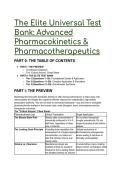
The Elite Universal Test
Bank: Advanced
Pharmacokinetics &
Pharmacotherapeutics
PART 0: THE TABLE OF CONTENTS
● PART I: THE PREVIEW
○ The Mission Objective
○ The "Critical Axioms" Cheat Sheet
● PART II: THE ELITE TEST BANK
○ Tier 1 (Questions 1–10): Foundational Syntax & Application
○ Tier 2 (Questions 11–20): Complex Application & Simulation
○ Tier 3 (Questions 21–30): Grandmaster Synthesis
PART I: THE PREVIEW
Mastering this test bank translates directly to elite clinical performance; it strips away rote
memorization and forges the cognitive reflexes required for independent, high-stakes
prescriptive authority. You are not here to memorize flashcards—you are here to anticipate
pharmacokinetic warfare in the human body, avert iatrogenic harm, and engineer precise
therapeutic outcomes.
The "Critical Axioms" Cheat Sheet:
Pharmacokinetic Law Clinical Translation Target Application
The Steady-State Rule Steady-state concentration is Do not draw therapeutic
universally achieved in 4 to 5 troughs prematurely. Do not
half-lives, regardless of dose chase fluctuating levels before
size or interval. plateau.
The Loading Dose Principle A loading dose expedites the Utilized exclusively in
achievement of a target plasma life-threatening emergencies
concentration, but does not where waiting 5 half-lives is
alter the intrinsic time to true clinically unacceptable.
steady state.
Volume vs. Clearance Maintenance doses are In acute kidney injury, loading
dictated entirely by systemic doses remain unchanged, while
Clearance (Cl); Loading doses maintenance doses plummet.
are dictated entirely by Volume
,Pharmacokinetic Law Clinical Translation Target Application
of Distribution (Vd).
The P-glycoprotein (P-gp) P-gp is an efflux pump. When adding verapamil,
Trap Inhibiting P-gp traps substrates amiodarone, or ritonavir to a
inside the body, causing digoxin regimen, proactively
massive serum spikes. reduce the digoxin dose by
25–50%.
Nonlinear Danger Saturated hepatic enzymes Microscopic dose increases of
(Zero-Order) clear a constant amount of phenytoin trigger exponential,
drug, not a constant fraction. lethal toxicity.
PART II: THE ELITE TEST BANK
Tier 1 - Foundational Syntax & Application
Q1: An Advanced Practice Nurse (APN) initiates an intravenous infusion of a
narrow-therapeutic-index medication with an elimination half-life of 12 hours. Assuming
first-order kinetics and the absence of a loading dose, at what chronological point will the drug
achieve at least 95% of its steady-state concentration? A) 12 hours B) 24 hours C) 48 to 60
hours D) 120 hours
● Answer: C (48 to 60 hours)
● Distractor Analysis:
○ A is incorrect: Twelve hours represents exactly one half-life, yielding only 50% of
the steady-state concentration. Drawing a level here guarantees a falsely low
reading.
○ B is incorrect: Twenty-four hours represents two half-lives, achieving only 75% of
steady state. Clinical interventions based on this level will result in toxic
over-prescribing.
○ D is incorrect: One hundred twenty hours (10 half-lives) is far beyond the clinical
threshold required to reach steady state.
The Mentor's Analysis: Steady state is a mathematical absolute, achieved after approximately
4 to 5 half-lives, independent of the infusion rate or dose size. Multiplying the 12-hour half-life by
4 yields 48 hours; multiplying by 5 yields 60 hours.
Half-Lives Elapsed Percentage of Steady State Reached
1 50.00%
2 75.00%
3 87.50%
4 93.75%
5 ~97.00%
Professional/Academic Intuition: Never draw a steady-state therapeutic trough before 4
to 5 half-lives have elapsed; treating a pre-steady-state trough as a failure of dosing is
the genesis of iatrogenic overdose.
Q2: A patient presents in status epilepticus. The prescriber orders a massive intravenous
loading dose of fosphenytoin, followed by a standard maintenance regimen. What is the
fundamental pharmacokinetic rationale for administering this loading dose? A) To artificially
shorten the drug's elimination half-life, forcing the rapid achievement of metabolic steady state.
B) To saturate peripheral adipose compartments, temporarily altering the drug's first-order
, kinetics into zero-order elimination. C) To immediately fill the Volume of Distribution and achieve
a target therapeutic concentration without waiting 4 to 5 half-lives. D) To deliberately decrease
the drug's Volume of Distribution (Vd) and trap the active medication entirely within the central
plasma compartment.
● Answer: C (To immediately fill the Volume of Distribution and achieve a target therapeutic
concentration without waiting 4 to 5 half-lives)
● Distractor Analysis:
○ A is incorrect: A loading dose cannot alter a drug's intrinsic elimination half-life or
the biological time it takes to reach true pharmacokinetic steady state.
○ B is incorrect: Loading doses do not alter the fundamental kinetic elimination model
of a medication; they simply provide a larger initial mass.
○ D is incorrect: A loading dose is calculated based on the Vd; it does not dynamically
decrease the physiological Vd.
The Mentor's Analysis: For drugs with long half-lives, waiting 4 to 5 half-lives to achieve
therapeutic efficacy is clinically unacceptable in emergency scenarios. A loading dose bypasses
this chronological delay by rapidly filling the physiological "tank" (Volume of Distribution)
immediately. Professional/Academic Intuition: Loading doses buy clinical time in
emergencies; maintenance doses sustain that time via clearance matching.
Q3: A 6-year-old patient undergoes a routine tonsillectomy and adenoidectomy. The surgeon
prescribes oral codeine for postoperative analgesia. Twelve hours later, the patient is found
unresponsive due to lethal respiratory depression. Genomic testing reveals a CYP2D6
polymorphism. Which pharmacokinetic mechanism explicitly explains this fatal event? A) The
patient is a poor metabolizer, leading to toxic accumulation of the un-metabolized prodrug
codeine in the central nervous system. B) The patient is an ultrarapid metabolizer, causing
rapid, massive, and uncontrolled conversion of codeine into active morphine. C) The CYP2D6
polymorphism caused complete inhibition of P-glycoprotein, allowing codeine to cross the
blood-brain barrier unchecked. D) The patient lacked the CYP2D6 enzyme entirely, forcing
alternative metabolism through CYP3A4 into neurotoxic byproducts.
● Answer: B (The patient is an ultrarapid metabolizer, causing rapid, massive, and
uncontrolled conversion of codeine into active morphine)
● Distractor Analysis:
○ A is incorrect: Codeine is a prodrug possessing minimal intrinsic analgesic activity.
A poor metabolizer would experience a lack of analgesia, not respiratory
depression, because the drug would never convert to active morphine.
○ C is incorrect: CYP enzymes mediate hepatic metabolism; they do not dictate
P-glycoprotein efflux transport at the blood-brain barrier.
○ D is incorrect: The absolute absence of CYP2D6 would prevent the formation of
morphine entirely, resulting in therapeutic failure, not opioid toxicity.
The Mentor's Analysis: Codeine is entirely dependent on the hepatic CYP2D6 enzyme to
metabolize into its pharmacologically active form, morphine. Ultrarapid metabolizers possess
gene duplications that convert the prodrug with lethal speed, causing massive, unpredictable
opioid toxicity. This mechanism forms the basis of the absolute contraindication for codeine in
pediatric tonsillectomy patients. Professional/Academic Intuition: Prodrug toxicity is driven
by hyper-metabolism; active drug toxicity is driven by hypo-metabolism.
Q4: A patient stabilized on digoxin is prescribed oral verapamil for rate control of atrial
fibrillation. Within ten days, the patient presents with severe nausea, visual halos, and
life-threatening bradycardia. Which explicit mechanism dictates this specific drug-drug
interaction? A) Verapamil directly damages renal nephrons, causing secondary digoxin retention
Bank: Advanced
Pharmacokinetics &
Pharmacotherapeutics
PART 0: THE TABLE OF CONTENTS
● PART I: THE PREVIEW
○ The Mission Objective
○ The "Critical Axioms" Cheat Sheet
● PART II: THE ELITE TEST BANK
○ Tier 1 (Questions 1–10): Foundational Syntax & Application
○ Tier 2 (Questions 11–20): Complex Application & Simulation
○ Tier 3 (Questions 21–30): Grandmaster Synthesis
PART I: THE PREVIEW
Mastering this test bank translates directly to elite clinical performance; it strips away rote
memorization and forges the cognitive reflexes required for independent, high-stakes
prescriptive authority. You are not here to memorize flashcards—you are here to anticipate
pharmacokinetic warfare in the human body, avert iatrogenic harm, and engineer precise
therapeutic outcomes.
The "Critical Axioms" Cheat Sheet:
Pharmacokinetic Law Clinical Translation Target Application
The Steady-State Rule Steady-state concentration is Do not draw therapeutic
universally achieved in 4 to 5 troughs prematurely. Do not
half-lives, regardless of dose chase fluctuating levels before
size or interval. plateau.
The Loading Dose Principle A loading dose expedites the Utilized exclusively in
achievement of a target plasma life-threatening emergencies
concentration, but does not where waiting 5 half-lives is
alter the intrinsic time to true clinically unacceptable.
steady state.
Volume vs. Clearance Maintenance doses are In acute kidney injury, loading
dictated entirely by systemic doses remain unchanged, while
Clearance (Cl); Loading doses maintenance doses plummet.
are dictated entirely by Volume
,Pharmacokinetic Law Clinical Translation Target Application
of Distribution (Vd).
The P-glycoprotein (P-gp) P-gp is an efflux pump. When adding verapamil,
Trap Inhibiting P-gp traps substrates amiodarone, or ritonavir to a
inside the body, causing digoxin regimen, proactively
massive serum spikes. reduce the digoxin dose by
25–50%.
Nonlinear Danger Saturated hepatic enzymes Microscopic dose increases of
(Zero-Order) clear a constant amount of phenytoin trigger exponential,
drug, not a constant fraction. lethal toxicity.
PART II: THE ELITE TEST BANK
Tier 1 - Foundational Syntax & Application
Q1: An Advanced Practice Nurse (APN) initiates an intravenous infusion of a
narrow-therapeutic-index medication with an elimination half-life of 12 hours. Assuming
first-order kinetics and the absence of a loading dose, at what chronological point will the drug
achieve at least 95% of its steady-state concentration? A) 12 hours B) 24 hours C) 48 to 60
hours D) 120 hours
● Answer: C (48 to 60 hours)
● Distractor Analysis:
○ A is incorrect: Twelve hours represents exactly one half-life, yielding only 50% of
the steady-state concentration. Drawing a level here guarantees a falsely low
reading.
○ B is incorrect: Twenty-four hours represents two half-lives, achieving only 75% of
steady state. Clinical interventions based on this level will result in toxic
over-prescribing.
○ D is incorrect: One hundred twenty hours (10 half-lives) is far beyond the clinical
threshold required to reach steady state.
The Mentor's Analysis: Steady state is a mathematical absolute, achieved after approximately
4 to 5 half-lives, independent of the infusion rate or dose size. Multiplying the 12-hour half-life by
4 yields 48 hours; multiplying by 5 yields 60 hours.
Half-Lives Elapsed Percentage of Steady State Reached
1 50.00%
2 75.00%
3 87.50%
4 93.75%
5 ~97.00%
Professional/Academic Intuition: Never draw a steady-state therapeutic trough before 4
to 5 half-lives have elapsed; treating a pre-steady-state trough as a failure of dosing is
the genesis of iatrogenic overdose.
Q2: A patient presents in status epilepticus. The prescriber orders a massive intravenous
loading dose of fosphenytoin, followed by a standard maintenance regimen. What is the
fundamental pharmacokinetic rationale for administering this loading dose? A) To artificially
shorten the drug's elimination half-life, forcing the rapid achievement of metabolic steady state.
B) To saturate peripheral adipose compartments, temporarily altering the drug's first-order
, kinetics into zero-order elimination. C) To immediately fill the Volume of Distribution and achieve
a target therapeutic concentration without waiting 4 to 5 half-lives. D) To deliberately decrease
the drug's Volume of Distribution (Vd) and trap the active medication entirely within the central
plasma compartment.
● Answer: C (To immediately fill the Volume of Distribution and achieve a target therapeutic
concentration without waiting 4 to 5 half-lives)
● Distractor Analysis:
○ A is incorrect: A loading dose cannot alter a drug's intrinsic elimination half-life or
the biological time it takes to reach true pharmacokinetic steady state.
○ B is incorrect: Loading doses do not alter the fundamental kinetic elimination model
of a medication; they simply provide a larger initial mass.
○ D is incorrect: A loading dose is calculated based on the Vd; it does not dynamically
decrease the physiological Vd.
The Mentor's Analysis: For drugs with long half-lives, waiting 4 to 5 half-lives to achieve
therapeutic efficacy is clinically unacceptable in emergency scenarios. A loading dose bypasses
this chronological delay by rapidly filling the physiological "tank" (Volume of Distribution)
immediately. Professional/Academic Intuition: Loading doses buy clinical time in
emergencies; maintenance doses sustain that time via clearance matching.
Q3: A 6-year-old patient undergoes a routine tonsillectomy and adenoidectomy. The surgeon
prescribes oral codeine for postoperative analgesia. Twelve hours later, the patient is found
unresponsive due to lethal respiratory depression. Genomic testing reveals a CYP2D6
polymorphism. Which pharmacokinetic mechanism explicitly explains this fatal event? A) The
patient is a poor metabolizer, leading to toxic accumulation of the un-metabolized prodrug
codeine in the central nervous system. B) The patient is an ultrarapid metabolizer, causing
rapid, massive, and uncontrolled conversion of codeine into active morphine. C) The CYP2D6
polymorphism caused complete inhibition of P-glycoprotein, allowing codeine to cross the
blood-brain barrier unchecked. D) The patient lacked the CYP2D6 enzyme entirely, forcing
alternative metabolism through CYP3A4 into neurotoxic byproducts.
● Answer: B (The patient is an ultrarapid metabolizer, causing rapid, massive, and
uncontrolled conversion of codeine into active morphine)
● Distractor Analysis:
○ A is incorrect: Codeine is a prodrug possessing minimal intrinsic analgesic activity.
A poor metabolizer would experience a lack of analgesia, not respiratory
depression, because the drug would never convert to active morphine.
○ C is incorrect: CYP enzymes mediate hepatic metabolism; they do not dictate
P-glycoprotein efflux transport at the blood-brain barrier.
○ D is incorrect: The absolute absence of CYP2D6 would prevent the formation of
morphine entirely, resulting in therapeutic failure, not opioid toxicity.
The Mentor's Analysis: Codeine is entirely dependent on the hepatic CYP2D6 enzyme to
metabolize into its pharmacologically active form, morphine. Ultrarapid metabolizers possess
gene duplications that convert the prodrug with lethal speed, causing massive, unpredictable
opioid toxicity. This mechanism forms the basis of the absolute contraindication for codeine in
pediatric tonsillectomy patients. Professional/Academic Intuition: Prodrug toxicity is driven
by hyper-metabolism; active drug toxicity is driven by hypo-metabolism.
Q4: A patient stabilized on digoxin is prescribed oral verapamil for rate control of atrial
fibrillation. Within ten days, the patient presents with severe nausea, visual halos, and
life-threatening bradycardia. Which explicit mechanism dictates this specific drug-drug
interaction? A) Verapamil directly damages renal nephrons, causing secondary digoxin retention


