

Gizmo | Student Exploration: Hardy-Weinberg Equilibrium
Name: Date: 4/13/2026
Student Exploration: Hardy-Weinberg Equilibrium
Directions: Follow the instructions to go through the simulation. Respond to the questions and
prompts in the orange boxes.
Vocabulary: allele, genotype, Hardy-Weinberg equation, Hardy-Weinberg principle, heterozygous,
homozygous, incompletely dominant, Punnett square
Gizmo Warm-up
Many factors—immigration, natural selection, hunting, etc—can influence the
composition of a population. To determine if one of these factors is affecting a
population, it is useful to know what a population looks like when none of these
factors is present.
In 1908, Godfrey Hardy and Wilhelm Weinberg independently discovered the laws that govern such
populations. These laws can be explored in the Hardy-Weinberg Equilibrium Gizmo.
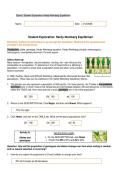
1. The parrots you see represent a population of 500 parrots. For these parrots, the D allele is incompletely
dominant over d, which means that Dd parrots are intermediate between DD and dd parrots. In the Gizmo,
select the TABLE tab. How many parrots of each genotype are in the initial population?
DD 250 Dd 100 dd 150
2. Return to the DESCRIPTION tab. Click Begin, and then click Breed. What happens?
They lay eggs.
3. Click Hatch, and look on the TABLE tab. What are the parrot populations now?
DD 188 Dd 229 dd 83
Activity A: Get the Gizmo ready:
Alleles and ● On the DESCRIPTION tab, click Reset.
genotypes ● Check that DD is 50% and dd is 30%.
Question: How will the proportion of genotypes and alleles change over time when mating is random
and no natural selection is occurring?
1. How do you expect the proportions of D and d alleles to change over time?
DD will increase as dd decreases.
, 2. Run a generation in the Gizmo. After clicking Hatch, fill in the allele and genotype percentages for
generation 1. Repeat this process for 5 generations.
Name: Date: 4/13/2026
Student Exploration: Hardy-Weinberg Equilibrium
Directions: Follow the instructions to go through the simulation. Respond to the questions and
prompts in the orange boxes.
Vocabulary: allele, genotype, Hardy-Weinberg equation, Hardy-Weinberg principle, heterozygous,
homozygous, incompletely dominant, Punnett square
Gizmo Warm-up
Many factors—immigration, natural selection, hunting, etc—can influence the
composition of a population. To determine if one of these factors is affecting a
population, it is useful to know what a population looks like when none of these
factors is present.
In 1908, Godfrey Hardy and Wilhelm Weinberg independently discovered the laws that govern such
populations. These laws can be explored in the Hardy-Weinberg Equilibrium Gizmo.
1. The parrots you see represent a population of 500 parrots. For these parrots, the D allele is incompletely
dominant over d, which means that Dd parrots are intermediate between DD and dd parrots. In the Gizmo,
select the TABLE tab. How many parrots of each genotype are in the initial population?
DD 250 Dd 100 dd 150
2. Return to the DESCRIPTION tab. Click Begin, and then click Breed. What happens?
They lay eggs.
3. Click Hatch, and look on the TABLE tab. What are the parrot populations now?
DD 188 Dd 229 dd 83
Activity A: Get the Gizmo ready:
Alleles and ● On the DESCRIPTION tab, click Reset.
genotypes ● Check that DD is 50% and dd is 30%.
Question: How will the proportion of genotypes and alleles change over time when mating is random
and no natural selection is occurring?
1. How do you expect the proportions of D and d alleles to change over time?
DD will increase as dd decreases.
, 2. Run a generation in the Gizmo. After clicking Hatch, fill in the allele and genotype percentages for
generation 1. Repeat this process for 5 generations.


