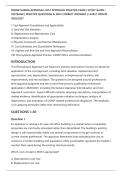
PENNSYLVANIA APPRAISAL COST APPROACH PRACTICE EXAM | STUDY GUIDE |
TESTBANK | PRACTICE QUESTIONS & 100% CORRECT ANSWERS | LATEST UPDATE
2026/2027
I. Cost Approach Foundations and Applicability
II. Land and Site Valuation
III. Replacement and Reproduction Cost
IV. Depreciation Analysis
V. Physical, Functional, and External Obsolescence
VI. Cost Estimation and Quantitative Techniques
VII. Highest and Best Use and Cost-Approach Reconciliation
VIII. Pennsylvania Appraisal Practice, USPAP, Ethics, and Documentation
INTRODUCTION
This Pennsylvania Appraisal Cost Approach practice examination focuses on advanced
application of the cost approach, including land valuation, replacement and
reproduction cost, depreciation, obsolescence, entrepreneurial incentive, site
improvements, and reconciliation. The questions are designed around professional-
level appraisal judgment and the current Pennsylvania qualification framework
applicable in 2026/2027, including the General Appraiser Site Valuation and Cost
Approach curriculum. Expect difficult scenarios requiring calculations, interpretation of
market evidence, identification of appropriate valuation techniques, analysis of
depreciation, and evaluation of USPAP-related professional obligations. The emphasis
is on applying principles rather than memorizing definitions.
QUESTIONS 1–30
Question 1
An appraiser is valuing a 25-year-old office building in a market where comparable
properties are commonly renovated rather than demolished. The building's existing
design is still economically viable, but several components no longer conform to
current market preferences. The appraiser determines that estimating the cost to
construct a modern building with equivalent utility would better represent the market's
reaction than reproducing the existing structure exactly.
Which cost concept is MOST appropriate?
A. Reproduction cost new
B. Replacement cost new
,C. Historical cost
D. Salvage cost
Correct Answer: B
Explanation: Replacement cost represents the cost to construct a building of
comparable utility using current materials, standards, and design, whereas
reproduction cost duplicates the existing property's exact characteristics.
Question 2
A property's estimated replacement cost new is $4,800,000. The appraiser identifies
physical deterioration of $600,000, functional obsolescence of $300,000, and external
obsolescence of $240,000. No other adjustments are warranted.
What is the indicated depreciated cost of the improvements before considering land?
A. $3,420,000
B. $3,660,000
C. $3,900,000
D. $4,140,000
Correct Answer: B
Explanation: Total depreciation is $600,000 + $300,000 + $240,000 = $1,140,000.
Subtracting this from $4,800,000 produces a depreciated improvement value of
$3,660,000.
Question 3
An appraiser is estimating the value of a vacant commercial site. Three comparable
land sales are available. Sale 1 requires a substantial downward adjustment because it
has superior highway exposure. Sale 2 has similar exposure but inferior zoning. Sale 3
has nearly identical physical and legal characteristics but sold under unusually favorable
financing terms.
Which sale should generally receive the greatest analytical weight, assuming reliable
adjustments can be quantified?
A. Sale 1 because its higher price demonstrates superior market demand
B. Sale 2 because zoning differences are always more important than financing
,C. Sale 3 because physical and legal comparability is strongest
D. All three equally because land sales should always be averaged
Correct Answer: C
Explanation: Comparable selection emphasizes similarity to the subject and the
reliability of adjustments. A financing difference can be adjusted when adequately
supported, while major physical or legal differences may create greater uncertainty.
Question 4
A newly constructed building contains unusually expensive decorative features that are
not reflected in prevailing market rents or selling prices. The owner insists that these
features should be included at their full construction cost in the appraisal.
What is the BEST appraisal response?
A. Include the entire cost because all construction expenditures automatically add
equal value
B. Exclude all decorative features regardless of market reaction
C. Analyze whether the market recognizes the expenditures as contributory value
D. Add the expenditures to land value rather than improvement value
Correct Answer: C
Explanation: Cost does not necessarily equal value. The appraiser must determine
whether the market recognizes the expenditures as contributing to the property's
value and account for any resulting functional or external obsolescence.
Question 5
A 10-year-old property has an effective age of 6 years because it has been
exceptionally well maintained and periodically modernized. Its remaining economic life
is estimated at 24 years.
Using the age-life method, what is the indicated percentage of depreciation
attributable to the improvements?
A. 20%
B. 25%
, C. 40%
D. 60%
Correct Answer: B
Explanation: Total economic life is 6 years of effective age plus 24 years remaining, or
30 years. Depreciation is therefore 6 ÷ 30 = 20%.
Question 6
An appraiser discovers that the calculation in Question 5 produces an inconsistency
with the property's market evidence. Several comparable properties indicate
approximately 25% depreciation despite the subject's calculated age-life depreciation
being 20%.
What is the MOST defensible response?
A. Automatically use the 25% figure because comparable properties always override
cost analysis
B. Ignore the market evidence because the age-life formula is mathematically objective
C. Investigate the causes of the discrepancy and determine whether the age-life
assumptions adequately reflect market behavior
D. Average 20% and 25% without further analysis
Correct Answer: C
Explanation: Depreciation is a market-derived concept. When a formula conflicts with
market evidence, the appraiser should investigate effective age, economic life,
maintenance, obsolescence, and other factors rather than mechanically averaging
results.
Question 7
A warehouse has a roof system expected to last 30 years. The roof is 15 years old and
has a current replacement cost of $900,000. Inspection indicates that its actual
condition is consistent with its age, and no unusual deterioration exists.
Using a straight-line age-life assumption for the roof alone, what is the indicated
depreciated value of the roof?
TESTBANK | PRACTICE QUESTIONS & 100% CORRECT ANSWERS | LATEST UPDATE
2026/2027
I. Cost Approach Foundations and Applicability
II. Land and Site Valuation
III. Replacement and Reproduction Cost
IV. Depreciation Analysis
V. Physical, Functional, and External Obsolescence
VI. Cost Estimation and Quantitative Techniques
VII. Highest and Best Use and Cost-Approach Reconciliation
VIII. Pennsylvania Appraisal Practice, USPAP, Ethics, and Documentation
INTRODUCTION
This Pennsylvania Appraisal Cost Approach practice examination focuses on advanced
application of the cost approach, including land valuation, replacement and
reproduction cost, depreciation, obsolescence, entrepreneurial incentive, site
improvements, and reconciliation. The questions are designed around professional-
level appraisal judgment and the current Pennsylvania qualification framework
applicable in 2026/2027, including the General Appraiser Site Valuation and Cost
Approach curriculum. Expect difficult scenarios requiring calculations, interpretation of
market evidence, identification of appropriate valuation techniques, analysis of
depreciation, and evaluation of USPAP-related professional obligations. The emphasis
is on applying principles rather than memorizing definitions.
QUESTIONS 1–30
Question 1
An appraiser is valuing a 25-year-old office building in a market where comparable
properties are commonly renovated rather than demolished. The building's existing
design is still economically viable, but several components no longer conform to
current market preferences. The appraiser determines that estimating the cost to
construct a modern building with equivalent utility would better represent the market's
reaction than reproducing the existing structure exactly.
Which cost concept is MOST appropriate?
A. Reproduction cost new
B. Replacement cost new
,C. Historical cost
D. Salvage cost
Correct Answer: B
Explanation: Replacement cost represents the cost to construct a building of
comparable utility using current materials, standards, and design, whereas
reproduction cost duplicates the existing property's exact characteristics.
Question 2
A property's estimated replacement cost new is $4,800,000. The appraiser identifies
physical deterioration of $600,000, functional obsolescence of $300,000, and external
obsolescence of $240,000. No other adjustments are warranted.
What is the indicated depreciated cost of the improvements before considering land?
A. $3,420,000
B. $3,660,000
C. $3,900,000
D. $4,140,000
Correct Answer: B
Explanation: Total depreciation is $600,000 + $300,000 + $240,000 = $1,140,000.
Subtracting this from $4,800,000 produces a depreciated improvement value of
$3,660,000.
Question 3
An appraiser is estimating the value of a vacant commercial site. Three comparable
land sales are available. Sale 1 requires a substantial downward adjustment because it
has superior highway exposure. Sale 2 has similar exposure but inferior zoning. Sale 3
has nearly identical physical and legal characteristics but sold under unusually favorable
financing terms.
Which sale should generally receive the greatest analytical weight, assuming reliable
adjustments can be quantified?
A. Sale 1 because its higher price demonstrates superior market demand
B. Sale 2 because zoning differences are always more important than financing
,C. Sale 3 because physical and legal comparability is strongest
D. All three equally because land sales should always be averaged
Correct Answer: C
Explanation: Comparable selection emphasizes similarity to the subject and the
reliability of adjustments. A financing difference can be adjusted when adequately
supported, while major physical or legal differences may create greater uncertainty.
Question 4
A newly constructed building contains unusually expensive decorative features that are
not reflected in prevailing market rents or selling prices. The owner insists that these
features should be included at their full construction cost in the appraisal.
What is the BEST appraisal response?
A. Include the entire cost because all construction expenditures automatically add
equal value
B. Exclude all decorative features regardless of market reaction
C. Analyze whether the market recognizes the expenditures as contributory value
D. Add the expenditures to land value rather than improvement value
Correct Answer: C
Explanation: Cost does not necessarily equal value. The appraiser must determine
whether the market recognizes the expenditures as contributing to the property's
value and account for any resulting functional or external obsolescence.
Question 5
A 10-year-old property has an effective age of 6 years because it has been
exceptionally well maintained and periodically modernized. Its remaining economic life
is estimated at 24 years.
Using the age-life method, what is the indicated percentage of depreciation
attributable to the improvements?
A. 20%
B. 25%
, C. 40%
D. 60%
Correct Answer: B
Explanation: Total economic life is 6 years of effective age plus 24 years remaining, or
30 years. Depreciation is therefore 6 ÷ 30 = 20%.
Question 6
An appraiser discovers that the calculation in Question 5 produces an inconsistency
with the property's market evidence. Several comparable properties indicate
approximately 25% depreciation despite the subject's calculated age-life depreciation
being 20%.
What is the MOST defensible response?
A. Automatically use the 25% figure because comparable properties always override
cost analysis
B. Ignore the market evidence because the age-life formula is mathematically objective
C. Investigate the causes of the discrepancy and determine whether the age-life
assumptions adequately reflect market behavior
D. Average 20% and 25% without further analysis
Correct Answer: C
Explanation: Depreciation is a market-derived concept. When a formula conflicts with
market evidence, the appraiser should investigate effective age, economic life,
maintenance, obsolescence, and other factors rather than mechanically averaging
results.
Question 7
A warehouse has a roof system expected to last 30 years. The roof is 15 years old and
has a current replacement cost of $900,000. Inspection indicates that its actual
condition is consistent with its age, and no unusual deterioration exists.
Using a straight-line age-life assumption for the roof alone, what is the indicated
depreciated value of the roof?