

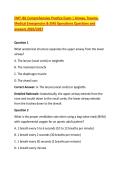
EMT JBL Comprehensive Practice Exam | Airway, Trauma,
Medical Emergencies & EMS Operations Questions and
answers 2026/2027
Question 1
What anatomical structure separates the upper airway from the lower
airway?
A. The larynx (vocal cords) or epiglottis
B. The mainstem bronchi
C. The diaphragm muscle
D. The alveoli sacs
Correct Answer: A. The larynx (vocal cords) or epiglottis
Detailed Rationale: Anatomically, the upper airway extends from the
nose and mouth down to the vocal cords; the lower airway extends
from the trachea down to the alveoli.
Question 2
What is the proper ventilation rate when using a bag-valve-mask (BVM)
with supplemental oxygen for an apneic adult patient?
A. 1 breath every 5 to 6 seconds (10 to 12 breaths per minute)
B. 1 breath every 2 seconds (30 breaths per minute)
C. 1 breath every 30 seconds (2 breaths per minute)
D. 1 breath every minute
,Correct Answer: A. 1 breath every 5 to 6 seconds (10 to 12 breaths per
minute)
Detailed Rationale: Current resuscitation guidelines recommend
ventilating an adult respiratory or cardiac arrest patient once every 5 to
6 seconds to maintain adequate gas exchange without gastric over-
inflation.
Question 3
What is the maximum recommended time limit for suctioning an adult
patient's airway with a rigid catheter?
A. 15 seconds
B. 45 seconds
C. 2 minutes
D. 5 seconds
Correct Answer: A. 15 seconds
Detailed Rationale: Suctioning removes vital oxygen. Limiting suction
attempts to 15 seconds for adults prevents severe hypoxia and cardiac
arrhythmias.
Question 4
When is an oropharyngeal airway (OPA) strictly contraindicated?
A. In an unresponsive adult patient in cardiac arrest
B. In a conscious or semi-conscious patient with an active gag reflex
C. In a patient who is apneic and intubated
D. In an infant under 1 year old
,Correct Answer: B. In a conscious or semi-conscious patient with an
active gag reflex
Detailed Rationale: Inserting an OPA into a patient with an intact gag
reflex can trigger severe vomiting, aspiration, or laryngospasm. OPAs
are restricted to unresponsive patients without a gag reflex.
Question 5
How is the correct size of a nasopharyngeal airway (NPA) measured for
an adult patient?
A. From the tip of the nose to the earlobe (angle of the jaw)
B. From the center of the lips to the sternum notch
C. From the eyebrow to the chin tip
D. From the shoulder to the fingertips
Correct Answer: A. From the tip of the nose to the earlobe (angle of the
jaw)
Detailed Rationale: Sizing an NPA from the tip of the nose to the
earlobe ensures the tube reaches the nasopharynx correctly without
entering the esophagus or causing trauma.
Question 6
What is the preferred manual airway maneuver for an unresponsive
trauma patient with suspected cervical spine injury?
A. Head-tilt/chin-lift maneuver
B. Jaw-thrust maneuver
C. Neck hyperflexion maneuver
, D. Tongue-jaw lift maneuver
Correct Answer: B. Jaw-thrust maneuver
Detailed Rationale: The jaw-thrust opens the upper airway without
extending or manipulating the cervical spine, minimizing the risk of
secondary spinal cord injury in trauma victims.
Question 7
What is the primary indication for applying Continuous Positive Airway
Pressure (CPAP) in the prehospital setting?
A. Cardiac arrest in asystole
B. Severe respiratory distress associated with COPD, asthma, or acute
pulmonary edema in a spontaneously breathing patient
C. Minor nosebleeds
D. Simple extremity fractures
Correct Answer: B. Severe respiratory distress associated with COPD,
asthma, or acute pulmonary edema in a spontaneously breathing
patient
Detailed Rationale: CPAP applies positive pressure to keep alveoli open,
clear fluid, and reduce the work of breathing in spontaneously
breathing patients experiencing severe respiratory distress.
Question 8
What is the maximum oxygen delivery concentration (FIO2) provided by
a non-rebreather mask (NRB) connected to a 15 L/min oxygen flow
rate?
A. 24% to 44%
Medical Emergencies & EMS Operations Questions and
answers 2026/2027
Question 1
What anatomical structure separates the upper airway from the lower
airway?
A. The larynx (vocal cords) or epiglottis
B. The mainstem bronchi
C. The diaphragm muscle
D. The alveoli sacs
Correct Answer: A. The larynx (vocal cords) or epiglottis
Detailed Rationale: Anatomically, the upper airway extends from the
nose and mouth down to the vocal cords; the lower airway extends
from the trachea down to the alveoli.
Question 2
What is the proper ventilation rate when using a bag-valve-mask (BVM)
with supplemental oxygen for an apneic adult patient?
A. 1 breath every 5 to 6 seconds (10 to 12 breaths per minute)
B. 1 breath every 2 seconds (30 breaths per minute)
C. 1 breath every 30 seconds (2 breaths per minute)
D. 1 breath every minute
,Correct Answer: A. 1 breath every 5 to 6 seconds (10 to 12 breaths per
minute)
Detailed Rationale: Current resuscitation guidelines recommend
ventilating an adult respiratory or cardiac arrest patient once every 5 to
6 seconds to maintain adequate gas exchange without gastric over-
inflation.
Question 3
What is the maximum recommended time limit for suctioning an adult
patient's airway with a rigid catheter?
A. 15 seconds
B. 45 seconds
C. 2 minutes
D. 5 seconds
Correct Answer: A. 15 seconds
Detailed Rationale: Suctioning removes vital oxygen. Limiting suction
attempts to 15 seconds for adults prevents severe hypoxia and cardiac
arrhythmias.
Question 4
When is an oropharyngeal airway (OPA) strictly contraindicated?
A. In an unresponsive adult patient in cardiac arrest
B. In a conscious or semi-conscious patient with an active gag reflex
C. In a patient who is apneic and intubated
D. In an infant under 1 year old
,Correct Answer: B. In a conscious or semi-conscious patient with an
active gag reflex
Detailed Rationale: Inserting an OPA into a patient with an intact gag
reflex can trigger severe vomiting, aspiration, or laryngospasm. OPAs
are restricted to unresponsive patients without a gag reflex.
Question 5
How is the correct size of a nasopharyngeal airway (NPA) measured for
an adult patient?
A. From the tip of the nose to the earlobe (angle of the jaw)
B. From the center of the lips to the sternum notch
C. From the eyebrow to the chin tip
D. From the shoulder to the fingertips
Correct Answer: A. From the tip of the nose to the earlobe (angle of the
jaw)
Detailed Rationale: Sizing an NPA from the tip of the nose to the
earlobe ensures the tube reaches the nasopharynx correctly without
entering the esophagus or causing trauma.
Question 6
What is the preferred manual airway maneuver for an unresponsive
trauma patient with suspected cervical spine injury?
A. Head-tilt/chin-lift maneuver
B. Jaw-thrust maneuver
C. Neck hyperflexion maneuver
, D. Tongue-jaw lift maneuver
Correct Answer: B. Jaw-thrust maneuver
Detailed Rationale: The jaw-thrust opens the upper airway without
extending or manipulating the cervical spine, minimizing the risk of
secondary spinal cord injury in trauma victims.
Question 7
What is the primary indication for applying Continuous Positive Airway
Pressure (CPAP) in the prehospital setting?
A. Cardiac arrest in asystole
B. Severe respiratory distress associated with COPD, asthma, or acute
pulmonary edema in a spontaneously breathing patient
C. Minor nosebleeds
D. Simple extremity fractures
Correct Answer: B. Severe respiratory distress associated with COPD,
asthma, or acute pulmonary edema in a spontaneously breathing
patient
Detailed Rationale: CPAP applies positive pressure to keep alveoli open,
clear fluid, and reduce the work of breathing in spontaneously
breathing patients experiencing severe respiratory distress.
Question 8
What is the maximum oxygen delivery concentration (FIO2) provided by
a non-rebreather mask (NRB) connected to a 15 L/min oxygen flow
rate?
A. 24% to 44%


