

DIVERSITY IN THE LIVING WORLD
- Biology is the study of life forms and living processes, covering the vast diversity of
organisms on Earth.
- Classification and nomenclature have been developed to systematically identify and describe
living organisms, revealing similarities and relationships among them.
- Evolution and Biodiversity: Organisms are interconnected through common ancestry,
highlighting the importance of understanding and conserving biodiversity.
ICBN —> International Code for Botanical Nomenclature
ICZN —> International Code for Zoological Nomenclature
Binomial Nomenclature —> Formal system of naming living creatures by giving them names
consisting of two parts, both of which use Latin grammatical forms.
CHARACTERISTICS OF LIVING ORGANISMS-
i) Respiration
ii) Locomotion/ movements
iii) Digestion/ Metabolism
iv) Reproduction
v) Growth
vi) Consciousness
ERNEST MAYR- IMPORTANT SCIENTIST WHO HELPED WITH A LOT OF DISCOVERING
OF THE LIVING WORLD
- Living organisms occur across extremely diverse habitats
- Organisms show extraordinary variations in size, colour, morphology, physiology and habitat
- Known and described species are stated in the chapter as about 1.7-1.8 million.
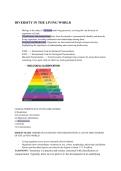
TAXONOMY- Taxonomy is a practice and science concerned with classification or
categorization. Typically, there are two parts to it: the development of an underlying
- Biology is the study of life forms and living processes, covering the vast diversity of
organisms on Earth.
- Classification and nomenclature have been developed to systematically identify and describe
living organisms, revealing similarities and relationships among them.
- Evolution and Biodiversity: Organisms are interconnected through common ancestry,
highlighting the importance of understanding and conserving biodiversity.
ICBN —> International Code for Botanical Nomenclature
ICZN —> International Code for Zoological Nomenclature
Binomial Nomenclature —> Formal system of naming living creatures by giving them names
consisting of two parts, both of which use Latin grammatical forms.
CHARACTERISTICS OF LIVING ORGANISMS-
i) Respiration
ii) Locomotion/ movements
iii) Digestion/ Metabolism
iv) Reproduction
v) Growth
vi) Consciousness
ERNEST MAYR- IMPORTANT SCIENTIST WHO HELPED WITH A LOT OF DISCOVERING
OF THE LIVING WORLD
- Living organisms occur across extremely diverse habitats
- Organisms show extraordinary variations in size, colour, morphology, physiology and habitat
- Known and described species are stated in the chapter as about 1.7-1.8 million.
TAXONOMY- Taxonomy is a practice and science concerned with classification or
categorization. Typically, there are two parts to it: the development of an underlying


