

Advanced EKG Rhythms
Advanced EKG Rhythms- Copy
Study online at https://quizlet.com/_8epr2m
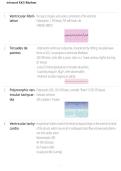
1. Ventricular Fibril- the rapid, irregular, and useless contractions of the ventricles
lation Polymorphic, > 350 beats, PVT with faster rate
CARDIAC ARREST
2. Torsades de -Polymorphic ventricular tachycardia, characterized by shifting sinusoidal wave-
pointes forms on ECG; can progress to ventricular fibrillation.
200-300 beats, starts after a pause, starts on a T wave, previous rhythm has long
QT interval
-Long QT interval predisposes to torsades de pointes.
-Caused by drugs,K+, Mg2+, other abnormalities
-Treatment includes magnesium sulfate.
3. Polymorphic ven- Polymorphic QRS, 120-150 beats, (consider "flutter" if 250-350 beats)
tricular tachycar- Indicates ischemia
dia QRS complex > P waves
4. Ventricular tachy- A rapid heart rhythm in which the electrical impulse begins in the ventricle (instead
cardia of the atrium), which may result in inadequate blood flow and eventually deterio-
rate into cardiac arrest.
Monomorphic QRS
VR 100-250 beats
No P waves visible
Usually post MI (scarring)
1/6
, Advanced EKG Rhythms
Advanced EKG Rhythms- Copy
Study online at https://quizlet.com/_8epr2m
5. Accelerated Monomorphic QRS
interventricular VR 40-100 beats
rhythm Short lived due to sinus pause as an escape rhythm (wide complex)
6. Atrial fibrillation occurs when the normal rhythmic contractions of the atria are replaced by rapid
irregular twitching of the muscular heart wall
No decipherable P waves
>350 bpm
"IRREGULARLY IRREGULAR"
7. Atrial flutter Slanted P waves
200-350 bpm
"SAWTOOTH PATTERN"
8. Supraventricular No P wave after QRS
tachycardia Rapid regular narrow complex
9. Multifocal atrial Rate 100-250/bpm P wave two or more ectopic P waves with different morpholo-
tachycardia gies QRS normal Rhythm irregular
10. Atrial tachycardia Rapid heartbeat originating from the atria
1-2 different P waves
2/6
Advanced EKG Rhythms- Copy
Study online at https://quizlet.com/_8epr2m
1. Ventricular Fibril- the rapid, irregular, and useless contractions of the ventricles
lation Polymorphic, > 350 beats, PVT with faster rate
CARDIAC ARREST
2. Torsades de -Polymorphic ventricular tachycardia, characterized by shifting sinusoidal wave-
pointes forms on ECG; can progress to ventricular fibrillation.
200-300 beats, starts after a pause, starts on a T wave, previous rhythm has long
QT interval
-Long QT interval predisposes to torsades de pointes.
-Caused by drugs,K+, Mg2+, other abnormalities
-Treatment includes magnesium sulfate.
3. Polymorphic ven- Polymorphic QRS, 120-150 beats, (consider "flutter" if 250-350 beats)
tricular tachycar- Indicates ischemia
dia QRS complex > P waves
4. Ventricular tachy- A rapid heart rhythm in which the electrical impulse begins in the ventricle (instead
cardia of the atrium), which may result in inadequate blood flow and eventually deterio-
rate into cardiac arrest.
Monomorphic QRS
VR 100-250 beats
No P waves visible
Usually post MI (scarring)
1/6
, Advanced EKG Rhythms
Advanced EKG Rhythms- Copy
Study online at https://quizlet.com/_8epr2m
5. Accelerated Monomorphic QRS
interventricular VR 40-100 beats
rhythm Short lived due to sinus pause as an escape rhythm (wide complex)
6. Atrial fibrillation occurs when the normal rhythmic contractions of the atria are replaced by rapid
irregular twitching of the muscular heart wall
No decipherable P waves
>350 bpm
"IRREGULARLY IRREGULAR"
7. Atrial flutter Slanted P waves
200-350 bpm
"SAWTOOTH PATTERN"
8. Supraventricular No P wave after QRS
tachycardia Rapid regular narrow complex
9. Multifocal atrial Rate 100-250/bpm P wave two or more ectopic P waves with different morpholo-
tachycardia gies QRS normal Rhythm irregular
10. Atrial tachycardia Rapid heartbeat originating from the atria
1-2 different P waves
2/6


