

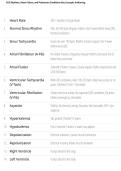
ECG Rhythms, Heart Failure, and Pulmonary Conditions Key Concepts forNursing
ECG Rhythms, Heart Failure, and Pulmonary Conditions: Key Concepts for
Nursing
Study online at https://quizlet.com/_jpu7k0
1. Heart Rate 300 ÷ Number of Large Boxes
2. Normal Sinus Rhythm Rate: 60-100 bpm, Regular rhythm, One P wave before every QRS,
Normal conduction
3. Sinus Tachycardia Heart rate over 100 bpm, Rhythm remains regular, One P wave
before every QRS
4. Atrial Fibrillation (A-Fib) No visible P waves, Irregularly irregular rhythm, Increased risk of
blood clots and stroke
5. Atrial Flutter Sawtooth ("flutter") waves, Usually regular rhythm, Rapid atrial rate
(250-350 bpm)
6. Ventricular Tachycardia Wide QRS complexes, Rate: 100-250 bpm, May have a pulse or no
(V-Tach) pulse, Pulseless V-Tach = Shockable
7. Ventricular Fibrillation Chaotic electrical activity, No organized QRS complexes, No pulse,
(V-Fib) Medical emergency, Shockable
8. Asystole Flatline, No electrical activity, No pulse, Not shockable, CPR + Epi-
nephrine
9. Hyperkalemia Tall, peaked ("tented") T waves
10. Hypokalemia Flat or inverted T waves, U waves may appear
11. Depolarization Electrical activation, Causes muscle contraction
12. Repolarization Electrical recovery, Allows muscle relaxation
13. Right Ventricle Pumps blood to the lungs
14. Left Ventricle Pumps blood to the body
1/2
ECG Rhythms, Heart Failure, and Pulmonary Conditions: Key Concepts for
Nursing
Study online at https://quizlet.com/_jpu7k0
1. Heart Rate 300 ÷ Number of Large Boxes
2. Normal Sinus Rhythm Rate: 60-100 bpm, Regular rhythm, One P wave before every QRS,
Normal conduction
3. Sinus Tachycardia Heart rate over 100 bpm, Rhythm remains regular, One P wave
before every QRS
4. Atrial Fibrillation (A-Fib) No visible P waves, Irregularly irregular rhythm, Increased risk of
blood clots and stroke
5. Atrial Flutter Sawtooth ("flutter") waves, Usually regular rhythm, Rapid atrial rate
(250-350 bpm)
6. Ventricular Tachycardia Wide QRS complexes, Rate: 100-250 bpm, May have a pulse or no
(V-Tach) pulse, Pulseless V-Tach = Shockable
7. Ventricular Fibrillation Chaotic electrical activity, No organized QRS complexes, No pulse,
(V-Fib) Medical emergency, Shockable
8. Asystole Flatline, No electrical activity, No pulse, Not shockable, CPR + Epi-
nephrine
9. Hyperkalemia Tall, peaked ("tented") T waves
10. Hypokalemia Flat or inverted T waves, U waves may appear
11. Depolarization Electrical activation, Causes muscle contraction
12. Repolarization Electrical recovery, Allows muscle relaxation
13. Right Ventricle Pumps blood to the lungs
14. Left Ventricle Pumps blood to the body
1/2


