

Cardiac Rhythms, ECG Interpretation, and Dysrhythmia Management in
Cardiac Rhythms, ECG Interpretation, and Dysrhythmia Management in
Nursing
Study online at https://quizlet.com/_juamfr
1. What is depolarization The electrical activation of a cell caused by the influx of sodium into the
in cardiac physiology? cell while potassium exits.
2. What does systole refer The mechanical contraction of the heart.
to?
3. What is repolarization? The return of the cell to its resting state, caused by the reentry of potas-
sium into the cell while sodium exits.
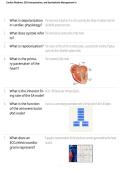
4. What is the prima- The sinoatrial (SA) node.
ry pacemaker of the
heart?
5. What is the inherent fir- 60 to 100 beats per minute (bpm).
ing rate of the SA node?
6. What is the function It acts as a secondary pacemaker with a firing rate of 40 to 60 bpm.
of the atrioventricular
(AV) node?
7. What does an A graphic representation of the electrical currents generated by the heart
ECG (electrocardio- muscle.
gram) represent?
, Cardiac Rhythms, ECG Interpretation, and Dysrhythmia Management in
Cardiac Rhythms, ECG Interpretation, and Dysrhythmia Management in
Nursing
Study online at https://quizlet.com/_juamfr
8. What are the standard Leads I, II, III, aVR, aVL, aVF, and precordial leads V1 to V6.
leads in a 12-lead ECG?
9. What does the P wave Atrial depolarization.
represent in an ECG?
10. What does the QRS Ventricular depolarization.
complex represent?
11. What does the T wave Ventricular repolarization.
indicate?
12. What is the duration of 0.12 to 0.20 seconds.
a normal PR interval?
13. What does the ST seg- Early ventricular repolarization.
ment represent?
14. What is the QT interval The total time for ventricular depolarization and repolarization.
in an ECG?
15. What is sinus rhythm? The electrical activity of the heart initiated by the SA node at a regular rate
and rhythm.
Cardiac Rhythms, ECG Interpretation, and Dysrhythmia Management in
Nursing
Study online at https://quizlet.com/_juamfr
1. What is depolarization The electrical activation of a cell caused by the influx of sodium into the
in cardiac physiology? cell while potassium exits.
2. What does systole refer The mechanical contraction of the heart.
to?
3. What is repolarization? The return of the cell to its resting state, caused by the reentry of potas-
sium into the cell while sodium exits.
4. What is the prima- The sinoatrial (SA) node.
ry pacemaker of the
heart?
5. What is the inherent fir- 60 to 100 beats per minute (bpm).
ing rate of the SA node?
6. What is the function It acts as a secondary pacemaker with a firing rate of 40 to 60 bpm.
of the atrioventricular
(AV) node?
7. What does an A graphic representation of the electrical currents generated by the heart
ECG (electrocardio- muscle.
gram) represent?
, Cardiac Rhythms, ECG Interpretation, and Dysrhythmia Management in
Cardiac Rhythms, ECG Interpretation, and Dysrhythmia Management in
Nursing
Study online at https://quizlet.com/_juamfr
8. What are the standard Leads I, II, III, aVR, aVL, aVF, and precordial leads V1 to V6.
leads in a 12-lead ECG?
9. What does the P wave Atrial depolarization.
represent in an ECG?
10. What does the QRS Ventricular depolarization.
complex represent?
11. What does the T wave Ventricular repolarization.
indicate?
12. What is the duration of 0.12 to 0.20 seconds.
a normal PR interval?
13. What does the ST seg- Early ventricular repolarization.
ment represent?
14. What is the QT interval The total time for ventricular depolarization and repolarization.
in an ECG?
15. What is sinus rhythm? The electrical activity of the heart initiated by the SA node at a regular rate
and rhythm.


