

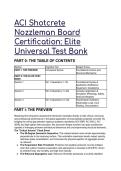
ACI Shotcrete
Nozzleman Board
Certification: Elite
Universal Test Bank
PART 0: THE TABLE OF CONTENTS
Section Cognitive Tier Subject Focus
PART I: THE PREVIEW Conceptual Syntax Foundational Axioms and
Structural Mechanics
PART II: THE ELITE TEST
BANK
Section 1 Tier 1 (Questions 1–10) Foundational Syntax &
Application (Definitions,
Equipment, Gradations)
Section 2 Tier 2 (Questions 11–20) Complex Application &
Simulation (Rheology, Safety,
Hot/Cold Weather)
Section 3 Tier 3 (Questions 21–30) Grandmaster Synthesis
(Hydrostatic Load, Core
Grading, Groundwater)
PART I: THE PREVIEW
Mastering this exhaustive assessment framework translates directly to elite clinical, structural,
and professional performance in the global application of pneumatically projected concrete. By
bridging the critical gap between rigorous academic standards (ACI 506R, ACI 506.2, ACI
305R) and high-stakes field execution, this document forges scholars into apex practitioners
capable of managing extreme architectural tolerances and uncompromising structural demands.
The "Critical Axioms" Cheat Sheet
● The 90-Degree Geometric Imperative: The material stream must remain approximately
perpendicular to the receiving surface. This orientation maximizes kinetic impact velocity,
optimizes paste consolidation, and minimizes the physical rejection of aggregate known
as rebound.
● The Evaporation Rate Threshold: Protective hot-weather protocols must be initiated
when the surface moisture evaporation rate approaches or exceeds 0.20 lb/ft²/hr, driven
by ambient heat, low humidity, and high wind velocity.
● The Rebound Segregation Law: Rebound inherently possesses a severely depleted
, cement-to-aggregate ratio because the heavy aggregates bounce off the wall, leaving
their cementitious coating behind. It must never be incorporated back into the structural
placement.
● The ACI 506.6T Absolute Grading Rule: Structural acceptance requires a mean visual
core grade not exceeding 2.5, with no single core allowed to exceed Grade 3.0. A single
Grade 4 or Grade 5 core exhibiting a deep, unbonded sand pocket behind reinforcement
mandates absolute rejection.
● The Encapsulation Mechanic: When shooting dense reinforcement, the pneumatic
stream must maintain sufficient velocity, optimal stand-off distance (18–24 inches for
wet-mix), and slight angle modulation to force the highly plastic material to flow around
and perfectly encapsulate the leeward side of the steel.
PART II: THE ELITE TEST BANK
Tier 1 - Foundational Syntax & Application
Q1: A heavy civil contractor is evaluating delivery systems for a highly variable retaining wall
repair in a remote region. The specification requires real-time control over the water-cement
ratio at the exact point of placement to accommodate rapidly changing subsurface moisture
conditions. Based on the principles of ACI 506R, which operational methodology is the MOST
ACCURATE selection? A) The wet-mix process, utilizing a positive-displacement piston pump
and pre-batched ready-mix concrete. B) The wet-mix process, utilizing a progressive cavity
pump and a continuous hydration-control admixture injection system. C) The dry-mix process,
utilizing a double-chamber rotor gun and a manually controlled water ring at the nozzle. D) The
dry-mix process, utilizing a predampener and a tremie pipe for gravity-fed continuous
placement.
● Answer: C (The dry-mix process, utilizing a double-chamber rotor gun and a manually
controlled water ring at the nozzle.)
● Distractor Analysis:
○ A is incorrect: The wet-mix process requires all structural ingredients, including the
total hydration water, to be thoroughly mixed prior to introduction into the delivery
hose. This fundamentally removes real-time water-cement ratio manipulation from
the nozzle operator.
○ B is incorrect: While sophisticated hydration-control admixtures extend the plasticity
and working life of wet-mix concrete during long transit times, they do not provide
the nozzleman with immediate, variable control over the paste moisture content at
the point of impact.
○ D is incorrect: A tremie pipe is explicitly utilized for gravity-fed, underwater concrete
placement. This completely contradicts the defining mechanism of shotcrete, which
mandates high-velocity pneumatic projection.
The Mentor's Analysis: The fundamental architectural distinction between global shotcrete
processes lies in the precise moment of hydration. When facing highly variable substrate
moisture conditions that require instantaneous paste adjustments, the immediate priority is
selecting a delivery system that isolates water injection. By utilizing the dry-mix process, the
practitioner bypasses the rigid, unalterable batching constraints of pre-mixed concrete.
Professional/Academic Intuition: In the dry-mix process, the nozzleman serves as the
ultimate arbiter of the water-cement ratio and, consequently, the structural integrity of the
, consolidated matrix.
Q2: During the application of a heavily reinforced seismic shear wall, a novice operator
frequently sweeps the nozzle at extreme oblique angles relative to the formwork in an attempt to
cover a wider surface area rapidly. Based on the fundamental physics of high-velocity
pneumatic projection outlined in ACI 506R, which structural outcome is the MOST LIKELY
consequence of this specific action? A) An exponential increase in production rates coupled
with optimal aggregate interlock across the entire lateral span. B) Massive increases in rebound
generation and the formation of porous, unbonded sand pockets directly behind the primary
reinforcement. C) A substantial reduction in the overall water-cement ratio due to the increased
kinetic evaporation across the air stream. D) The complete elimination of overspray onto
adjacent, unformed structural surfaces.
● Answer: B (Massive increases in rebound generation and the formation of porous,
unbonded sand pockets directly behind the primary reinforcement.)
● Distractor Analysis:
○ A is incorrect: Extreme oblique angles drastically siphon the impact velocity away
from the receiving surface, destroying the kinetic energy required for consolidation
and entirely preventing optimal aggregate embedment.
○ C is incorrect: The geometric angle of material impact has absolutely no direct
causal relationship with the inherent chemical water-cement ratio or the ambient
thermodynamic evaporation rate.
○ D is incorrect: Extreme oblique trajectories inherently increase both rebound and
overspray, because the high-velocity material stream skips off the receiving
surface—much like a stone skipping across water—rather than penetrating and
embedding into the fresh paste.
The Mentor's Analysis: The consolidation physics of pneumatically projected concrete rely
entirely on the transfer of direct, perpendicular kinetic energy to achieve maximum density.
When facing vast structural surface areas, the immediate priority is maintaining strict geometric
discipline. By utilizing a strict 90-degree impact angle, the scholar bypasses the common trap of
generating localized porosity and severely compromised bond strength.
Professional/Academic Intuition: Impact velocity is the fundamental engine of structural
consolidation; oblique angles siphon that critical energy directly into destructive
rebound and structural voids.
Q3: An inspection of a commercial dry-mix shotcrete operation reveals a thick, continuous
accumulation of loose material ricocheting off the receiving surface and piling at the base of the
wall. To optimize economic efficiency, the contractor proposes gathering this fallen material and
mechanically mixing it back into the dry-mix feed hopper. Based on the stringent guidelines of
ACI 506R, which regulatory response is the MOST ACCURATE? A) The action is structurally
acceptable provided the fallen material is rigorously re-screened to remove deleterious debris
prior to reintroduction. B) The action is conditionally acceptable only if supplementary Portland
cement paste is injected at the nozzle manifold to re-bind the matrix. C) The action is strictly
prohibited because the rejected material possesses a severely depleted cement content and is
considered contaminated. D) The action is strictly prohibited because the fallen material is
technically classified as overspray, which lacks the appropriate moisture content for adhesion.
● Answer: C (The action is strictly prohibited because the rejected material possesses a
severely depleted cement content and is considered contaminated.)
● Distractor Analysis:
○ A is incorrect: Mechanical re-screening does not replace the vital cement paste that
was stripped off the aggregate when it initially adhered to the wall. The remaining
Nozzleman Board
Certification: Elite
Universal Test Bank
PART 0: THE TABLE OF CONTENTS
Section Cognitive Tier Subject Focus
PART I: THE PREVIEW Conceptual Syntax Foundational Axioms and
Structural Mechanics
PART II: THE ELITE TEST
BANK
Section 1 Tier 1 (Questions 1–10) Foundational Syntax &
Application (Definitions,
Equipment, Gradations)
Section 2 Tier 2 (Questions 11–20) Complex Application &
Simulation (Rheology, Safety,
Hot/Cold Weather)
Section 3 Tier 3 (Questions 21–30) Grandmaster Synthesis
(Hydrostatic Load, Core
Grading, Groundwater)
PART I: THE PREVIEW
Mastering this exhaustive assessment framework translates directly to elite clinical, structural,
and professional performance in the global application of pneumatically projected concrete. By
bridging the critical gap between rigorous academic standards (ACI 506R, ACI 506.2, ACI
305R) and high-stakes field execution, this document forges scholars into apex practitioners
capable of managing extreme architectural tolerances and uncompromising structural demands.
The "Critical Axioms" Cheat Sheet
● The 90-Degree Geometric Imperative: The material stream must remain approximately
perpendicular to the receiving surface. This orientation maximizes kinetic impact velocity,
optimizes paste consolidation, and minimizes the physical rejection of aggregate known
as rebound.
● The Evaporation Rate Threshold: Protective hot-weather protocols must be initiated
when the surface moisture evaporation rate approaches or exceeds 0.20 lb/ft²/hr, driven
by ambient heat, low humidity, and high wind velocity.
● The Rebound Segregation Law: Rebound inherently possesses a severely depleted
, cement-to-aggregate ratio because the heavy aggregates bounce off the wall, leaving
their cementitious coating behind. It must never be incorporated back into the structural
placement.
● The ACI 506.6T Absolute Grading Rule: Structural acceptance requires a mean visual
core grade not exceeding 2.5, with no single core allowed to exceed Grade 3.0. A single
Grade 4 or Grade 5 core exhibiting a deep, unbonded sand pocket behind reinforcement
mandates absolute rejection.
● The Encapsulation Mechanic: When shooting dense reinforcement, the pneumatic
stream must maintain sufficient velocity, optimal stand-off distance (18–24 inches for
wet-mix), and slight angle modulation to force the highly plastic material to flow around
and perfectly encapsulate the leeward side of the steel.
PART II: THE ELITE TEST BANK
Tier 1 - Foundational Syntax & Application
Q1: A heavy civil contractor is evaluating delivery systems for a highly variable retaining wall
repair in a remote region. The specification requires real-time control over the water-cement
ratio at the exact point of placement to accommodate rapidly changing subsurface moisture
conditions. Based on the principles of ACI 506R, which operational methodology is the MOST
ACCURATE selection? A) The wet-mix process, utilizing a positive-displacement piston pump
and pre-batched ready-mix concrete. B) The wet-mix process, utilizing a progressive cavity
pump and a continuous hydration-control admixture injection system. C) The dry-mix process,
utilizing a double-chamber rotor gun and a manually controlled water ring at the nozzle. D) The
dry-mix process, utilizing a predampener and a tremie pipe for gravity-fed continuous
placement.
● Answer: C (The dry-mix process, utilizing a double-chamber rotor gun and a manually
controlled water ring at the nozzle.)
● Distractor Analysis:
○ A is incorrect: The wet-mix process requires all structural ingredients, including the
total hydration water, to be thoroughly mixed prior to introduction into the delivery
hose. This fundamentally removes real-time water-cement ratio manipulation from
the nozzle operator.
○ B is incorrect: While sophisticated hydration-control admixtures extend the plasticity
and working life of wet-mix concrete during long transit times, they do not provide
the nozzleman with immediate, variable control over the paste moisture content at
the point of impact.
○ D is incorrect: A tremie pipe is explicitly utilized for gravity-fed, underwater concrete
placement. This completely contradicts the defining mechanism of shotcrete, which
mandates high-velocity pneumatic projection.
The Mentor's Analysis: The fundamental architectural distinction between global shotcrete
processes lies in the precise moment of hydration. When facing highly variable substrate
moisture conditions that require instantaneous paste adjustments, the immediate priority is
selecting a delivery system that isolates water injection. By utilizing the dry-mix process, the
practitioner bypasses the rigid, unalterable batching constraints of pre-mixed concrete.
Professional/Academic Intuition: In the dry-mix process, the nozzleman serves as the
ultimate arbiter of the water-cement ratio and, consequently, the structural integrity of the
, consolidated matrix.
Q2: During the application of a heavily reinforced seismic shear wall, a novice operator
frequently sweeps the nozzle at extreme oblique angles relative to the formwork in an attempt to
cover a wider surface area rapidly. Based on the fundamental physics of high-velocity
pneumatic projection outlined in ACI 506R, which structural outcome is the MOST LIKELY
consequence of this specific action? A) An exponential increase in production rates coupled
with optimal aggregate interlock across the entire lateral span. B) Massive increases in rebound
generation and the formation of porous, unbonded sand pockets directly behind the primary
reinforcement. C) A substantial reduction in the overall water-cement ratio due to the increased
kinetic evaporation across the air stream. D) The complete elimination of overspray onto
adjacent, unformed structural surfaces.
● Answer: B (Massive increases in rebound generation and the formation of porous,
unbonded sand pockets directly behind the primary reinforcement.)
● Distractor Analysis:
○ A is incorrect: Extreme oblique angles drastically siphon the impact velocity away
from the receiving surface, destroying the kinetic energy required for consolidation
and entirely preventing optimal aggregate embedment.
○ C is incorrect: The geometric angle of material impact has absolutely no direct
causal relationship with the inherent chemical water-cement ratio or the ambient
thermodynamic evaporation rate.
○ D is incorrect: Extreme oblique trajectories inherently increase both rebound and
overspray, because the high-velocity material stream skips off the receiving
surface—much like a stone skipping across water—rather than penetrating and
embedding into the fresh paste.
The Mentor's Analysis: The consolidation physics of pneumatically projected concrete rely
entirely on the transfer of direct, perpendicular kinetic energy to achieve maximum density.
When facing vast structural surface areas, the immediate priority is maintaining strict geometric
discipline. By utilizing a strict 90-degree impact angle, the scholar bypasses the common trap of
generating localized porosity and severely compromised bond strength.
Professional/Academic Intuition: Impact velocity is the fundamental engine of structural
consolidation; oblique angles siphon that critical energy directly into destructive
rebound and structural voids.
Q3: An inspection of a commercial dry-mix shotcrete operation reveals a thick, continuous
accumulation of loose material ricocheting off the receiving surface and piling at the base of the
wall. To optimize economic efficiency, the contractor proposes gathering this fallen material and
mechanically mixing it back into the dry-mix feed hopper. Based on the stringent guidelines of
ACI 506R, which regulatory response is the MOST ACCURATE? A) The action is structurally
acceptable provided the fallen material is rigorously re-screened to remove deleterious debris
prior to reintroduction. B) The action is conditionally acceptable only if supplementary Portland
cement paste is injected at the nozzle manifold to re-bind the matrix. C) The action is strictly
prohibited because the rejected material possesses a severely depleted cement content and is
considered contaminated. D) The action is strictly prohibited because the fallen material is
technically classified as overspray, which lacks the appropriate moisture content for adhesion.
● Answer: C (The action is strictly prohibited because the rejected material possesses a
severely depleted cement content and is considered contaminated.)
● Distractor Analysis:
○ A is incorrect: Mechanical re-screening does not replace the vital cement paste that
was stripped off the aggregate when it initially adhered to the wall. The remaining


