

APUS Unit 3
APUS Unit 3
Study online at https://quizlet.com/_afqdfk
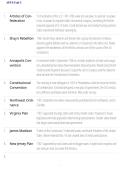
1. Articles of Con- 1st Constitution of the U.S. 1781-1788, weak (no executive, no judicial, no power
federation to tax, no power to regulate trade) Unicameral congress, amending the Articles
required approval of al 13 states. Could declare war and conduct foreign policies.
States maintained individual sovereignty.
2. Shay's Rebellion 1786: Daniel Shays (veteran and farmer) led a group of protestors in Massa-
chusetts against debtors and tax collection. In response to the debt crisis. Made
apparent the weaknesses of the Articles and was one of the causes of the US
Constitution.
3. Annapolis Con- A convention held in September 1786 to consider problems of trade and naviga-
vention tion, attended by five states (New Hampshire, Massachusetts, Rhode Island, North
Carolina) and important because it issued the call to Congress and the states for
what became the Constitutional Convention.
4. Constitutional The meeting of state delegates in 1787 in Philadelphia called to revise the Articles
Convention of Confederation. It instead designed a new plan of government, the US Constitu-
tion. Jefferson and Adams were not there. Met under secrecy.
5. Northwest Ordi- 1787: Establishes line where slavery will be prohibited (In the northwest). Led to
nance Civil War.
6. Virginia Plan 1787: Supported my large states and not by smaller states. Proposed 2 house
legislature with state population determining representation. Smaller states feared
that larger states would dominate government.
7. James Madison "Father of the Constitution," Federalist leader, and fourth President of the United
States. Wrote Federalist No. 10 and created idea of checks and balances.
8. New Jersey Plan 1787: Supported by small states and not bigger states. Single house congress and
one vote per state (as under the Articles).
9.
1/7
, APUS Unit 3
APUS Unit 3
Study online at https://quizlet.com/_afqdfk
Connecticut 1787: Compromise of Virginia and New Jersey Plans. Created 2 house congress
Compromise consisting of the senate (2 member per state) and the House of Representatives
apportioned by population. Senators serve 6 years (appointed by legislature) and
Representatives serve 2 years (elected by people). Senate has equal representation
and the House is determined by population.
10. 3/5 Compromise 1787: Supported by South. Provided more representation for the south and stated
that 3/5 of a state's slave population will be counted for.
11. Legislative the lawmaking branch of government (Congress). This is the Senate and House of
Branch Rep. Senates= 6 years + Reps= 2 years
12. Executive Branch Branch of government that carries out laws (the president, vice president, and the
Cabinet)
13. Judicial Branch Branch of government that interprets the laws (Supreme Court and other courts)
14. Federalists Supported strong national/federal government. Strict constructionists. (Hamilton,
Washington, John Adams, Madison)
15. Anti-Federalists In favor of weaker national government and more power on the state level. Loose
constructionists. Wanted inclusion of Bill of Rights. Wanted to achieve the common
good of the people. (Jefferson, Samuel Adams, James Monroe, Patrick Henry)
16. Federalist #10 1787: Written by James Madison. Discusses advantages of ratifying the consti-
tution, idea of opposing factions controlling each other and that they are less
dangerous in a national government, introduces idea of checks and balances.
17. Ratification the action of signing or giving formal consent to a treaty, contract, or agreement,
making it officially valid.
18. Separation and Constitutional division of powers among the legislative, executive, and judicial
Powers + Checks branches, with the legislative branch making law, the executive applying and
and Balances enforcing the law, and the judiciary interpreting the law. + Prevents one branch
2/7
APUS Unit 3
Study online at https://quizlet.com/_afqdfk
1. Articles of Con- 1st Constitution of the U.S. 1781-1788, weak (no executive, no judicial, no power
federation to tax, no power to regulate trade) Unicameral congress, amending the Articles
required approval of al 13 states. Could declare war and conduct foreign policies.
States maintained individual sovereignty.
2. Shay's Rebellion 1786: Daniel Shays (veteran and farmer) led a group of protestors in Massa-
chusetts against debtors and tax collection. In response to the debt crisis. Made
apparent the weaknesses of the Articles and was one of the causes of the US
Constitution.
3. Annapolis Con- A convention held in September 1786 to consider problems of trade and naviga-
vention tion, attended by five states (New Hampshire, Massachusetts, Rhode Island, North
Carolina) and important because it issued the call to Congress and the states for
what became the Constitutional Convention.
4. Constitutional The meeting of state delegates in 1787 in Philadelphia called to revise the Articles
Convention of Confederation. It instead designed a new plan of government, the US Constitu-
tion. Jefferson and Adams were not there. Met under secrecy.
5. Northwest Ordi- 1787: Establishes line where slavery will be prohibited (In the northwest). Led to
nance Civil War.
6. Virginia Plan 1787: Supported my large states and not by smaller states. Proposed 2 house
legislature with state population determining representation. Smaller states feared
that larger states would dominate government.
7. James Madison "Father of the Constitution," Federalist leader, and fourth President of the United
States. Wrote Federalist No. 10 and created idea of checks and balances.
8. New Jersey Plan 1787: Supported by small states and not bigger states. Single house congress and
one vote per state (as under the Articles).
9.
1/7
, APUS Unit 3
APUS Unit 3
Study online at https://quizlet.com/_afqdfk
Connecticut 1787: Compromise of Virginia and New Jersey Plans. Created 2 house congress
Compromise consisting of the senate (2 member per state) and the House of Representatives
apportioned by population. Senators serve 6 years (appointed by legislature) and
Representatives serve 2 years (elected by people). Senate has equal representation
and the House is determined by population.
10. 3/5 Compromise 1787: Supported by South. Provided more representation for the south and stated
that 3/5 of a state's slave population will be counted for.
11. Legislative the lawmaking branch of government (Congress). This is the Senate and House of
Branch Rep. Senates= 6 years + Reps= 2 years
12. Executive Branch Branch of government that carries out laws (the president, vice president, and the
Cabinet)
13. Judicial Branch Branch of government that interprets the laws (Supreme Court and other courts)
14. Federalists Supported strong national/federal government. Strict constructionists. (Hamilton,
Washington, John Adams, Madison)
15. Anti-Federalists In favor of weaker national government and more power on the state level. Loose
constructionists. Wanted inclusion of Bill of Rights. Wanted to achieve the common
good of the people. (Jefferson, Samuel Adams, James Monroe, Patrick Henry)
16. Federalist #10 1787: Written by James Madison. Discusses advantages of ratifying the consti-
tution, idea of opposing factions controlling each other and that they are less
dangerous in a national government, introduces idea of checks and balances.
17. Ratification the action of signing or giving formal consent to a treaty, contract, or agreement,
making it officially valid.
18. Separation and Constitutional division of powers among the legislative, executive, and judicial
Powers + Checks branches, with the legislative branch making law, the executive applying and
and Balances enforcing the law, and the judiciary interpreting the law. + Prevents one branch
2/7


