

Written by students who passed Immediately available after payment Read online or as PDF Wrong document? Swap it for free 4.6 TrustPilot
logo-home
Document preview thumbnail
Preview 4 out of 31 pages
Exam (elaborations)

NSG 533 Exam 3 2026/2027 – 130+ Questions & Verified Answers | Heart Failure, CAD, Hypertension, Dementia, Pediatrics & Obesity | Wilkes University

Document preview thumbnail
Preview 4 out of 31 pages

The NSG 533 Exam 3 2026/2027 Advanced Pharmacology Guide is a comprehensive 31-page study resource with 130+ questions and verified answers designed around major cardiovascular, neurologic, pediatric, and metabolic concepts covered in NSG 533 at Wilkes University. The material emphasizes clinically relevant pathophysiology and pharmacology, including heart failure, coronary artery disease (CAD), atherosclerosis, acute coronary syndromes, hypertension, dementia, delirium, pediatric gastrointestinal and genitourinary disorders, lead toxicity, obesity, adipose physiology, and cardiovascular hemodynamics. The uploaded document identifies itself as a Grade A, 100% correct guide with verified solutions for the 2026/2027 course update. A major section concentrates on heart failure pathophysiology and pharmacologic targets. It reviews the universal stages of heart failure, HFrEF versus HFpEF, systolic and diastolic dysfunction, ejection fraction, inotropy and lusitropy, right- versus left-sided heart failure manifestations, ventricular remodeling, and compensatory mechanisms involving the Frank-Starling response, sympathetic nervous system, and renin-angiotensin-aldosterone system. Medication-related concepts include beta blockers, ACE inhibitors, inotropes, RAAS inhibition, neprilysin and ARNI therapy, alongside the roles of angiotensin II, aldosterone, catecholamines, natriuretic peptides, bradykinin, nitric oxide, and endothelin. The cardiovascular content extends into coronary artery disease and atherosclerosis, covering dyslipidemia, LDL and HDL function, familial hypercholesterolemia, modifiable and nonmodifiable CAD risk factors, novel cardiovascular risk markers, endothelial dysfunction, foam-cell and fatty-streak formation, fibrous and occlusive plaque development, unstable plaques, thrombosis, and plaque rupture. Students also review stable and unstable angina, NSTEMI, STEMI, myocardial infarction biomarkers, ECG changes, and complications of myocardial infarction, providing an integrated review of cardiovascular disease progression from endothelial injury through acute coronary syndromes. The hypertension section addresses primary, secondary, and isolated systolic hypertension, medications that may contribute to elevated vascular resistance or cardiac output, major risk factors, blood-pressure categories, and mechanisms involving neurohumoral dysfunction, inflammation, insulin resistance, sodium handling, RAAS activity, sympathetic nervous system activity, and peripheral vascular resistance. The material also reviews proper blood-pressure assessment and target-organ consequences involving the heart, brain, kidneys, and eyes. Neurologic material differentiates dementia and delirium, including irreversible dementia categories, Alzheimer’s disease, Lewy body dementia, frontotemporal dementia, progressive cognitive decline, acute changes in attention and awareness, DSM-V delirium criteria, neurotransmitter-altering medications, and the roles of microglia, astrocytes, and oligodendrocytes. This makes the guide particularly useful for distinguishing gradual neurocognitive decline from acute fluctuating cognitive disturbances. The pediatric section covers intussusception, infantile hypertrophic pyloric stenosis, vesicoureteral reflux, and lead poisoning. Questions review age groups, risk factors, characteristic clinical presentations, diagnostic imaging, complications, blood lead levels, and organ systems affected by lead exposure. For example, the material associates intussusception with severe abdominal pain and currant-jelly stool, while pyloric stenosis is reviewed through non-bilious postprandial vomiting, an olive-sized abdominal mass, dehydration, and metabolic alkalosis. The final portion provides a detailed review of obesity and metabolic physiology, including white, brown, beige, and bone-marrow adipose tissue; leptin and adiponectin; adipokines; positive energy balance; obesogens; leptin resistance; orexigenic and anorexigenic mechanisms; and age-associated anorexia. Cardiovascular fundamentals are reinforced through calculations and concepts involving cardiac output, preload, afterload, myocardial contractility, inotropes, vascular compliance, peripheral resistance, and systolic and diastolic blood pressure. Relevant students: Wilkes University NSG 533 students, Advanced Pharmacology students, Family Nurse Practitioner students, Adult-Gerontology Nurse Practitioner students, Psychiatric Mental Health Nurse Practitioner students where applicable, MSN and graduate nursing students, APRN students, and nursing students reviewing cardiovascular pharmacology, pathophysiology, pediatric disorders, neurologic disorders, and metabolic disease for Exam 3. Keywords NSG 533 Exam 3, NSG 533 exam questions, NSG 533 Exam 3 2026, NSG 533 Exam 3 2027, NSG 533 questions and answers, NSG 533 verified answers, Wilkes University NSG 533, advanced pharmacology exam, advanced pharmacology study guide, pharmacology questions and answers, heart failure pharmacology, HFrEF, HFpEF, heart failure pathophysiology, RAAS, beta blockers, ACE inhibitors, neprilysin inhibitors, natriuretic peptides, coronary artery disease, CAD risk factors, atherosclerosis, dyslipidemia, LDL cholesterol, HDL cholesterol, acute coronary syndrome, stable angina, unstable angina, STEMI, NSTEMI, myocardial infarction, hypertension pathophysiology, hypertension pharmacology, blood pressure categories, dementia, delirium, Alzheimer disease, Lewy body dementia, intussusception, pyloric stenosis, vesicoureteral reflux, lead poisoning, obesity pathophysiology, adipose tissue, leptin resistance, adiponectin, cardiac output, preload, afterload, myocardial contractility, vascular compliance, FNP pharmacology, nurse practitioner pharmacology, graduate nursing exam, Exam 3 study guide

Content preview

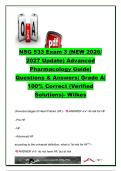
NSG 533 Exam 3 (NEW 2026/
2027 Update) Advanced
Pharmacology Guide|
Questions & Answers| Grade A|
100% Correct (Verified
Solutions)- Wilkes

Universal stages of Heart Failure (HF) - ANSWER ✔✔- At-risk for HF


- Pre HF

- HF

- Advanced HF

according to the universal definition, what is "at-risk for HF"? -

ANSWER ✔✔- do not have HF, but at risk

,- no current or prior s/s

- no structural, functional, or biomarker evidence supporting HF


according to the universal definition, what is "HF" - ANSWER ✔✔-

clinical syndrome

- current or prior s/s of HF

- caused by structural of functional cardiac abnormality

- elevated natriuretic peptide levels

- evidence of pulmonary or systemic congestion


who is most at risk for HF - ANSWER ✔✔black males and females;

older women


two biggest causes of HF - ANSWER ✔✔1. ischemic heart disease

(CAD)

2. HTN


calculate EF - ANSWER ✔✔SV/LVEDV


synonym for inotropy - ANSWER ✔✔contraction (HFrEF)


synonym for lusitropy - ANSWER ✔✔relaxation (HFpEF)

,two organizations for classification of HF - ANSWER ✔✔1. American

Heart Assocation (A,B,C,D) - based on structure

2. New York Heart Association (None, I, I, II, III, IV, V) - based on

physical activity limitations


how to distinguish cardiac dysfunction versus cardiac HF - ANSWER

✔✔cardiac dysfunction has structural abnormalities w/o symptoms


once a patient develops symptoms along with structural abnormalities,

they have HF


compensatory mechanisms for HF - ANSWER ✔✔1. Hemodynamics

(Frank Starling Law) - can give inotropes as short term use to increase

contractility (long-term can cause mortality)


2. SNS activation (increase contractility, tachycardia, vasoconstriction)


3. RAAS activation (angiotensin II binds to AT 1 Receptor -

vasoconstriction)


two types of angiotensin II - ANSWER ✔✔1. circulating

3
COPYRIGHT©JOSHCLAY 2025/2026. YEAR PUBLISHED 2026. COMPANY REGISTRATION NUMBER: 619652435. TERMS OF USE. PRIVACY
STATEMENT. ALL RIGHTS RESERVED

, 2. tissue-derived


effects of circulating angiotensin II on HF - ANSWER ✔✔- causes

vasoconstriction

- increases secretion of ADH

- increase aldosterone secretion

- increases sodium reabsorption


are aldosterone levels high or low in HF? - ANSWER ✔✔20x higher

than normal


effects of aldosterone on HF - ANSWER ✔✔- increases sodium and

water reabsorption

- decreased potassium and magnesium

- decreased baroreceptor reflex

- sympathetic activation

list the comprehensive risk factors of Coronary Artery Disease -

ANSWER ✔✔- dyslipidemia


- genetic studies

- modifiable risk factors

- non-modifiable risk factors

Document information

Uploaded on
August 20, 2026
Number of pages
31
Written in
2026/2027
Type
Exam (elaborations)
Contains
Questions & answers
$18.99

Wrong document? Swap it for free Within 14 days of purchase and before downloading, you can choose a different document. You can simply spend the amount again.
Written by students who passed
Immediately available after payment
Read online or as PDF

Seller avatar
Reputation scores are based on the amount of documents a seller has sold for a fee and the reviews they have received for those documents. There are three levels: Bronze, Silver and Gold. The better the reputation, the more your can rely on the quality of the sellers work.
JOSHCLAY
3.5
(83)
Sold
390
Followers
16
Items
20497
Last sold
1 day ago


Why students choose Stuvia

Created by fellow students, verified by reviews

Quality you can trust: written by students who passed their tests and reviewed by others who've used these notes.

Didn't get what you expected? Choose another document

No worries! You can instantly pick a different document that better fits what you're looking for.

Pay as you like, start learning right away

No subscription, no commitments. Pay the way you're used to via credit card and download your PDF document instantly.

Student with book image

“Bought, downloaded, and aced it. It really can be that simple.”

Alisha Student

Working on your references?

Create accurate citations in APA, MLA and Harvard with our free citation generator.

Working on your references?

Frequently asked questions

