
Oral Pathology Exam
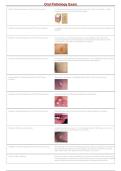
Bulla ( Clinical Appearance of Soft Tissue Lesions) A circumscribed,elevated lesion that is more than 5mm in diameter, usually
contains serous fluid and looks like a blister.
Lobule ( Clinical Appearance of Soft Tissue Lesions) A segment or lobe that is part of the whole; these lobes sometimes appear fused
together.
Macule ( Clinical Appearance of Soft Tissue Lesions) An area that is usually distinguished by a color different from that of the
surrounding tissue; it is flat and does not protrude above the surface of the
normal tissue. A freckle is an example of a macule.
Papule ( Clinical Appearance of Soft Tissue Lesions) A small circumscribed lesion usually less than 1 cm in diameter that is elevated
or protrudes above the surface of normal surrounding tissue.
pedunculated ( Clinical Appearance of Soft Tissue attached by a stemlike or stalklike base similar to that of a mushroom
Lesions)
pustules ( Clinical Appearance of Soft Tissue Lesions) Variously sized circumscribed elevations containing pus.
Sessile ( Clinical Appearance of Soft Tissue Lesions) Describing the base of a lesion that is flat or broad instead of stemlike.
Nodule ( soft tissue consistency) A palpable solid lesion up to 1 cm in diameter found in soft tissue; it can occur
above, level with, or beneath the skin surface.
Palpation ( Clinical Appearance of Soft Tissue Lesions) The evaluation of a lesion by feeling it with the fingers to determine the texture of
the area; the descriptive terms for palpation are soft, firm, semifirm, and fluid
filled; these terms also describe the consistency of a lesion.
Colors ( color of lesion) Red, pink, salmon, white, blue-black, gray, brown, and blck are the words used
most frequently to describe the colors of oral lesions; they can be used to identify
specific lesions and may also be incorporated into general descriptions.
Bulla ( Clinical Appearance of Soft Tissue Lesions) A circumscribed,elevated lesion that is more than 5mm in diameter, usually
contains serous fluid and looks like a blister.
Lobule ( Clinical Appearance of Soft Tissue Lesions) A segment or lobe that is part of the whole; these lobes sometimes appear fused
together.
Macule ( Clinical Appearance of Soft Tissue Lesions) An area that is usually distinguished by a color different from that of the
surrounding tissue; it is flat and does not protrude above the surface of the
normal tissue. A freckle is an example of a macule.
Papule ( Clinical Appearance of Soft Tissue Lesions) A small circumscribed lesion usually less than 1 cm in diameter that is elevated
or protrudes above the surface of normal surrounding tissue.
pedunculated ( Clinical Appearance of Soft Tissue attached by a stemlike or stalklike base similar to that of a mushroom
Lesions)
pustules ( Clinical Appearance of Soft Tissue Lesions) Variously sized circumscribed elevations containing pus.
Sessile ( Clinical Appearance of Soft Tissue Lesions) Describing the base of a lesion that is flat or broad instead of stemlike.
Nodule ( soft tissue consistency) A palpable solid lesion up to 1 cm in diameter found in soft tissue; it can occur
above, level with, or beneath the skin surface.
Palpation ( Clinical Appearance of Soft Tissue Lesions) The evaluation of a lesion by feeling it with the fingers to determine the texture of
the area; the descriptive terms for palpation are soft, firm, semifirm, and fluid
filled; these terms also describe the consistency of a lesion.
Colors ( color of lesion) Red, pink, salmon, white, blue-black, gray, brown, and blck are the words used
most frequently to describe the colors of oral lesions; they can be used to identify
specific lesions and may also be incorporated into general descriptions.


