

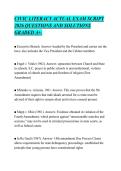
CIVIC LITERACY ACTUAL EXAM SCRIPT
2026 QUESTIONS AND SOLUTIONS
GRADED A+.
■ Executive Branch. Answer- headed by the President and carries out the
laws; also includes the Vice President and the Cabinet members
■ Engel v. Vitale (1962). Answer- separation between Church and State
in schools. S.C. prayer in public schools is unconstitutional, violates
separation of church and state and freedom of religion (First
Amendment)
■ Miranda vs. Arizona, 1961. Answer- This case proves that the 5th
Amendment requires that individuals arrested for a crime must be
advised of their right to remain silent and to have counsel present.
■ Mapp v. Ohio (1961). Answer- Evidence obtained in violation of the
Fourth Amendment, which protects against "unreasonable searches and
seizures," may not be used in criminal prosecutions in state courts, as
well as federal courts.
■ In Re Gault (1967). Answer- 14th amendment Due Process Clause
allows requirements for state delinquency proceedings. established the
principle that young persons have constitutional rights
,■ Bill. Answer- a statute in draft before it becomes law
■ Chief Justice. Answer- the judge who presides over the supreme court
■ Commander-in-Chief. Answer- The role of the president as the
supreme commander of the armed forces of the United States.
■ Governor. Answer- highest ranking member of a state's executive
branch
■ Reserved powers. Answer- powers reserved for the states; examples:
creating and maintaining an education system, creating local
governments
■ Veto power. Answer- presidential power to stop a bill from becoming a
law by rejecting it
■ impeachment. Answer- a formal document charging a public official
with misconduct in office
■ presidential succession. Answer- the order in which officials fill the
office of president in case of a vacancy-1. Vice President, 2. Speaker of
the House of Representatives, 3. President of the Senate Pro Tempore, ...
, ■ U.S. Supreme Court. Answer- 9 justices nominated by President,
confirmed by Senate; highest court in the nation; hears only appeals;
interprets Constitutional law
■ Intolerable Acts/Coercive Acts. Answer- A series of acts passed by the
government in response to the Boston Tea Party. They caused outrage, as
the colonists viewed the acts as a violation of their rights. This led to the
creation of the First Continental Congress and the Revolutionary War.
■ Boston Tea Party. Answer- demonstration (1773) by citizens of Boston
who raided three British ships in Boston harbor and dumped hundreds of
chests of tea into the harbor; organized as a protest against taxes on tea.
■ Amendment 9. Answer- People's rights are not limited to those in the
Constitution.
■ Amendment 10. Answer- Amendment that states some powers
reserved to the states
■ Amendment 11. Answer- Amendment that states cases in which a state
was sued without the consent from jurisdiction of federal government
must be removed
2026 QUESTIONS AND SOLUTIONS
GRADED A+.
■ Executive Branch. Answer- headed by the President and carries out the
laws; also includes the Vice President and the Cabinet members
■ Engel v. Vitale (1962). Answer- separation between Church and State
in schools. S.C. prayer in public schools is unconstitutional, violates
separation of church and state and freedom of religion (First
Amendment)
■ Miranda vs. Arizona, 1961. Answer- This case proves that the 5th
Amendment requires that individuals arrested for a crime must be
advised of their right to remain silent and to have counsel present.
■ Mapp v. Ohio (1961). Answer- Evidence obtained in violation of the
Fourth Amendment, which protects against "unreasonable searches and
seizures," may not be used in criminal prosecutions in state courts, as
well as federal courts.
■ In Re Gault (1967). Answer- 14th amendment Due Process Clause
allows requirements for state delinquency proceedings. established the
principle that young persons have constitutional rights
,■ Bill. Answer- a statute in draft before it becomes law
■ Chief Justice. Answer- the judge who presides over the supreme court
■ Commander-in-Chief. Answer- The role of the president as the
supreme commander of the armed forces of the United States.
■ Governor. Answer- highest ranking member of a state's executive
branch
■ Reserved powers. Answer- powers reserved for the states; examples:
creating and maintaining an education system, creating local
governments
■ Veto power. Answer- presidential power to stop a bill from becoming a
law by rejecting it
■ impeachment. Answer- a formal document charging a public official
with misconduct in office
■ presidential succession. Answer- the order in which officials fill the
office of president in case of a vacancy-1. Vice President, 2. Speaker of
the House of Representatives, 3. President of the Senate Pro Tempore, ...
, ■ U.S. Supreme Court. Answer- 9 justices nominated by President,
confirmed by Senate; highest court in the nation; hears only appeals;
interprets Constitutional law
■ Intolerable Acts/Coercive Acts. Answer- A series of acts passed by the
government in response to the Boston Tea Party. They caused outrage, as
the colonists viewed the acts as a violation of their rights. This led to the
creation of the First Continental Congress and the Revolutionary War.
■ Boston Tea Party. Answer- demonstration (1773) by citizens of Boston
who raided three British ships in Boston harbor and dumped hundreds of
chests of tea into the harbor; organized as a protest against taxes on tea.
■ Amendment 9. Answer- People's rights are not limited to those in the
Constitution.
■ Amendment 10. Answer- Amendment that states some powers
reserved to the states
■ Amendment 11. Answer- Amendment that states cases in which a state
was sued without the consent from jurisdiction of federal government
must be removed


