PGDL STUDY GUIDE
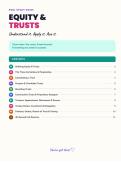
EQUITY &
TRUSTS
Understand it. Apply it. Ace it.
Clear notes. Key cases. Exam focused.
Everything you need to succeed.
CONTENTS
01 Defining Equity & Trusts 2
02 The Three Certainties & Perpetuities 3
03 Constituting a Trust 4
04 Purpose & Charitable Trusts 5
05 Resulting Trusts 6
06 Constructive Trusts & Proprietary Estoppel 7
07 Trustees: Appointment, Retirement & Powers 8
08 Trustee Duties, Investment & Delegation 9
09 Fiduciary Duties, Breach of Trust & Tracing 10
★ 30-Second Full Revision 11
You've got this! ♡
, 01 DEFINING EQUITY & TRUSTS
A trust is a binding obligation on a trustee to hold property for the benefit of a beneficiary (or a lawful purpose). It separates control
(legal title) from enjoyment (equitable/beneficial title).
TRUSTEE — LEGAL TITLE BENEFICIARY — EQUITABLE TITLE
Manages the property, but must act for the beneficiary's benefit — Has a personal right against the trustee AND a proprietary right in the
indirect enjoyment only. property — binds everyone except a bona fide purchaser for value
without notice.
TYPES OF TRUST
Fixed trust — beneficiaries' shares are fixed by the trust terms; trustees have no discretion (e.g. life interest + remainder).
Discretionary trust — trustees decide who benefits and by how much; until exercised, potential recipients are 'objects', not beneficiaries.
Bare trust — sole adult beneficiary with full capacity; can end the trust and demand the property any time (Saunders v Vautier).
BENEFICIAL INTERESTS — 3 SPECTRUMS
Vested/contingent — unconditional now, or dependent on a future event? In possession/in remainder — enjoy now, or after another interest ends?
Absolute/limited — income + capital, or income only? A beneficiary who is vested, in possession, and unlimited is absolutely entitled.
2
EQUITY &
TRUSTS
Understand it. Apply it. Ace it.
Clear notes. Key cases. Exam focused.
Everything you need to succeed.
CONTENTS
01 Defining Equity & Trusts 2
02 The Three Certainties & Perpetuities 3
03 Constituting a Trust 4
04 Purpose & Charitable Trusts 5
05 Resulting Trusts 6
06 Constructive Trusts & Proprietary Estoppel 7
07 Trustees: Appointment, Retirement & Powers 8
08 Trustee Duties, Investment & Delegation 9
09 Fiduciary Duties, Breach of Trust & Tracing 10
★ 30-Second Full Revision 11
You've got this! ♡
, 01 DEFINING EQUITY & TRUSTS
A trust is a binding obligation on a trustee to hold property for the benefit of a beneficiary (or a lawful purpose). It separates control
(legal title) from enjoyment (equitable/beneficial title).
TRUSTEE — LEGAL TITLE BENEFICIARY — EQUITABLE TITLE
Manages the property, but must act for the beneficiary's benefit — Has a personal right against the trustee AND a proprietary right in the
indirect enjoyment only. property — binds everyone except a bona fide purchaser for value
without notice.
TYPES OF TRUST
Fixed trust — beneficiaries' shares are fixed by the trust terms; trustees have no discretion (e.g. life interest + remainder).
Discretionary trust — trustees decide who benefits and by how much; until exercised, potential recipients are 'objects', not beneficiaries.
Bare trust — sole adult beneficiary with full capacity; can end the trust and demand the property any time (Saunders v Vautier).
BENEFICIAL INTERESTS — 3 SPECTRUMS
Vested/contingent — unconditional now, or dependent on a future event? In possession/in remainder — enjoy now, or after another interest ends?
Absolute/limited — income + capital, or income only? A beneficiary who is vested, in possession, and unlimited is absolutely entitled.
2