

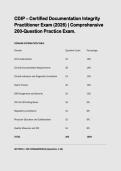
CDIP – Certified Documentation Integrity
Practitioner Exam (2026) | Comprehensive
200-Question Practice Exam.
DOMAIN DISTRIBUTION TABLE
Domain Question Count Percentage
CDI Fundamentals 32 16%
Clinical Documentation Requirements 28 14%
Clinical Indicators and Diagnostic Correlation 24 12%
Query Process 26 13%
DRG Assignment and Severity 24 12%
ICD-10-CM Coding Basics 18 9%
Regulatory Compliance 16 8%
Physician Education and Collaboration 16 8%
Quality Measures and CDI 16 8%
TOTAL 200 100%
SECTION 1: CDI FUNDAMENTALS (Questions 1-32)
,Q1: What is the primary purpose of a Clinical Documentation Improvement (CDI) program?
A. To increase hospital reimbursement through aggressive coding practices
B. To ensure complete, accurate, and compliant clinical documentation that reflects patient
severity of illness and risk of mortality
C. To replace the coding department's responsibilities
D. To document all physician errors for quality improvement purposes
Correct Answer: B
Rationale: The primary purpose of CDI is to improve clinical documentation accuracy and
completeness to accurately reflect patient severity of illness (SOI), risk of mortality (ROM), and
ensure compliant coding and reimbursement. AHIMA defines CDI as a process to improve
healthcare documentation to support quality care and accurate coding.
Q2: Which of the following is the MOST accurate definition of a CDI specialist's role?
A. A coder who reviews charts for missed diagnoses
B. A healthcare professional who performs concurrent and retrospective medical record reviews
to identify documentation gaps and facilitate accurate documentation
C. A physician who corrects all documentation errors
D. An auditor who identifies fraudulent billing practices
Correct Answer: B
Rationale: The CDI specialist conducts both concurrent (during the patient stay) and
retrospective reviews to identify documentation deficiencies, facilitate clarification through
compliant querying, and ensure documentation accurately supports the clinical picture. This is a
core function established in AHIMA's CDI practice standards.
Q3: Which key performance indicator (KPI) measures the percentage of records reviewed that
require at least one query?
A. Agreement rate
B. Query rate
C. DRG capture rate
D. Physician response rate
Correct Answer: B
Rationale: Query rate specifically measures the percentage of records reviewed that result in at
least one query being issued. This metric helps CDI programs understand documentation
improvement needs and track program effectiveness over time.
,Q4: What does the Case Mix Index (CMI) represent in a healthcare organization?
A. Total number of patients treated annually
B. Average hospital-acquired condition rate
C. Average relative weight of all DRGs assigned, reflecting patient acuity and resource utilization
D. Percentage of Medicare patients in the facility
Correct Answer: C
Rationale: CMI is calculated by summing the relative weights of all DRGs assigned and dividing
by the total number of cases. It serves as a measure of patient complexity and resource
intensity, and is a key metric for CDI program success.
Q5: What is a CDI program's "agreement rate"?
A. The percentage of CDI recommendations accepted by physicians
B. The percentage of queries answered by physicians
C. The rate at which CDI specialists agree with coding assignments
D. The rate of physician satisfaction with CDI services
Correct Answer: A
Rationale: Agreement rate measures the percentage of CDI recommendations that are accepted
and documented by physicians. This KPI demonstrates physician engagement and the
effectiveness of the CDI program's collaborative efforts.
Q6: Which of the following BEST describes concurrent CDI review?
A. Review performed after the patient is discharged
B. Review performed during the patient's hospitalization while care is ongoing
C. Review performed for quality reporting purposes only
D. Review performed exclusively for Medicare patients
Correct Answer: B
Rationale: Concurrent review occurs while the patient is still hospitalized, allowing CDI
specialists to identify documentation gaps in real-time and facilitate immediate clarification,
potentially affecting treatment decisions and DRG assignment.
Q7: Which of the following is NOT a typical goal of a CDI program?
A. Accurate reflection of severity of illness
B. Appropriate reimbursement for services provided
C. Maximizing physician productivity by correcting their documentation
D. Improved clinical communication and patient safety
, Correct Answer: C
Rationale: While CDI programs aim to improve documentation quality, they do not exist to
"correct" physician documentation or maximize physician productivity. The goals include
accurate severity reflection, appropriate reimbursement, compliance, and improved patient
care.
Q8: What does ROI (Return on Investment) measure in a CDI program?
A. Rate of infection outcomes
B. Financial benefit derived from CDI activities compared to program costs
C. Rate of improvement in documentation quality
D. Risk of illness for the patient population
Correct Answer: B
Rationale: CDI program ROI measures the financial return generated by documentation
improvements (such as appropriate DRG assignment and reduced denials) compared to the cost
of operating the CDI program. AHIMA guidance supports tracking ROI as a program
effectiveness measure.
Q9: Which of the following is an example of a hospital-acquired condition (HAC)?
A. Congestive heart failure
B. Stage 3 pressure injury acquired during hospitalization
C. Diabetes mellitus with complications
D. Chronic obstructive pulmonary disease
Correct Answer: B
Rationale: Hospital-acquired conditions are conditions that develop during the hospitalization
and were not present on admission. A stage 3 pressure injury acquired during the stay qualifies
as a HAC under CMS guidelines.
Q10: What is the role of the Present on Admission (POA) indicator in CDI?
A. It determines the primary diagnosis
B. It indicates whether a condition was present at the time of inpatient admission, affecting DRG
assignment and reimbursement
C. It identifies the patient's admission source
D. It determines the patient's length of stay
Correct Answer: B
Rationale: The POA indicator identifies whether a diagnosis was present at the time of inpatient
Practitioner Exam (2026) | Comprehensive
200-Question Practice Exam.
DOMAIN DISTRIBUTION TABLE
Domain Question Count Percentage
CDI Fundamentals 32 16%
Clinical Documentation Requirements 28 14%
Clinical Indicators and Diagnostic Correlation 24 12%
Query Process 26 13%
DRG Assignment and Severity 24 12%
ICD-10-CM Coding Basics 18 9%
Regulatory Compliance 16 8%
Physician Education and Collaboration 16 8%
Quality Measures and CDI 16 8%
TOTAL 200 100%
SECTION 1: CDI FUNDAMENTALS (Questions 1-32)
,Q1: What is the primary purpose of a Clinical Documentation Improvement (CDI) program?
A. To increase hospital reimbursement through aggressive coding practices
B. To ensure complete, accurate, and compliant clinical documentation that reflects patient
severity of illness and risk of mortality
C. To replace the coding department's responsibilities
D. To document all physician errors for quality improvement purposes
Correct Answer: B
Rationale: The primary purpose of CDI is to improve clinical documentation accuracy and
completeness to accurately reflect patient severity of illness (SOI), risk of mortality (ROM), and
ensure compliant coding and reimbursement. AHIMA defines CDI as a process to improve
healthcare documentation to support quality care and accurate coding.
Q2: Which of the following is the MOST accurate definition of a CDI specialist's role?
A. A coder who reviews charts for missed diagnoses
B. A healthcare professional who performs concurrent and retrospective medical record reviews
to identify documentation gaps and facilitate accurate documentation
C. A physician who corrects all documentation errors
D. An auditor who identifies fraudulent billing practices
Correct Answer: B
Rationale: The CDI specialist conducts both concurrent (during the patient stay) and
retrospective reviews to identify documentation deficiencies, facilitate clarification through
compliant querying, and ensure documentation accurately supports the clinical picture. This is a
core function established in AHIMA's CDI practice standards.
Q3: Which key performance indicator (KPI) measures the percentage of records reviewed that
require at least one query?
A. Agreement rate
B. Query rate
C. DRG capture rate
D. Physician response rate
Correct Answer: B
Rationale: Query rate specifically measures the percentage of records reviewed that result in at
least one query being issued. This metric helps CDI programs understand documentation
improvement needs and track program effectiveness over time.
,Q4: What does the Case Mix Index (CMI) represent in a healthcare organization?
A. Total number of patients treated annually
B. Average hospital-acquired condition rate
C. Average relative weight of all DRGs assigned, reflecting patient acuity and resource utilization
D. Percentage of Medicare patients in the facility
Correct Answer: C
Rationale: CMI is calculated by summing the relative weights of all DRGs assigned and dividing
by the total number of cases. It serves as a measure of patient complexity and resource
intensity, and is a key metric for CDI program success.
Q5: What is a CDI program's "agreement rate"?
A. The percentage of CDI recommendations accepted by physicians
B. The percentage of queries answered by physicians
C. The rate at which CDI specialists agree with coding assignments
D. The rate of physician satisfaction with CDI services
Correct Answer: A
Rationale: Agreement rate measures the percentage of CDI recommendations that are accepted
and documented by physicians. This KPI demonstrates physician engagement and the
effectiveness of the CDI program's collaborative efforts.
Q6: Which of the following BEST describes concurrent CDI review?
A. Review performed after the patient is discharged
B. Review performed during the patient's hospitalization while care is ongoing
C. Review performed for quality reporting purposes only
D. Review performed exclusively for Medicare patients
Correct Answer: B
Rationale: Concurrent review occurs while the patient is still hospitalized, allowing CDI
specialists to identify documentation gaps in real-time and facilitate immediate clarification,
potentially affecting treatment decisions and DRG assignment.
Q7: Which of the following is NOT a typical goal of a CDI program?
A. Accurate reflection of severity of illness
B. Appropriate reimbursement for services provided
C. Maximizing physician productivity by correcting their documentation
D. Improved clinical communication and patient safety
, Correct Answer: C
Rationale: While CDI programs aim to improve documentation quality, they do not exist to
"correct" physician documentation or maximize physician productivity. The goals include
accurate severity reflection, appropriate reimbursement, compliance, and improved patient
care.
Q8: What does ROI (Return on Investment) measure in a CDI program?
A. Rate of infection outcomes
B. Financial benefit derived from CDI activities compared to program costs
C. Rate of improvement in documentation quality
D. Risk of illness for the patient population
Correct Answer: B
Rationale: CDI program ROI measures the financial return generated by documentation
improvements (such as appropriate DRG assignment and reduced denials) compared to the cost
of operating the CDI program. AHIMA guidance supports tracking ROI as a program
effectiveness measure.
Q9: Which of the following is an example of a hospital-acquired condition (HAC)?
A. Congestive heart failure
B. Stage 3 pressure injury acquired during hospitalization
C. Diabetes mellitus with complications
D. Chronic obstructive pulmonary disease
Correct Answer: B
Rationale: Hospital-acquired conditions are conditions that develop during the hospitalization
and were not present on admission. A stage 3 pressure injury acquired during the stay qualifies
as a HAC under CMS guidelines.
Q10: What is the role of the Present on Admission (POA) indicator in CDI?
A. It determines the primary diagnosis
B. It indicates whether a condition was present at the time of inpatient admission, affecting DRG
assignment and reimbursement
C. It identifies the patient's admission source
D. It determines the patient's length of stay
Correct Answer: B
Rationale: The POA indicator identifies whether a diagnosis was present at the time of inpatient


