

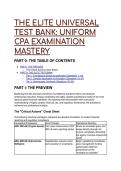
THE ELITE UNIVERSAL
TEST BANK: UNIFORM
CPA EXAMINATION
MASTERY
PART 0: THE TABLE OF CONTENTS
● PART I: THE PREVIEW
○ The Critical Axioms Cheat Sheet
● PART II: THE ELITE TEST BANK
○ Tier 1: Foundational Syntax & Application (Questions 1–18)
○ Tier 2: Complex Application & Simulation (Questions 19–37)
○ Tier 3: Grandmaster Synthesis (Questions 38–55)
PART I: THE PREVIEW
Mastering this elite test bank transforms foundational academic theory into absolute
professional execution, forging candidates into highly capable practitioners ready for the most
rigorous global financial standards. By replacing rote memorization with a structural
understanding of highly complex financial, tax, and regulatory frameworks, the practitioner
achieves true professional intuition.
The "Critical Axioms" Cheat Sheet
The following structural paradigms represent the absolute foundation of modern financial
reporting and regulatory compliance.
Conceptual Framework Core Principle Operational Directive
ASU 2023-08 (Crypto Assets) Fair value measurement (ASC Route all unrealized gains and
820) at every reporting period. losses directly through net
income, completely discarding
the legacy cost-less-impairment
model.
ASU 2025-06 (Internal-Use Capitalization requires intent Begin capitalizing immediately
Software) and resolution of uncertainty. upon management funding
authorization AND the
achievement of the
"probable-to-complete"
,Conceptual Framework Core Principle Operational Directive
threshold.
IRC Section 174A (OBBBA) Strict geographic bifurcation of Immediately deduct domestic
R&E tax treatments. R&E expenditures (post-2024);
strictly capitalize and amortize
foreign R&E over 15 years.
SECURE 2.0 Section 603 High-earner tax revenue Mandate Roth designation for
acceleration via forced after-tax age 50+ catch-up contributions
deferrals. if the participant's prior-year
FICA wages exceeded
$150,000.
SOC Reporting (AT-C 320) Validation of outsourced Rely exclusively on SOC 1
processes requires temporal Type 2 reports for internal
operating effectiveness. control over financial reporting
(ICFR), ensuring
Complementary User Entity
Controls (CUECs) are tested.
PART II: THE ELITE TEST BANK
Tier 1: Foundational Syntax & Application
Q1: An entity acquires Bitcoin for its corporate treasury. Based on the principles of ASU
2023-08, which measurement model is the MOST ACCURATE for subsequent reporting
periods? A) Historical cost less permanent impairment. B) Fair value with changes recorded in
Other Comprehensive Income (OCI). C) Fair value with changes in fair value recorded in net
income. D) Amortized cost tested annually for impairment.
● Answer: C (Fair value with changes in fair value recorded in net income)
● Distractor Analysis:
○ A is incorrect: Historical cost less impairment represents the outdated legacy model
that existed prior to the issuance of ASU 2023-08.
○ B is incorrect: Recording changes in OCI aligns with certain International Financial
Reporting Standards (IFRS) revaluation models, which fundamentally contradicts
US GAAP ASC 350-60 directives.
○ D is incorrect: Crypto assets constitute indefinite-lived intangibles; therefore,
amortization mechanics are strictly prohibited.
The Mentor's Analysis: The Financial Accounting Standards Board (FASB) explicitly eradicated
the one-way impairment model to better reflect the underlying economics of digital assets.
When facing the subsequent measurement of in-scope crypto, the immediate priority is fair
value remeasurement. By utilizing ASC 820 Fair Value principles, the practitioner bypasses the
common trap of ignoring unrealized market appreciation. Professional/Academic Intuition:
Always route crypto fair value fluctuations directly through net income.
Q2: A SaaS corporation develops new internal-use software utilizing an Agile methodology.
Based on the principles of ASU 2025-06, what is the FIRST mandatory trigger to begin
capitalizing development costs? A) The completion of the preliminary project stage. B) The
technological feasibility of the software is established via a working model. C) Management
authorization and funding, coupled with passing the probable-to-complete threshold. D) The
software is placed into production for end-users.
, ● Answer: C (Management authorization and funding, coupled with passing the
probable-to-complete threshold)
● Distractor Analysis:
○ A is incorrect: ASU 2025-06 intentionally eliminates the rigid, linear "project stage"
framework to accommodate modern iterative development.
○ B is incorrect: Technological feasibility strictly applies to external-use software
governed by ASC 985-20, not internal-use systems under ASC 350-40.
○ D is incorrect: Placing software into production marks the cessation of the
capitalization period, not the commencement.
The Mentor's Analysis: Modernizing internal software accounting requires focusing on economic
intent and risk reduction rather than artificial linear phases. When facing Agile development
cycles, the immediate priority is identifying management commitment and resolving significant
development uncertainty. By utilizing the probable-to-complete threshold, the entity bypasses
the common trap of stage-based capitalization delays. Professional/Academic Intuition:
Capitalization demands funded intent paired with the absence of significant development
uncertainty.
Q3: A multinational enterprise incurs both US-based and European-based research and
experimental (R&E) costs in 2025. Based on the principles of IRC Section 174A, which tax
treatment is MOST ACCURATE? A) Both domestic and foreign R&E must be amortized over 5
years. B) Both domestic and foreign R&E are immediately expensed. C) Domestic R&E is
immediately expensed; foreign R&E is amortized over 15 years. D) Domestic R&E is amortized
over 5 years; foreign R&E is amortized over 15 years.
● Answer: C (Domestic R&E is immediately expensed; foreign R&E is amortized over 15
years)
● Distractor Analysis:
○ A is incorrect: This reflects the historical requirement under the Tax Cuts and Jobs
Act (TCJA) prior to the One Big Beautiful Bill Act (OBBBA) amendments.
○ B is incorrect: Immediate expensing under Section 174A is strictly localized to
domestic R&E expenditures.
○ D is incorrect: This distracts by offering the expired TCJA treatment, failing to
account for the Section 174A permanent restoration of domestic expensing.
The Mentor's Analysis: The Internal Revenue Code rigorously separates R&E treatments based
entirely on geographic location to incentivize domestic labor. When facing mixed-team
development, the immediate priority is spatial allocation of costs. By utilizing Section 174A
exclusively for United States-based costs, the taxpayer bypasses the common trap of
over-capitalizing domestic expenditures. Professional/Academic Intuition: Domestic R&E
dictates immediate deduction; Foreign R&E dictates 15-year amortization.
Q4: A 52-year-old executive earned $185,000 in FICA wages in 2025 from their sponsoring
employer. Based on the principles of SECURE 2.0 Section 603, which action regarding their
2026 catch-up contribution is REQUIRED? A) The catch-up contribution must be made on a
pre-tax basis. B) The catch-up contribution must be deposited into a non-qualified deferred
compensation plan. C) The catch-up contribution must be designated as a Roth (after-tax)
contribution. D) The executive is prohibited from making any catch-up contributions.
● Answer: C (The catch-up contribution must be designated as a Roth (after-tax)
contribution)
● Distractor Analysis:
○ A is incorrect: High earners exceeding the $150,000 FICA threshold are explicitly
forbidden from utilizing pre-tax status for catch-up contributions starting in 2026.
TEST BANK: UNIFORM
CPA EXAMINATION
MASTERY
PART 0: THE TABLE OF CONTENTS
● PART I: THE PREVIEW
○ The Critical Axioms Cheat Sheet
● PART II: THE ELITE TEST BANK
○ Tier 1: Foundational Syntax & Application (Questions 1–18)
○ Tier 2: Complex Application & Simulation (Questions 19–37)
○ Tier 3: Grandmaster Synthesis (Questions 38–55)
PART I: THE PREVIEW
Mastering this elite test bank transforms foundational academic theory into absolute
professional execution, forging candidates into highly capable practitioners ready for the most
rigorous global financial standards. By replacing rote memorization with a structural
understanding of highly complex financial, tax, and regulatory frameworks, the practitioner
achieves true professional intuition.
The "Critical Axioms" Cheat Sheet
The following structural paradigms represent the absolute foundation of modern financial
reporting and regulatory compliance.
Conceptual Framework Core Principle Operational Directive
ASU 2023-08 (Crypto Assets) Fair value measurement (ASC Route all unrealized gains and
820) at every reporting period. losses directly through net
income, completely discarding
the legacy cost-less-impairment
model.
ASU 2025-06 (Internal-Use Capitalization requires intent Begin capitalizing immediately
Software) and resolution of uncertainty. upon management funding
authorization AND the
achievement of the
"probable-to-complete"
,Conceptual Framework Core Principle Operational Directive
threshold.
IRC Section 174A (OBBBA) Strict geographic bifurcation of Immediately deduct domestic
R&E tax treatments. R&E expenditures (post-2024);
strictly capitalize and amortize
foreign R&E over 15 years.
SECURE 2.0 Section 603 High-earner tax revenue Mandate Roth designation for
acceleration via forced after-tax age 50+ catch-up contributions
deferrals. if the participant's prior-year
FICA wages exceeded
$150,000.
SOC Reporting (AT-C 320) Validation of outsourced Rely exclusively on SOC 1
processes requires temporal Type 2 reports for internal
operating effectiveness. control over financial reporting
(ICFR), ensuring
Complementary User Entity
Controls (CUECs) are tested.
PART II: THE ELITE TEST BANK
Tier 1: Foundational Syntax & Application
Q1: An entity acquires Bitcoin for its corporate treasury. Based on the principles of ASU
2023-08, which measurement model is the MOST ACCURATE for subsequent reporting
periods? A) Historical cost less permanent impairment. B) Fair value with changes recorded in
Other Comprehensive Income (OCI). C) Fair value with changes in fair value recorded in net
income. D) Amortized cost tested annually for impairment.
● Answer: C (Fair value with changes in fair value recorded in net income)
● Distractor Analysis:
○ A is incorrect: Historical cost less impairment represents the outdated legacy model
that existed prior to the issuance of ASU 2023-08.
○ B is incorrect: Recording changes in OCI aligns with certain International Financial
Reporting Standards (IFRS) revaluation models, which fundamentally contradicts
US GAAP ASC 350-60 directives.
○ D is incorrect: Crypto assets constitute indefinite-lived intangibles; therefore,
amortization mechanics are strictly prohibited.
The Mentor's Analysis: The Financial Accounting Standards Board (FASB) explicitly eradicated
the one-way impairment model to better reflect the underlying economics of digital assets.
When facing the subsequent measurement of in-scope crypto, the immediate priority is fair
value remeasurement. By utilizing ASC 820 Fair Value principles, the practitioner bypasses the
common trap of ignoring unrealized market appreciation. Professional/Academic Intuition:
Always route crypto fair value fluctuations directly through net income.
Q2: A SaaS corporation develops new internal-use software utilizing an Agile methodology.
Based on the principles of ASU 2025-06, what is the FIRST mandatory trigger to begin
capitalizing development costs? A) The completion of the preliminary project stage. B) The
technological feasibility of the software is established via a working model. C) Management
authorization and funding, coupled with passing the probable-to-complete threshold. D) The
software is placed into production for end-users.
, ● Answer: C (Management authorization and funding, coupled with passing the
probable-to-complete threshold)
● Distractor Analysis:
○ A is incorrect: ASU 2025-06 intentionally eliminates the rigid, linear "project stage"
framework to accommodate modern iterative development.
○ B is incorrect: Technological feasibility strictly applies to external-use software
governed by ASC 985-20, not internal-use systems under ASC 350-40.
○ D is incorrect: Placing software into production marks the cessation of the
capitalization period, not the commencement.
The Mentor's Analysis: Modernizing internal software accounting requires focusing on economic
intent and risk reduction rather than artificial linear phases. When facing Agile development
cycles, the immediate priority is identifying management commitment and resolving significant
development uncertainty. By utilizing the probable-to-complete threshold, the entity bypasses
the common trap of stage-based capitalization delays. Professional/Academic Intuition:
Capitalization demands funded intent paired with the absence of significant development
uncertainty.
Q3: A multinational enterprise incurs both US-based and European-based research and
experimental (R&E) costs in 2025. Based on the principles of IRC Section 174A, which tax
treatment is MOST ACCURATE? A) Both domestic and foreign R&E must be amortized over 5
years. B) Both domestic and foreign R&E are immediately expensed. C) Domestic R&E is
immediately expensed; foreign R&E is amortized over 15 years. D) Domestic R&E is amortized
over 5 years; foreign R&E is amortized over 15 years.
● Answer: C (Domestic R&E is immediately expensed; foreign R&E is amortized over 15
years)
● Distractor Analysis:
○ A is incorrect: This reflects the historical requirement under the Tax Cuts and Jobs
Act (TCJA) prior to the One Big Beautiful Bill Act (OBBBA) amendments.
○ B is incorrect: Immediate expensing under Section 174A is strictly localized to
domestic R&E expenditures.
○ D is incorrect: This distracts by offering the expired TCJA treatment, failing to
account for the Section 174A permanent restoration of domestic expensing.
The Mentor's Analysis: The Internal Revenue Code rigorously separates R&E treatments based
entirely on geographic location to incentivize domestic labor. When facing mixed-team
development, the immediate priority is spatial allocation of costs. By utilizing Section 174A
exclusively for United States-based costs, the taxpayer bypasses the common trap of
over-capitalizing domestic expenditures. Professional/Academic Intuition: Domestic R&E
dictates immediate deduction; Foreign R&E dictates 15-year amortization.
Q4: A 52-year-old executive earned $185,000 in FICA wages in 2025 from their sponsoring
employer. Based on the principles of SECURE 2.0 Section 603, which action regarding their
2026 catch-up contribution is REQUIRED? A) The catch-up contribution must be made on a
pre-tax basis. B) The catch-up contribution must be deposited into a non-qualified deferred
compensation plan. C) The catch-up contribution must be designated as a Roth (after-tax)
contribution. D) The executive is prohibited from making any catch-up contributions.
● Answer: C (The catch-up contribution must be designated as a Roth (after-tax)
contribution)
● Distractor Analysis:
○ A is incorrect: High earners exceeding the $150,000 FICA threshold are explicitly
forbidden from utilizing pre-tax status for catch-up contributions starting in 2026.


