

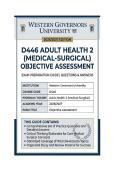
,WGU D446 Adult Health 2 (Medical-Surgical) Objective Assessment |
Questions & Answers 2026/2027
SECTION 1: CARDIOVASCULAR DISORDERS
**1.** A patient with acute decompensated heart failure (ADHF) presents
with dyspnea, orthopnea, and bilateral crackles auscultated to the
midscapular region. Which finding is most indicative of severe fluid overload
requiring immediate intervention?
A) Jugular venous distension at 45 degrees
B) Peripheral pitting edema +3 in lower extremities
C) Crackles audible to the midscapular region
D) Weight gain of 2 kg over 24 hours
**Correct Answer:** C) Crackles audible to the midscapular region
**Rationale:** Crackles extending to the midscapular region indicate severe
pulmonary edema and imminent respiratory compromise. While JVD,
peripheral edema, and weight gain are important signs of fluid overload,
they do not represent the same immediate life threat as extensive
pulmonary edema.
---
**2.** A patient receiving amiodarone for atrial fibrillation reports new bluish-
gray discoloration on the face. What is the nurse's most appropriate action?
A) Discontinue the medication immediately
B) Document the finding and continue to monitor
C) Notify the provider of this expected side effect
,D) Apply topical corticosteroids to the affected areas
**Correct Answer:** C) Notify the provider of this expected side effect
**Rationale:** Amiodarone can cause bluish-gray skin discoloration (slate-
gray syndrome) due to drug deposition in the skin. This is a known side
effect and not immediately dangerous, but it should be reported to the
provider for possible dose adjustment or alternative therapy. The medication
should not be abruptly discontinued without provider guidance.
---
**3.** A patient is admitted with suspected infective endocarditis. Which
assessment finding would most strongly support this diagnosis?
A) Fever and night sweats
B) New-onset murmur and splinter hemorrhages
C) Fatigue and weight loss
D) Chest pain and palpitations
**Correct Answer:** B) New-onset murmur and splinter hemorrhages
**Rationale:** Infective endocarditis is characterized by fever, new or
changed heart murmur, and peripheral manifestations including splinter
hemorrhages, Osler's nodes, and Janeway lesions. A new murmur is a
hallmark finding resulting from valvular damage from vegetations.
---
, **4.** A patient presents with pallor, decreased mean arterial pressure
(MAP), tachycardia, decreased urinary output, hypotension, decreased pulse
pressure, and cold clammy skin. What is this patient most likely
experiencing?
A) Myocardial infarction
B) Hemorrhagic shock
C) Hypertensive crisis
D) Heart failure exacerbation
**Correct Answer:** B) Hemorrhagic shock
**Rationale:** These findings are classic signs of hemorrhage indicating
hypovolemic shock. The body compensates with tachycardia,
vasoconstriction (cold clammy skin), and decreased urine output to preserve
perfusion to vital organs. The decreased pulse pressure and hypotension
reflect significant volume loss.
---
**5.** A patient with unstable angina reports chest pain unrelieved by rest
and sublingual nitroglycerin. Which nursing intervention has the highest
priority?
A) Administer a second nitroglycerin tablet
B) Obtain a 12-lead ECG STAT
C) Prepare the patient for cardiac catheterization
D) Administer aspirin 325 mg chewed
**Correct Answer:** B) Obtain a 12-lead ECG STAT
Questions & Answers 2026/2027
SECTION 1: CARDIOVASCULAR DISORDERS
**1.** A patient with acute decompensated heart failure (ADHF) presents
with dyspnea, orthopnea, and bilateral crackles auscultated to the
midscapular region. Which finding is most indicative of severe fluid overload
requiring immediate intervention?
A) Jugular venous distension at 45 degrees
B) Peripheral pitting edema +3 in lower extremities
C) Crackles audible to the midscapular region
D) Weight gain of 2 kg over 24 hours
**Correct Answer:** C) Crackles audible to the midscapular region
**Rationale:** Crackles extending to the midscapular region indicate severe
pulmonary edema and imminent respiratory compromise. While JVD,
peripheral edema, and weight gain are important signs of fluid overload,
they do not represent the same immediate life threat as extensive
pulmonary edema.
---
**2.** A patient receiving amiodarone for atrial fibrillation reports new bluish-
gray discoloration on the face. What is the nurse's most appropriate action?
A) Discontinue the medication immediately
B) Document the finding and continue to monitor
C) Notify the provider of this expected side effect
,D) Apply topical corticosteroids to the affected areas
**Correct Answer:** C) Notify the provider of this expected side effect
**Rationale:** Amiodarone can cause bluish-gray skin discoloration (slate-
gray syndrome) due to drug deposition in the skin. This is a known side
effect and not immediately dangerous, but it should be reported to the
provider for possible dose adjustment or alternative therapy. The medication
should not be abruptly discontinued without provider guidance.
---
**3.** A patient is admitted with suspected infective endocarditis. Which
assessment finding would most strongly support this diagnosis?
A) Fever and night sweats
B) New-onset murmur and splinter hemorrhages
C) Fatigue and weight loss
D) Chest pain and palpitations
**Correct Answer:** B) New-onset murmur and splinter hemorrhages
**Rationale:** Infective endocarditis is characterized by fever, new or
changed heart murmur, and peripheral manifestations including splinter
hemorrhages, Osler's nodes, and Janeway lesions. A new murmur is a
hallmark finding resulting from valvular damage from vegetations.
---
, **4.** A patient presents with pallor, decreased mean arterial pressure
(MAP), tachycardia, decreased urinary output, hypotension, decreased pulse
pressure, and cold clammy skin. What is this patient most likely
experiencing?
A) Myocardial infarction
B) Hemorrhagic shock
C) Hypertensive crisis
D) Heart failure exacerbation
**Correct Answer:** B) Hemorrhagic shock
**Rationale:** These findings are classic signs of hemorrhage indicating
hypovolemic shock. The body compensates with tachycardia,
vasoconstriction (cold clammy skin), and decreased urine output to preserve
perfusion to vital organs. The decreased pulse pressure and hypotension
reflect significant volume loss.
---
**5.** A patient with unstable angina reports chest pain unrelieved by rest
and sublingual nitroglycerin. Which nursing intervention has the highest
priority?
A) Administer a second nitroglycerin tablet
B) Obtain a 12-lead ECG STAT
C) Prepare the patient for cardiac catheterization
D) Administer aspirin 325 mg chewed
**Correct Answer:** B) Obtain a 12-lead ECG STAT


