

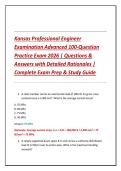
Kansas Professional Engineer
Examination Advanced 100-Question
Practice Exam 2026 | Questions &
Answers with Detailed Rationales |
Complete Exam Prep & Study Guide
1. A steel member carries an axial tensile load of 180 kN. Its gross cross-
sectional area is 2,400 mm². What is the average normal stress?
A. 55 MPa
B. 60 MPa
C. 75 MPa
D. 90 MPa
Answer: 75 MPa
Rationale: Average normal stress is σ = P/A = 180,000 N / 2,400 mm² = 75
N/mm² = 75 MPa.
2. A simply supported beam spans 8 m and carries a uniformly distributed
load of 12 kN/m over its entire span. What is the maximum bending
moment?
,A. 72 kN·m
B. 84 kN·m
C. 96 kN·m
D. 108 kN·m
Answer: 96 kN·m
Rationale: For a simply supported beam with a uniform load, Mmax = wL²/8 =
12(8²)/8 = 96 kN·m.
3. A reinforced concrete column is subjected to a concentric compressive
load. If the load is increased beyond the design capacity, the most
appropriate engineering response is to:
A. Reduce the concrete cover
B. Increase the slenderness ratio
C. Increase the column's load-carrying capacity
D. Assume load redistribution eliminates the issue
Answer: Increase the column's load-carrying capacity
Rationale: A deficient column must be strengthened or redesigned so its
factored resistance exceeds the required factored load.
4. A soil has a total unit weight of 19 kN/m³, water table at the ground
surface, and saturated unit weight of 19 kN/m³. Taking γw = 9.81 kN/m³,
what is the effective vertical stress at 5 m depth?
A. 45.95 kPa
B. 49.05 kPa
C. 95 kPa
D. 145 kPa
Answer: 45.95 kPa
Rationale: Effective stress is σ′ = (γsat − γw)z = (19 − 9.81)(5) = 45.95 kPa.
, 5. Which condition generally produces the greatest lateral earth pressure
against a retaining wall?
A. Active earth pressure
B. At-rest earth pressure
C. Passive earth pressure
D. Hydrostatic pressure only
Answer: Passive earth pressure
Rationale: Passive resistance develops when the wall moves into the soil and is
substantially greater than active pressure for the same soil conditions.
6. Water flows through a pipe at 0.40 m³/s. If the pipe diameter is 0.50 m,
approximately what is the mean velocity?
A. 0.51 m/s
B. 1.02 m/s
C. 2.04 m/s
D. 3.20 m/s
Answer: 2.04 m/s
Rationale: A = πD²/4 = 0.19635 m². Therefore V = Q/A = 0.40/0.19635 ≈ 2.04
m/s.
7. For steady incompressible flow through a pipe of constant diameter with
no pumps or turbines, an increase in elevation generally causes:
A. An increase in pressure head if losses are ignored
B. A decrease in pressure head if velocity remains constant
C. No change in pressure
D. An increase in velocity only
Answer: A decrease in pressure head if velocity remains constant
, Rationale: Bernoulli's equation requires total energy to remain constant when
losses and shaft work are absent. An elevation-head increase therefore requires
a pressure-head decrease when velocity is unchanged.
8. The Reynolds number is primarily used to determine:
A. Fluid density
B. Flow regime
C. Atmospheric pressure
D. Pump efficiency
Answer: Flow regime
Rationale: Reynolds number compares inertial and viscous effects and is used to
distinguish laminar, transitional, and turbulent flow.
9. A pump delivers 0.20 m³/s against a total head of 30 m. If water weighs
9.81 kN/m³ and pump efficiency is 80%, what input power is required?
A. 58.9 kW
B. 73.6 kW
C. 88.3 kW
D. 98.1 kW
Answer: 73.6 kW
Rationale: Hydraulic power = γQH = 9.81(0.20)(30) = 58.86 kW. Input power =
58.86/0.80 = 73.6 kW.
10.A project has an initial investment of $100,000 and produces equal annual
net cash flows of $25,000. Ignoring salvage value and discounting, the
simple payback period is:
A. 2 years
B. 3 years
C. 4 years
D. 5 years
Examination Advanced 100-Question
Practice Exam 2026 | Questions &
Answers with Detailed Rationales |
Complete Exam Prep & Study Guide
1. A steel member carries an axial tensile load of 180 kN. Its gross cross-
sectional area is 2,400 mm². What is the average normal stress?
A. 55 MPa
B. 60 MPa
C. 75 MPa
D. 90 MPa
Answer: 75 MPa
Rationale: Average normal stress is σ = P/A = 180,000 N / 2,400 mm² = 75
N/mm² = 75 MPa.
2. A simply supported beam spans 8 m and carries a uniformly distributed
load of 12 kN/m over its entire span. What is the maximum bending
moment?
,A. 72 kN·m
B. 84 kN·m
C. 96 kN·m
D. 108 kN·m
Answer: 96 kN·m
Rationale: For a simply supported beam with a uniform load, Mmax = wL²/8 =
12(8²)/8 = 96 kN·m.
3. A reinforced concrete column is subjected to a concentric compressive
load. If the load is increased beyond the design capacity, the most
appropriate engineering response is to:
A. Reduce the concrete cover
B. Increase the slenderness ratio
C. Increase the column's load-carrying capacity
D. Assume load redistribution eliminates the issue
Answer: Increase the column's load-carrying capacity
Rationale: A deficient column must be strengthened or redesigned so its
factored resistance exceeds the required factored load.
4. A soil has a total unit weight of 19 kN/m³, water table at the ground
surface, and saturated unit weight of 19 kN/m³. Taking γw = 9.81 kN/m³,
what is the effective vertical stress at 5 m depth?
A. 45.95 kPa
B. 49.05 kPa
C. 95 kPa
D. 145 kPa
Answer: 45.95 kPa
Rationale: Effective stress is σ′ = (γsat − γw)z = (19 − 9.81)(5) = 45.95 kPa.
, 5. Which condition generally produces the greatest lateral earth pressure
against a retaining wall?
A. Active earth pressure
B. At-rest earth pressure
C. Passive earth pressure
D. Hydrostatic pressure only
Answer: Passive earth pressure
Rationale: Passive resistance develops when the wall moves into the soil and is
substantially greater than active pressure for the same soil conditions.
6. Water flows through a pipe at 0.40 m³/s. If the pipe diameter is 0.50 m,
approximately what is the mean velocity?
A. 0.51 m/s
B. 1.02 m/s
C. 2.04 m/s
D. 3.20 m/s
Answer: 2.04 m/s
Rationale: A = πD²/4 = 0.19635 m². Therefore V = Q/A = 0.40/0.19635 ≈ 2.04
m/s.
7. For steady incompressible flow through a pipe of constant diameter with
no pumps or turbines, an increase in elevation generally causes:
A. An increase in pressure head if losses are ignored
B. A decrease in pressure head if velocity remains constant
C. No change in pressure
D. An increase in velocity only
Answer: A decrease in pressure head if velocity remains constant
, Rationale: Bernoulli's equation requires total energy to remain constant when
losses and shaft work are absent. An elevation-head increase therefore requires
a pressure-head decrease when velocity is unchanged.
8. The Reynolds number is primarily used to determine:
A. Fluid density
B. Flow regime
C. Atmospheric pressure
D. Pump efficiency
Answer: Flow regime
Rationale: Reynolds number compares inertial and viscous effects and is used to
distinguish laminar, transitional, and turbulent flow.
9. A pump delivers 0.20 m³/s against a total head of 30 m. If water weighs
9.81 kN/m³ and pump efficiency is 80%, what input power is required?
A. 58.9 kW
B. 73.6 kW
C. 88.3 kW
D. 98.1 kW
Answer: 73.6 kW
Rationale: Hydraulic power = γQH = 9.81(0.20)(30) = 58.86 kW. Input power =
58.86/0.80 = 73.6 kW.
10.A project has an initial investment of $100,000 and produces equal annual
net cash flows of $25,000. Ignoring salvage value and discounting, the
simple payback period is:
A. 2 years
B. 3 years
C. 4 years
D. 5 years


