
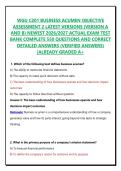
WGU C201 BUSINESS ACUMEN OBJECTIVE
ASSESSMENT 2 LATEST VERSIONS (VERSION A
AND B) NEWEST 2026/2027 ACTUAL EXAM TEST
BANK COMPLETE 550 QUESTIONS AND CORRECT
DETAILED ANSWERS (VERIFIED ANSWERS)
|ALREADY GRADED A+
1. Which of the following best defines business acumen?
A) The ability to memorize financial statements
B) The capacity to make quick decisions without data
C) The keen understanding of how businesses operate and how decisions impact
outcomes
D) The capacity to follow directives without question
Answer C: The keen understanding of how businesses operate and how
decisions impact outcomes
Rationale: Business acumen is a comprehensive understanding of how a company
generates value and how its parts interact, going beyond rote tasks to strategic
thinking.
2. What is the primary purpose of a company's mission statement?
A) To forecast financial performance
B) To define the company's reason for existence and its purpose
,C) To outline specific manufacturing steps
D) To detail the employee code of conduct
Answer B: To define the company's reason for existence and its purpose
Rationale: The mission statement defines the organization's purpose and answers
"why does this company exist?"
3. What is meant by a vision for the company?
A) A historical financial report
B) A target for the company's actions that directs it toward opportunities and
differentiates it from competitors
C) A summary of past performance
D) A list of employee benefits
Answer B: A target for the company's actions that directs it toward
opportunities and differentiates it from competitors
Rationale: A vision serves as a target for the company's actions, helping direct the
company towards opportunities and differentiating it from its competitors.
4. A multinational corporation is undergoing a major restructuring to
decentralize decision-making. The CEO advocates for a leadership approach
that empowers middle managers to take initiative and adapt to local market
conditions, while maintaining overall strategic alignment. Which leadership
theory best aligns with this approach?
A) Path-Goal Theory
,B) Transformational Leadership
C) Servant Leadership
D) Transactional Leadership
Answer A: Path-Goal Theory
Rationale: Path-Goal Theory focuses on leaders removing obstacles and providing
support to help subordinates achieve goals, which aligns with empowering middle
managers.
5. In strategic management, what does a SWOT analysis assess?
A) Savings, Wages, Obligations, and Taxes
B) Strategies, Workforce, Operations, and Technology
C) Strengths, Weaknesses, Opportunities, and Threats
D) Structure, Workflow, Output, and Throughput
Answer C: Strengths, Weaknesses, Opportunities, and Threats
Rationale: SWOT is a foundational tool identifying internal Strengths/Weaknesses
and external Opportunities/Threats to inform strategy.
6. What is the relationship between a manager's planning and controlling
functions?
A) Controlling is the first step; planning is the last
B) They are unrelated
C) Controlling assesses the success of planning and provides feedback
D) Planning is only for top managers; controlling is for supervisors
, Answer C: Controlling assesses the success of planning and provides feedback
Rationale: Controlling measures performance against plans and provides
feedback for future planning cycles.
7. Why is it important for a top executive to set high ethical standards?
A) To reduce government regulation
B) To increase short-term profits
C) High ethical standards often result in a stable workforce, job satisfaction, and
customer loyalty
D) To avoid all legal liability
Answer C: High ethical standards often result in a stable workforce, job
satisfaction, and customer loyalty
Rationale: Ethical leadership builds trust, reduces turnover, and enhances
reputation, all of which contribute to long-term organizational success.
8. A decision to enter a new, unfamiliar market is an example of a(n):
A) Programmed decision
B) Tactical decision
C) Nonprogrammed decision
D) Operational decision
Answer C: Nonprogrammed decision
Rationale: Nonprogrammed decisions are unique, novel, and require conscious
thought because no established rule exists.
ASSESSMENT 2 LATEST VERSIONS (VERSION A
AND B) NEWEST 2026/2027 ACTUAL EXAM TEST
BANK COMPLETE 550 QUESTIONS AND CORRECT
DETAILED ANSWERS (VERIFIED ANSWERS)
|ALREADY GRADED A+
1. Which of the following best defines business acumen?
A) The ability to memorize financial statements
B) The capacity to make quick decisions without data
C) The keen understanding of how businesses operate and how decisions impact
outcomes
D) The capacity to follow directives without question
Answer C: The keen understanding of how businesses operate and how
decisions impact outcomes
Rationale: Business acumen is a comprehensive understanding of how a company
generates value and how its parts interact, going beyond rote tasks to strategic
thinking.
2. What is the primary purpose of a company's mission statement?
A) To forecast financial performance
B) To define the company's reason for existence and its purpose
,C) To outline specific manufacturing steps
D) To detail the employee code of conduct
Answer B: To define the company's reason for existence and its purpose
Rationale: The mission statement defines the organization's purpose and answers
"why does this company exist?"
3. What is meant by a vision for the company?
A) A historical financial report
B) A target for the company's actions that directs it toward opportunities and
differentiates it from competitors
C) A summary of past performance
D) A list of employee benefits
Answer B: A target for the company's actions that directs it toward
opportunities and differentiates it from competitors
Rationale: A vision serves as a target for the company's actions, helping direct the
company towards opportunities and differentiating it from its competitors.
4. A multinational corporation is undergoing a major restructuring to
decentralize decision-making. The CEO advocates for a leadership approach
that empowers middle managers to take initiative and adapt to local market
conditions, while maintaining overall strategic alignment. Which leadership
theory best aligns with this approach?
A) Path-Goal Theory
,B) Transformational Leadership
C) Servant Leadership
D) Transactional Leadership
Answer A: Path-Goal Theory
Rationale: Path-Goal Theory focuses on leaders removing obstacles and providing
support to help subordinates achieve goals, which aligns with empowering middle
managers.
5. In strategic management, what does a SWOT analysis assess?
A) Savings, Wages, Obligations, and Taxes
B) Strategies, Workforce, Operations, and Technology
C) Strengths, Weaknesses, Opportunities, and Threats
D) Structure, Workflow, Output, and Throughput
Answer C: Strengths, Weaknesses, Opportunities, and Threats
Rationale: SWOT is a foundational tool identifying internal Strengths/Weaknesses
and external Opportunities/Threats to inform strategy.
6. What is the relationship between a manager's planning and controlling
functions?
A) Controlling is the first step; planning is the last
B) They are unrelated
C) Controlling assesses the success of planning and provides feedback
D) Planning is only for top managers; controlling is for supervisors
, Answer C: Controlling assesses the success of planning and provides feedback
Rationale: Controlling measures performance against plans and provides
feedback for future planning cycles.
7. Why is it important for a top executive to set high ethical standards?
A) To reduce government regulation
B) To increase short-term profits
C) High ethical standards often result in a stable workforce, job satisfaction, and
customer loyalty
D) To avoid all legal liability
Answer C: High ethical standards often result in a stable workforce, job
satisfaction, and customer loyalty
Rationale: Ethical leadership builds trust, reduces turnover, and enhances
reputation, all of which contribute to long-term organizational success.
8. A decision to enter a new, unfamiliar market is an example of a(n):
A) Programmed decision
B) Tactical decision
C) Nonprogrammed decision
D) Operational decision
Answer C: Nonprogrammed decision
Rationale: Nonprogrammed decisions are unique, novel, and require conscious
thought because no established rule exists.


