

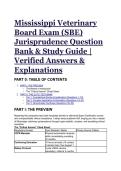
Mississippi Veterinary
Board Exam (SBE)
Jurisprudence Question
Bank & Study Guide |
Verified Answers &
Explanations
PART 0: TABLE OF CONTENTS
1. PART I: THE PREVIEW
○ The Mentor's Introduction
○ The "Critical Axioms" Cheat Sheet
2. PART II: THE ELITE TEST BANK
○ Tier 1: Foundational Syntax & Application (Questions 1–18)
○ Tier 2: Complex Application & Simulation (Questions 19–37)
○ Tier 3: Grandmaster Synthesis (Questions 38–55)
PART I: THE PREVIEW
Mastering this exhaustive test bank translates directly to elite-level Board Certification scores
and unimpeachable clinical compliance. It strips away academic fluff, forging you into a master
of Mississippi veterinary jurisprudence through hyper-realistic, complex, and escalating clinical
scenarios.
The "Critical Axioms" Cheat Sheet:
Regulatory Domain Core Standard / Metric Primary Source Citation
VCPR Mandate Physical examination required
within immediately preceding
12 months.
Continuing Education 15 hours annually (10 contact,
5 remote max). Due August 1.
Rabies Protocol 3-year USDA vaccine
mandatory; initial at 3 months,
,Regulatory Domain Core Standard / Metric Primary Source Citation
booster at 1 yr.
CS Inventory Annual inventory strictly
between May 1 and May 15.
Abandonment Requires certified mail notice +
10-day waiting period.
PART II: THE ELITE TEST BANK
Tier 1: Foundational Syntax & Application
Q1: A newly licensed veterinarian in Mississippi is preparing for their first annual license
renewal. Based on the principles of the Mississippi Veterinary Practice Act, which action is the
MOST ACCURATE regarding Continuing Education (CE)? A) Submit 20 hours of CE, with a
maximum of 10 hours completed online. B) Pay the reduced renewal fee and claim the
new-graduate exemption from CE. C) Complete 15 hours of CE, consisting of at least 10
contact hours and exactly 5 remote hours. D) Bypass CE because veterinarians under age 30
are temporarily exempt.
● Answer: B (Pay the reduced renewal fee and claim the new-graduate exemption from
CE.)
● Distractor Analysis:
○ A is incorrect: The total CE requirement is 15 hours, not 20 hours.
○ C is incorrect: While 15 hours is the standard, veterinarians who graduated in the
year preceding their renewal are explicitly exempt from CE.
○ D is incorrect: There is no age-based exemption for young veterinarians;
exemptions are strictly based on the graduation year.
The Mentor's Analysis: Foundational licensing requires precise chronological awareness. When
facing Initial License Renewal, the immediate priority is claiming the new-graduate CE
exemption. By utilizing this statutory grace period, you bypass the common trap of completing
unnecessary coursework during your first year of practice. Professional/Academic Intuition: New
graduates are exempt from Continuing Education during their very first license renewal
cycle.
Q2: A veterinarian plans their annual schedule. Based on the Mississippi Board of Pharmacy
controlled substance rules, when MUST the annual controlled substance inventory occur? A) By
December 31st of each calendar year. B) Exactly 24 months from the DEA registration
issuance. C) Annually, on or about May 1 but no later than May 15. D) Prior to the August 1st
veterinary license renewal.
● Answer: C (Annually, on or about May 1 but no later than May 15.)
● Distractor Analysis:
○ A is incorrect: End-of-year inventory is a common standard elsewhere, but violates
Mississippi law.
○ B is incorrect: The federal DEA requires biennial inventory, but Mississippi strictly
overrides this with an annual mandate .
○ D is incorrect: August 1 is the license renewal date, distinct from the pharmacy
board's fixed inventory window.
The Mentor's Analysis: State pharmacy regulations frequently supersede federal DEA
minimums. When facing Controlled Substance Compliance, the immediate priority is aligning
with the State's May 1-15 annual window. By utilizing the stricter state timeline, you bypass the
, common trap of relying solely on the federal biennial standard. Professional/Academic Intuition:
Default to the strictest standard: Mississippi demands an annual May inventory, eclipsing
the DEA's biennial rule.
Q3: A 14-week-old puppy is presented for its initial rabies vaccination. Based on the Mississippi
State Department of Health (MSDH) Rabies Regulations, which protocol is MOST
APPROPRIATE? A) Administer a 1-year labeled rabies vaccine, with a booster due in one year.
B) Administer a 3-year labeled USDA-licensed vaccine, with a booster due in one year. C)
Administer a 3-year labeled USDA-licensed vaccine, with a booster due in three years. D) Delay
vaccination until the puppy is 16 weeks of age.
● Answer: B (Administer a 3-year labeled USDA-licensed vaccine, with a booster due in
one year.)
● Distractor Analysis:
○ A is incorrect: Mississippi explicitly does not recognize 1-year labeled rabies
vaccines.
○ C is incorrect: Despite being a 3-year product, the initial dose in an animal's life
must always be boosted exactly one year later.
○ D is incorrect: Mississippi mandates initial rabies vaccination strictly at 3 months (12
weeks) of age.
The Mentor's Analysis: Rabies protocols in Mississippi uniquely blend product labeling with rigid
chronological schedules. When facing Initial Rabies Immunization, the immediate priority is
utilizing a 3-year product but scheduling a 1-year booster. By utilizing the mandatory 1-year
initial booster rule, you bypass the common trap of assuming a 3-year label provides 3 years of
initial legal immunity. Professional/Academic Intuition: The first rabies vaccine, regardless of
its 3-year label, always mandates a booster at 365 days.
Q4: A veterinarian from Tennessee wishes to perform relief work in Mississippi for three weeks.
Based on the Mississippi Veterinary Practice Act, what is the FIRST legal step? A) Obtain a
temporary permit for relief work by paying a $50 fee. B) Practice under the direct supervision of
the local clinic owner's license. C) Apply for full licensure by endorsement, as Mississippi does
not offer temporary relief licenses. D) Utilize the cross-state telemedicine exemption.
● Answer: C (Apply for full licensure by endorsement, as Mississippi does not offer
temporary relief licenses.)
● Distractor Analysis:
○ A is incorrect: Mississippi strictly does not offer temporary veterinary licenses for
out-of-state relief work.
○ B is incorrect: A veterinarian cannot practice using another's license.
○ D is incorrect: Telemedicine requires a pre-existing physical
Veterinarian-Client-Patient Relationship (VCPR) established in Mississippi.
The Mentor's Analysis: Jurisdictional boundaries strictly prohibit unlicensed practice regardless
of emergency or relief needs. When facing Out-of-State Relief Staffing, the immediate priority is
securing full licensure by endorsement. By utilizing the formal endorsement pathway, you
bypass the common trap of assuming temporary relief permits exist universally.
Professional/Academic Intuition: Mississippi requires full licensure by endorsement; no
temporary relief loopholes exist for out-of-state clinicians.
Q5: A client leaves a dog for boarding and ghosts the clinic. Based on the Mississippi Veterinary
Practice Act, which action IMMEDIATELY establishes legal abandonment? A) Waiting 14 days
after the scheduled pickup date. B) Sending a written notice via certified mail and waiting 10
days from the mailing date. C) Turning the animal over to the nearest humane society after 7
days of non-payment. D) Sending a digital notice (email/text) and waiting 5 days for a response.
Board Exam (SBE)
Jurisprudence Question
Bank & Study Guide |
Verified Answers &
Explanations
PART 0: TABLE OF CONTENTS
1. PART I: THE PREVIEW
○ The Mentor's Introduction
○ The "Critical Axioms" Cheat Sheet
2. PART II: THE ELITE TEST BANK
○ Tier 1: Foundational Syntax & Application (Questions 1–18)
○ Tier 2: Complex Application & Simulation (Questions 19–37)
○ Tier 3: Grandmaster Synthesis (Questions 38–55)
PART I: THE PREVIEW
Mastering this exhaustive test bank translates directly to elite-level Board Certification scores
and unimpeachable clinical compliance. It strips away academic fluff, forging you into a master
of Mississippi veterinary jurisprudence through hyper-realistic, complex, and escalating clinical
scenarios.
The "Critical Axioms" Cheat Sheet:
Regulatory Domain Core Standard / Metric Primary Source Citation
VCPR Mandate Physical examination required
within immediately preceding
12 months.
Continuing Education 15 hours annually (10 contact,
5 remote max). Due August 1.
Rabies Protocol 3-year USDA vaccine
mandatory; initial at 3 months,
,Regulatory Domain Core Standard / Metric Primary Source Citation
booster at 1 yr.
CS Inventory Annual inventory strictly
between May 1 and May 15.
Abandonment Requires certified mail notice +
10-day waiting period.
PART II: THE ELITE TEST BANK
Tier 1: Foundational Syntax & Application
Q1: A newly licensed veterinarian in Mississippi is preparing for their first annual license
renewal. Based on the principles of the Mississippi Veterinary Practice Act, which action is the
MOST ACCURATE regarding Continuing Education (CE)? A) Submit 20 hours of CE, with a
maximum of 10 hours completed online. B) Pay the reduced renewal fee and claim the
new-graduate exemption from CE. C) Complete 15 hours of CE, consisting of at least 10
contact hours and exactly 5 remote hours. D) Bypass CE because veterinarians under age 30
are temporarily exempt.
● Answer: B (Pay the reduced renewal fee and claim the new-graduate exemption from
CE.)
● Distractor Analysis:
○ A is incorrect: The total CE requirement is 15 hours, not 20 hours.
○ C is incorrect: While 15 hours is the standard, veterinarians who graduated in the
year preceding their renewal are explicitly exempt from CE.
○ D is incorrect: There is no age-based exemption for young veterinarians;
exemptions are strictly based on the graduation year.
The Mentor's Analysis: Foundational licensing requires precise chronological awareness. When
facing Initial License Renewal, the immediate priority is claiming the new-graduate CE
exemption. By utilizing this statutory grace period, you bypass the common trap of completing
unnecessary coursework during your first year of practice. Professional/Academic Intuition: New
graduates are exempt from Continuing Education during their very first license renewal
cycle.
Q2: A veterinarian plans their annual schedule. Based on the Mississippi Board of Pharmacy
controlled substance rules, when MUST the annual controlled substance inventory occur? A) By
December 31st of each calendar year. B) Exactly 24 months from the DEA registration
issuance. C) Annually, on or about May 1 but no later than May 15. D) Prior to the August 1st
veterinary license renewal.
● Answer: C (Annually, on or about May 1 but no later than May 15.)
● Distractor Analysis:
○ A is incorrect: End-of-year inventory is a common standard elsewhere, but violates
Mississippi law.
○ B is incorrect: The federal DEA requires biennial inventory, but Mississippi strictly
overrides this with an annual mandate .
○ D is incorrect: August 1 is the license renewal date, distinct from the pharmacy
board's fixed inventory window.
The Mentor's Analysis: State pharmacy regulations frequently supersede federal DEA
minimums. When facing Controlled Substance Compliance, the immediate priority is aligning
with the State's May 1-15 annual window. By utilizing the stricter state timeline, you bypass the
, common trap of relying solely on the federal biennial standard. Professional/Academic Intuition:
Default to the strictest standard: Mississippi demands an annual May inventory, eclipsing
the DEA's biennial rule.
Q3: A 14-week-old puppy is presented for its initial rabies vaccination. Based on the Mississippi
State Department of Health (MSDH) Rabies Regulations, which protocol is MOST
APPROPRIATE? A) Administer a 1-year labeled rabies vaccine, with a booster due in one year.
B) Administer a 3-year labeled USDA-licensed vaccine, with a booster due in one year. C)
Administer a 3-year labeled USDA-licensed vaccine, with a booster due in three years. D) Delay
vaccination until the puppy is 16 weeks of age.
● Answer: B (Administer a 3-year labeled USDA-licensed vaccine, with a booster due in
one year.)
● Distractor Analysis:
○ A is incorrect: Mississippi explicitly does not recognize 1-year labeled rabies
vaccines.
○ C is incorrect: Despite being a 3-year product, the initial dose in an animal's life
must always be boosted exactly one year later.
○ D is incorrect: Mississippi mandates initial rabies vaccination strictly at 3 months (12
weeks) of age.
The Mentor's Analysis: Rabies protocols in Mississippi uniquely blend product labeling with rigid
chronological schedules. When facing Initial Rabies Immunization, the immediate priority is
utilizing a 3-year product but scheduling a 1-year booster. By utilizing the mandatory 1-year
initial booster rule, you bypass the common trap of assuming a 3-year label provides 3 years of
initial legal immunity. Professional/Academic Intuition: The first rabies vaccine, regardless of
its 3-year label, always mandates a booster at 365 days.
Q4: A veterinarian from Tennessee wishes to perform relief work in Mississippi for three weeks.
Based on the Mississippi Veterinary Practice Act, what is the FIRST legal step? A) Obtain a
temporary permit for relief work by paying a $50 fee. B) Practice under the direct supervision of
the local clinic owner's license. C) Apply for full licensure by endorsement, as Mississippi does
not offer temporary relief licenses. D) Utilize the cross-state telemedicine exemption.
● Answer: C (Apply for full licensure by endorsement, as Mississippi does not offer
temporary relief licenses.)
● Distractor Analysis:
○ A is incorrect: Mississippi strictly does not offer temporary veterinary licenses for
out-of-state relief work.
○ B is incorrect: A veterinarian cannot practice using another's license.
○ D is incorrect: Telemedicine requires a pre-existing physical
Veterinarian-Client-Patient Relationship (VCPR) established in Mississippi.
The Mentor's Analysis: Jurisdictional boundaries strictly prohibit unlicensed practice regardless
of emergency or relief needs. When facing Out-of-State Relief Staffing, the immediate priority is
securing full licensure by endorsement. By utilizing the formal endorsement pathway, you
bypass the common trap of assuming temporary relief permits exist universally.
Professional/Academic Intuition: Mississippi requires full licensure by endorsement; no
temporary relief loopholes exist for out-of-state clinicians.
Q5: A client leaves a dog for boarding and ghosts the clinic. Based on the Mississippi Veterinary
Practice Act, which action IMMEDIATELY establishes legal abandonment? A) Waiting 14 days
after the scheduled pickup date. B) Sending a written notice via certified mail and waiting 10
days from the mailing date. C) Turning the animal over to the nearest humane society after 7
days of non-payment. D) Sending a digital notice (email/text) and waiting 5 days for a response.


