
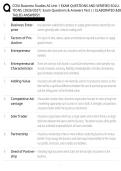
CCEA Business Studies AS Unit 1 EXAM QUESTIONS AND VERIFIED SOLU-
TIONS |2026/2027| Exam Questions & Answers Test || ELABORATED &DE
TAILED ANSWERS!!
1. Business Enter- Any operation established to produce or supply goods/services desired by con-
prise sumers generally with a view to making profit.
2. Factors of Pro- The inputs of land, labour, capital and enterprise required to produce or supply
duction goods/services.
3. Entrepreneur Someone who starts and runs a business and has the responsibility of the risks
involved.
4. Entrepreneurial These are common traits found in successful entrepreneurs and examples may
Characteristics include innovative, visionary, flexibility, knowledgeable, risk taker, decisiveness,
goal orientated, motivated and committed.
5. Adding Value A business will add value to raw materials used in its production process so that
there will be a significant difference between the cost of purchasing raw materials
and the selling prices of the finished article.
6. Competitive Ad- A favourable situation that a business organisation has over its rivals arising from
vantage a marketing opportunity such as price or cost or both. It strengths and positions
a business better within the business environment.
7. Sole Trader A business organisation which has a single owner and in which there is no legal
distinction between the owner and the business. The owner receives all the profits
and has unlimited responsibility for all losses and debts.
8. Partnership A business relationship of two or more entities conducting business for mutual
benefit. They manage the business and share equal responsibility for the compa-
ny's profits and losses, and its debts and liabilities.
9. Deed of Partner- A binding legal document which states the formal rights of partners in the
ship business.
, CCEA Business Studies AS Unit 1 EXAM QUESTIONS AND VERIFIED SOLU-
TIONS |2026/2027| Exam Questions & Answers Test || ELABORATED &DE
TAILED ANSWERS!!
10. Sleeping Partner A partner who contributes capital and shares in profits/losses but does not
participate in decision making.
11. Limited Partner- A partnership which has at least one ordinary partner who has unlimited liability.
ship A limited partner contributes capital, share in profits but has limited liability. A
limited partner cannot participate in decision making.
12. Limited Compa- A business organisation which has separate legal entity from those of its owners.
ny The liability of the members of the company is limited to what they have invested
to the company.
13. Shareholders Investors who have bought a share in the company.
14. Limited Liability Each shareholder is only liable for the original amount of money invested in the
business.
15. Franchise An agreement between two parties, which gives one party the rights to market a
product or service using the trademark of another business.
16. Social Enterprise A business venture established to address a social issue within a community or
to improve the quality or life for citizens or the environment. All profit made is
reinvested to help achieve the social objective of the business.
17. Stakeholder Specific groups of people who have a genuine interest in the activities of a
Groups particular business and who will be affected by the activities of the business. Ex-
amples include owners, employees, customers, lenders, government, suppliers,
management and community.
18. Consumer Goods This is where households purchase the goods/services they desire and business-
and Services es try to meet their demand by selling the goods/services in store, online etc.
Market
TIONS |2026/2027| Exam Questions & Answers Test || ELABORATED &DE
TAILED ANSWERS!!
1. Business Enter- Any operation established to produce or supply goods/services desired by con-
prise sumers generally with a view to making profit.
2. Factors of Pro- The inputs of land, labour, capital and enterprise required to produce or supply
duction goods/services.
3. Entrepreneur Someone who starts and runs a business and has the responsibility of the risks
involved.
4. Entrepreneurial These are common traits found in successful entrepreneurs and examples may
Characteristics include innovative, visionary, flexibility, knowledgeable, risk taker, decisiveness,
goal orientated, motivated and committed.
5. Adding Value A business will add value to raw materials used in its production process so that
there will be a significant difference between the cost of purchasing raw materials
and the selling prices of the finished article.
6. Competitive Ad- A favourable situation that a business organisation has over its rivals arising from
vantage a marketing opportunity such as price or cost or both. It strengths and positions
a business better within the business environment.
7. Sole Trader A business organisation which has a single owner and in which there is no legal
distinction between the owner and the business. The owner receives all the profits
and has unlimited responsibility for all losses and debts.
8. Partnership A business relationship of two or more entities conducting business for mutual
benefit. They manage the business and share equal responsibility for the compa-
ny's profits and losses, and its debts and liabilities.
9. Deed of Partner- A binding legal document which states the formal rights of partners in the
ship business.
, CCEA Business Studies AS Unit 1 EXAM QUESTIONS AND VERIFIED SOLU-
TIONS |2026/2027| Exam Questions & Answers Test || ELABORATED &DE
TAILED ANSWERS!!
10. Sleeping Partner A partner who contributes capital and shares in profits/losses but does not
participate in decision making.
11. Limited Partner- A partnership which has at least one ordinary partner who has unlimited liability.
ship A limited partner contributes capital, share in profits but has limited liability. A
limited partner cannot participate in decision making.
12. Limited Compa- A business organisation which has separate legal entity from those of its owners.
ny The liability of the members of the company is limited to what they have invested
to the company.
13. Shareholders Investors who have bought a share in the company.
14. Limited Liability Each shareholder is only liable for the original amount of money invested in the
business.
15. Franchise An agreement between two parties, which gives one party the rights to market a
product or service using the trademark of another business.
16. Social Enterprise A business venture established to address a social issue within a community or
to improve the quality or life for citizens or the environment. All profit made is
reinvested to help achieve the social objective of the business.
17. Stakeholder Specific groups of people who have a genuine interest in the activities of a
Groups particular business and who will be affected by the activities of the business. Ex-
amples include owners, employees, customers, lenders, government, suppliers,
management and community.
18. Consumer Goods This is where households purchase the goods/services they desire and business-
and Services es try to meet their demand by selling the goods/services in store, online etc.
Market


