

The Elite Universal Test
Bank: Prince Edward
Island Bar
Jurisprudence and
Ethics
PART 0: THE NAVIGATOR
● Tier 1 (Questions 1–28) - Foundational Syntax & Application
● Tier 2 (Questions 29–58) - Complex Application & Simulation
● Tier 3 (Questions 59–88) - Grandmaster Synthesis
PART I: THE PRIMER
Mastering this specific test bank translates directly to elite academic and professional
performance by embedding the Prince Edward Island (PEI) regulatory matrix into your analytical
reflexes. You will bypass common procedural traps, ensuring your practice management, trust
compliance, and litigation strategies are bulletproof under Law Society and Supreme Court
scrutiny.
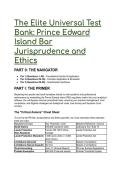
The "Critical Axioms" Cheat Sheet
To survive the PEI Bar Jurisprudence and Ethics gauntlet, you must internalize these absolute
limits and rules.
Regulatory Domain Key Threshold / Limit Statutory Reference / Source
Small Claims $16,000 maximum claim Judicature Act / Rule 74
Lands Protection 5 acres OR 165 ft shore Lands Protection Act
(Non-Resident) frontage
Lands Protection (Resident) 1,000 acres (Indiv.) / 3,000 Lands Protection Act
acres (Corp.)
Limitations (General) 6 Years Statute of Limitations
Limitations (Sexual Assault) No limit Statute of Limitations
Trust Accounting Form 17 (Annual Report) PEI Law Society Regulations
Probate Exemption $40,000 (Financial assets) Probate Threshold Update
,Regulatory Domain Key Threshold / Limit Statutory Reference / Source
Liability Insurance $1M per claim / $2M aggregate Law Society Insurance
Mandatory CPD 24 hours / 2 years (4h ethics) Mandatory CPD Policy
PART II: THE ELITE TEST BANK
Tier 1 - Foundational Syntax & Application
Q1: Every practising member in PEI who maintains a trust account must file specific
documentation with the Secretary-Treasurer annually. Based on the principles of the PEI Law
Society Regulations, which action is MOST ACCURATE? A) The lawyer must file a Federal T3
Trust Return to satisfy the Law Society. B) The lawyer must file a Form 17 Trust Account Report
and a Form 6 Statutory Declaration. C) The lawyer must submit a daily ledger printout directly to
the Prothonotary. D) The lawyer is exempt from filing if they have had no trust shortages in the
fiscal year.
● The Answer: B (The lawyer must file a Form 17 Trust Account Report and a Form 6
Statutory Declaration.)
● Distractor Analysis:
○ A is incorrect: Federal tax returns do not satisfy provincial Law Society regulatory
requirements.
○ C is incorrect: The Prothonotary is a judicial officer, not the Law Society regulator.
○ D is incorrect: Filing is mandatory regardless of perfect compliance history.
The Mentor's Analysis: Trust audits are the vital signs of a law firm. Every member must file a
Form 17 and Form 6 by the fixed date to verify compliance with trust safekeeping rules.
Professional/Academic Intuition: Form 17 is the non-negotiable annual proof of trust
compliance.
Q2: A non-resident of PEI wishes to purchase coastal property. Based on the principles of the
PEI Lands Protection Act, which conclusion is MOST ACCURATE without seeking prior IRAC
approval? A) They may acquire a maximum of 100 feet of shore frontage. B) They may acquire
up to 10 acres of land if it is landlocked. C) They may acquire an aggregate land holding of up to
5 acres or 165 feet of shore frontage. D) They are strictly prohibited from purchasing any real
property without an Order in Council.
● The Answer: C (They may acquire an aggregate land holding of up to 5 acres or 165 feet
of shore frontage.)
● Distractor Analysis:
○ A is incorrect: The statutory limit is 165 feet, making 100 feet too restrictive an
answer.
○ B is incorrect: The acreage limit is strictly 5 acres for non-residents without
approval.
○ D is incorrect: Non-residents have a statutory baseline before Executive Council
intervention is required.
The Mentor's Analysis: The Lands Protection Act strictly guards PEI's ecology. Exceeding 5
acres or 165 feet of shore frontage trips the regulatory wire requiring IRAC approval.
Professional/Academic Intuition: Memorize the non-resident triggers: 5 acres or 165 feet.
Q3: A plaintiff initiates a civil action for a breached commercial contract. Based on the principles
of the PEI Statute of Limitations, which conclusion is MOST ACCURATE? A) The claim must be
filed within 2 years of discovery. B) The claim must be filed within 6 years of the cause of action
arising. C) The claim must be filed within 15 years, acting as the ultimate limitation period. D)
,The claim is subject to a 3-year limitation period aligned with Quebec civil code.
● The Answer: B (The claim must be filed within 6 years of the cause of action arising.)
● Distractor Analysis:
○ A is incorrect: 2 years applies to defamation and specific statutory penalties, not
general contracts.
○ C is incorrect: PEI utilizes a 6-year general period, distinct from the 15-year ultimate
periods found in other common law provinces.
○ D is incorrect: This hallucinates the Quebec standard onto PEI law.
The Mentor's Analysis: PEI retains a longer general limitation period compared to the 2-year
standard in provinces like Ontario. Professional/Academic Intuition: Default to 6 years for
general civil claims in PEI, unless a specific statutory carve-out applies.
Q4: A PEI lawyer is drafting a statement of claim for a debt of $15,000. Based on the principles
of the PEI Judicature Act, which action is MOST ACCURATE? A) The claim must be filed in the
General Section because it exceeds $10,000. B) The claim must be filed in the Small Claims
Section of the Supreme Court. C) The claim must be heard by a jury in the Small Claims
Section. D) The claim must be filed in the Estates Section to secure a lien.
● The Answer: B (The claim must be filed in the Small Claims Section of the Supreme
Court.)
● Distractor Analysis:
○ A is incorrect: The Small Claims limit was increased to $16,000.
○ C is incorrect: Small Claims actions are determined by a judge without a jury.
○ D is incorrect: Debt collection is not an estate matter.
The Mentor's Analysis: Jurisdictional limits dictate the procedural venue. The PEI limit was
doubled to $16,000 to increase access to justice. Professional/Academic Intuition: PEI Small
Claims jurisdiction strictly captures debt and damages up to $16,000.
Q5: A lawyer discovers that a senior partner at their firm has been actively misappropriating
client trust funds to pay firm overhead. Based on the principles of the Code of Professional
Conduct (Rule 7.1-3), the discovering lawyer IMMEDIATELY must: A) Confront the partner
privately and demand the funds be replaced within 30 days. B) Report the misappropriation of
trust monies to the Law Society. C) Withdraw from the firm and maintain silence to uphold client
confidentiality. D) File a civil claim against the partner on behalf of the clients.
● The Answer: B (Report the misappropriation of trust monies to the Law Society.)
● Distractor Analysis:
○ A is incorrect: Private resolution does not satisfy the mandatory regulatory duty to
report serious misconduct.
○ C is incorrect: The duty to report misappropriation explicitly overrides generalized
professional silence.
○ D is incorrect: The lawyer's primary regulatory obligation is to the Society, not
instantly acting as the clients' civil litigator.
The Mentor's Analysis: Self-regulation requires radical transparency. Misappropriation threatens
the entire profession's mandate and public trust. Professional/Academic Intuition: The duty to
report misappropriation to the Law Society is absolute and immediate.
Q6: A lawyer uses a Generative AI platform to draft a complex commercial lease. Based on the
PEI Law Society Artificial Intelligence Guidelines, the lawyer's primary responsibility is: A) To
ensure the client consents to the software vendor's terms of service. B) To independently verify
the accuracy and legal soundness of the AI-generated output. C) To bill the client for the time
the AI took to generate the document. D) To avoid using AI entirely, as it violates the duty of
competence.
, ● The Answer: B (To independently verify the accuracy and legal soundness of the
AI-generated output.)
● Distractor Analysis:
○ A is incorrect: The lawyer's duty is to the client, not the vendor's terms of service.
○ C is incorrect: Lawyers may only charge for their reasonable human time spent
analyzing or editing, not machine generation time.
○ D is incorrect: AI use is permitted, provided the lawyer applies intellectual capacity
and judgment to the output.
The Mentor's Analysis: AI is a tool, not an associate. The lawyer bears absolute supervisory
liability for technological outputs to prevent hallucination or bias. Professional/Academic
Intuition: You cannot delegate your duty of competence to an algorithm; verify every
output.
Q7: A resident individual in PEI wishes to acquire agricultural land. Based on the Lands
Protection Act, what is the maximum aggregate land holding they can possess without special
exemption? A) 400 acres B) 1,000 acres C) 3,000 acres D) 5,000 acres
● The Answer: B (1,000 acres)
● Distractor Analysis:
○ A is incorrect: 400 acres is the non-arable exemption limit for individuals, not the
total aggregate ceiling.
○ C is incorrect: 3,000 acres is the limit reserved strictly for resident corporations.
○ D is incorrect: This exceeds all baseline statutory limits.
The Mentor's Analysis: PEI limits land monopolization. Individuals cap at 1,000 acres;
corporations cap at 3,000 acres. Professional/Academic Intuition: 1,000 acres is the strict
ceiling for a resident individual's aggregate land holding.
Q8: A lawyer fails to file their Form 17 Trust Account Report by the established deadline. Based
on PEI Law Society Regulations, the Secretary-Treasurer will MOST ACCURATELY: A) Impose
a mandatory $10,000 penalty fine. B) Administratively suspend the member from practice until
they comply. C) Revoke the lawyer's notary public status permanently. D) Order the lawyer to
complete 12 extra hours of CPD.
● The Answer: B (Administratively suspend the member from practice until they comply.)
● Distractor Analysis:
○ A is incorrect: While fines may exist, suspension is the specific, immediate
administrative lever used to compel compliance.
○ C is incorrect: Notary status is tied to active membership, but permanent revocation
requires a disciplinary hearing, not a clerical default.
○ D is incorrect: CPD does not cure a missed financial reporting deadline.
The Mentor's Analysis: Administrative suspensions are automatic mechanisms designed to halt
practice until financial compliance is achieved, protecting the public. Professional/Academic
Intuition: Miss the trust report deadline, immediately lose the license until cured.
Q9: A successful plaintiff seeks to recover legal expenses. Based on PEI Rule 57 regarding
costs, what is the default standard for cost recovery? A) Substantial indemnity costs B) Partial
indemnity costs C) Full indemnity costs D) Zero costs, as each party strictly bears their own
● The Answer: B (Partial indemnity costs)
● Distractor Analysis:
○ A is incorrect: Substantial indemnity is a punitive scale triggered by bad faith or
specific Rule 49 settlement mechanisms.
○ C is incorrect: Full indemnity is exceptionally rare and reserved for egregious
conduct.
Bank: Prince Edward
Island Bar
Jurisprudence and
Ethics
PART 0: THE NAVIGATOR
● Tier 1 (Questions 1–28) - Foundational Syntax & Application
● Tier 2 (Questions 29–58) - Complex Application & Simulation
● Tier 3 (Questions 59–88) - Grandmaster Synthesis
PART I: THE PRIMER
Mastering this specific test bank translates directly to elite academic and professional
performance by embedding the Prince Edward Island (PEI) regulatory matrix into your analytical
reflexes. You will bypass common procedural traps, ensuring your practice management, trust
compliance, and litigation strategies are bulletproof under Law Society and Supreme Court
scrutiny.
The "Critical Axioms" Cheat Sheet
To survive the PEI Bar Jurisprudence and Ethics gauntlet, you must internalize these absolute
limits and rules.
Regulatory Domain Key Threshold / Limit Statutory Reference / Source
Small Claims $16,000 maximum claim Judicature Act / Rule 74
Lands Protection 5 acres OR 165 ft shore Lands Protection Act
(Non-Resident) frontage
Lands Protection (Resident) 1,000 acres (Indiv.) / 3,000 Lands Protection Act
acres (Corp.)
Limitations (General) 6 Years Statute of Limitations
Limitations (Sexual Assault) No limit Statute of Limitations
Trust Accounting Form 17 (Annual Report) PEI Law Society Regulations
Probate Exemption $40,000 (Financial assets) Probate Threshold Update
,Regulatory Domain Key Threshold / Limit Statutory Reference / Source
Liability Insurance $1M per claim / $2M aggregate Law Society Insurance
Mandatory CPD 24 hours / 2 years (4h ethics) Mandatory CPD Policy
PART II: THE ELITE TEST BANK
Tier 1 - Foundational Syntax & Application
Q1: Every practising member in PEI who maintains a trust account must file specific
documentation with the Secretary-Treasurer annually. Based on the principles of the PEI Law
Society Regulations, which action is MOST ACCURATE? A) The lawyer must file a Federal T3
Trust Return to satisfy the Law Society. B) The lawyer must file a Form 17 Trust Account Report
and a Form 6 Statutory Declaration. C) The lawyer must submit a daily ledger printout directly to
the Prothonotary. D) The lawyer is exempt from filing if they have had no trust shortages in the
fiscal year.
● The Answer: B (The lawyer must file a Form 17 Trust Account Report and a Form 6
Statutory Declaration.)
● Distractor Analysis:
○ A is incorrect: Federal tax returns do not satisfy provincial Law Society regulatory
requirements.
○ C is incorrect: The Prothonotary is a judicial officer, not the Law Society regulator.
○ D is incorrect: Filing is mandatory regardless of perfect compliance history.
The Mentor's Analysis: Trust audits are the vital signs of a law firm. Every member must file a
Form 17 and Form 6 by the fixed date to verify compliance with trust safekeeping rules.
Professional/Academic Intuition: Form 17 is the non-negotiable annual proof of trust
compliance.
Q2: A non-resident of PEI wishes to purchase coastal property. Based on the principles of the
PEI Lands Protection Act, which conclusion is MOST ACCURATE without seeking prior IRAC
approval? A) They may acquire a maximum of 100 feet of shore frontage. B) They may acquire
up to 10 acres of land if it is landlocked. C) They may acquire an aggregate land holding of up to
5 acres or 165 feet of shore frontage. D) They are strictly prohibited from purchasing any real
property without an Order in Council.
● The Answer: C (They may acquire an aggregate land holding of up to 5 acres or 165 feet
of shore frontage.)
● Distractor Analysis:
○ A is incorrect: The statutory limit is 165 feet, making 100 feet too restrictive an
answer.
○ B is incorrect: The acreage limit is strictly 5 acres for non-residents without
approval.
○ D is incorrect: Non-residents have a statutory baseline before Executive Council
intervention is required.
The Mentor's Analysis: The Lands Protection Act strictly guards PEI's ecology. Exceeding 5
acres or 165 feet of shore frontage trips the regulatory wire requiring IRAC approval.
Professional/Academic Intuition: Memorize the non-resident triggers: 5 acres or 165 feet.
Q3: A plaintiff initiates a civil action for a breached commercial contract. Based on the principles
of the PEI Statute of Limitations, which conclusion is MOST ACCURATE? A) The claim must be
filed within 2 years of discovery. B) The claim must be filed within 6 years of the cause of action
arising. C) The claim must be filed within 15 years, acting as the ultimate limitation period. D)
,The claim is subject to a 3-year limitation period aligned with Quebec civil code.
● The Answer: B (The claim must be filed within 6 years of the cause of action arising.)
● Distractor Analysis:
○ A is incorrect: 2 years applies to defamation and specific statutory penalties, not
general contracts.
○ C is incorrect: PEI utilizes a 6-year general period, distinct from the 15-year ultimate
periods found in other common law provinces.
○ D is incorrect: This hallucinates the Quebec standard onto PEI law.
The Mentor's Analysis: PEI retains a longer general limitation period compared to the 2-year
standard in provinces like Ontario. Professional/Academic Intuition: Default to 6 years for
general civil claims in PEI, unless a specific statutory carve-out applies.
Q4: A PEI lawyer is drafting a statement of claim for a debt of $15,000. Based on the principles
of the PEI Judicature Act, which action is MOST ACCURATE? A) The claim must be filed in the
General Section because it exceeds $10,000. B) The claim must be filed in the Small Claims
Section of the Supreme Court. C) The claim must be heard by a jury in the Small Claims
Section. D) The claim must be filed in the Estates Section to secure a lien.
● The Answer: B (The claim must be filed in the Small Claims Section of the Supreme
Court.)
● Distractor Analysis:
○ A is incorrect: The Small Claims limit was increased to $16,000.
○ C is incorrect: Small Claims actions are determined by a judge without a jury.
○ D is incorrect: Debt collection is not an estate matter.
The Mentor's Analysis: Jurisdictional limits dictate the procedural venue. The PEI limit was
doubled to $16,000 to increase access to justice. Professional/Academic Intuition: PEI Small
Claims jurisdiction strictly captures debt and damages up to $16,000.
Q5: A lawyer discovers that a senior partner at their firm has been actively misappropriating
client trust funds to pay firm overhead. Based on the principles of the Code of Professional
Conduct (Rule 7.1-3), the discovering lawyer IMMEDIATELY must: A) Confront the partner
privately and demand the funds be replaced within 30 days. B) Report the misappropriation of
trust monies to the Law Society. C) Withdraw from the firm and maintain silence to uphold client
confidentiality. D) File a civil claim against the partner on behalf of the clients.
● The Answer: B (Report the misappropriation of trust monies to the Law Society.)
● Distractor Analysis:
○ A is incorrect: Private resolution does not satisfy the mandatory regulatory duty to
report serious misconduct.
○ C is incorrect: The duty to report misappropriation explicitly overrides generalized
professional silence.
○ D is incorrect: The lawyer's primary regulatory obligation is to the Society, not
instantly acting as the clients' civil litigator.
The Mentor's Analysis: Self-regulation requires radical transparency. Misappropriation threatens
the entire profession's mandate and public trust. Professional/Academic Intuition: The duty to
report misappropriation to the Law Society is absolute and immediate.
Q6: A lawyer uses a Generative AI platform to draft a complex commercial lease. Based on the
PEI Law Society Artificial Intelligence Guidelines, the lawyer's primary responsibility is: A) To
ensure the client consents to the software vendor's terms of service. B) To independently verify
the accuracy and legal soundness of the AI-generated output. C) To bill the client for the time
the AI took to generate the document. D) To avoid using AI entirely, as it violates the duty of
competence.
, ● The Answer: B (To independently verify the accuracy and legal soundness of the
AI-generated output.)
● Distractor Analysis:
○ A is incorrect: The lawyer's duty is to the client, not the vendor's terms of service.
○ C is incorrect: Lawyers may only charge for their reasonable human time spent
analyzing or editing, not machine generation time.
○ D is incorrect: AI use is permitted, provided the lawyer applies intellectual capacity
and judgment to the output.
The Mentor's Analysis: AI is a tool, not an associate. The lawyer bears absolute supervisory
liability for technological outputs to prevent hallucination or bias. Professional/Academic
Intuition: You cannot delegate your duty of competence to an algorithm; verify every
output.
Q7: A resident individual in PEI wishes to acquire agricultural land. Based on the Lands
Protection Act, what is the maximum aggregate land holding they can possess without special
exemption? A) 400 acres B) 1,000 acres C) 3,000 acres D) 5,000 acres
● The Answer: B (1,000 acres)
● Distractor Analysis:
○ A is incorrect: 400 acres is the non-arable exemption limit for individuals, not the
total aggregate ceiling.
○ C is incorrect: 3,000 acres is the limit reserved strictly for resident corporations.
○ D is incorrect: This exceeds all baseline statutory limits.
The Mentor's Analysis: PEI limits land monopolization. Individuals cap at 1,000 acres;
corporations cap at 3,000 acres. Professional/Academic Intuition: 1,000 acres is the strict
ceiling for a resident individual's aggregate land holding.
Q8: A lawyer fails to file their Form 17 Trust Account Report by the established deadline. Based
on PEI Law Society Regulations, the Secretary-Treasurer will MOST ACCURATELY: A) Impose
a mandatory $10,000 penalty fine. B) Administratively suspend the member from practice until
they comply. C) Revoke the lawyer's notary public status permanently. D) Order the lawyer to
complete 12 extra hours of CPD.
● The Answer: B (Administratively suspend the member from practice until they comply.)
● Distractor Analysis:
○ A is incorrect: While fines may exist, suspension is the specific, immediate
administrative lever used to compel compliance.
○ C is incorrect: Notary status is tied to active membership, but permanent revocation
requires a disciplinary hearing, not a clerical default.
○ D is incorrect: CPD does not cure a missed financial reporting deadline.
The Mentor's Analysis: Administrative suspensions are automatic mechanisms designed to halt
practice until financial compliance is achieved, protecting the public. Professional/Academic
Intuition: Miss the trust report deadline, immediately lose the license until cured.
Q9: A successful plaintiff seeks to recover legal expenses. Based on PEI Rule 57 regarding
costs, what is the default standard for cost recovery? A) Substantial indemnity costs B) Partial
indemnity costs C) Full indemnity costs D) Zero costs, as each party strictly bears their own
● The Answer: B (Partial indemnity costs)
● Distractor Analysis:
○ A is incorrect: Substantial indemnity is a punitive scale triggered by bad faith or
specific Rule 49 settlement mechanisms.
○ C is incorrect: Full indemnity is exceptionally rare and reserved for egregious
conduct.


