

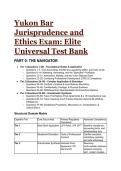
Yukon Bar
Jurisprudence and
Ethics Exam: Elite
Universal Test Bank
PART 0: THE NAVIGATOR
● Tier 1 (Questions 1–28) - Foundational Syntax & Application
○ Questions 1–7: Trust Accounting, Anti-Money Laundering (AML), and Cash Limits
○ Questions 8–14: Marketing, Advertising, and the "Specialist" Prohibition
○ Questions 15–21: Admissions, Mobility, and the Yukon Statutes Exam
○ Questions 22–28: Continuing Professional Development (CPD) & Competency
● Tier 2 (Questions 29–58) - Complex Application & Simulation
○ Questions 29–38: Conflicts of Interest & Joint Retainer Mechanics
○ Questions 39–48: Confidentiality, Privilege, & Physical Evidence
○ Questions 49–58: Withdrawal from Representation & Escrow/Fee Disputes
● Tier 3 (Questions 59–88) - Grandmaster Synthesis
○ Questions 59–68: Yukon First Nations Final Agreements & s. 35 Constitutional Law
○ Questions 69–78: Yukon Supreme Court Practice Direction General-29 (Artificial
Intelligence)
○ Questions 79–88: Disciplinary Procedures, Misconduct vs. Incompetence, &
Judicial Ethics
Structural Domain Matrix
Cognitive Tier Core Focus Area Primary Regulatory Assessed Competency
Framework
Tier 1 Hard-Deck Application LSY Rules, LPA 2017 Baseline compliance,
accounting limits, and
administrative duty.
Tier 2 Situational Simulation Code of Professional Conflict resolution,
Conduct mandatory reporting,
and safe withdrawal.
Tier 3 Grandmaster Synthesis Umbrella Final Resolving
Agreement, PD multi-variable collisions
General-29 between emerging
tech, modern treaties,
,Cognitive Tier Core Focus Area Primary Regulatory Assessed Competency
Framework
and tribunal candor.
PART I: THE PRIMER
Mastering the Yukon Code of Professional Conduct and the Legal Profession Act, 2017 bridges
the gap between basic legal competence and elite, defensible practice in a unique northern
jurisdiction. By isolating the exact friction points between strict trust accounting, constitutionally
protected Indigenous legal traditions, and modern technological mandates, this document
forges scholars capable of dominating both the Yukon Statutes Exam and high-stakes ethical
tribunals.
● The Trust Account Firewall: Only client funds advanceable for unbilled services go into
trust. General firm retainers and billed fees must stay out. Cash is strictly limited;
receiving $7,500 or more in cash is prohibited unless explicitly for professional fees,
disbursements, or bail, and refunds must also be in cash.
● The Generative AI Mandate: Under Yukon Supreme Court Practice Direction
General-29, reliance on AI (e.g., ChatGPT) for research or submissions strictly requires
proactive disclosure of the tool and its purpose.
● The Joint Retainer Blackout: When representing multiple clients jointly, there are no
secrets. If a contentious issue arises that requires legal advice, the lawyer must withdraw
from both, unless specific prior consent and sophisticated party exceptions apply.
● The "Specialist" Prohibition: Under Rule 4.3-1, a Yukon lawyer cannot advertise as a
"specialist" in any field unless explicitly certified by the Law Society of Yukon.
● The Final Agreement Supremacy: Yukon operates under the Umbrella Final Agreement
and 11 Self-Government Agreements. These are s. 35 constitutionally protected treaties,
rendering them supreme over conflicting territorial laws.
PART II: THE ELITE TEST BANK
Q1: A Yukon lawyer receives a $5,000 general retainer from a client. The lawyer is not obligated
to account for these specific funds against hourly billing. Under the Rules of the Law Society of
Yukon, the lawyer FIRST deposits this into: A) The firm's interest-bearing trust account, pending
allocation. B) A separate, client-specific interest-bearing trust account. C) The firm's general
operating account. D) An escrow account monitored by the Law Society.
● The Answer: C (The firm's general operating account.)
● Distractor Analysis:
○ A is incorrect: Money belonging entirely to the firm, including general retainers
without obligation to account, must not be deposited into trust.
○ B is incorrect: Client-specific trust accounts are strictly for holding client trust funds.
○ D is incorrect: Escrow accounts are not standard operating procedure for general
firm retainers.
The Mentor's Analysis: Trust accounts are exclusively for client money. A general retainer
without an accounting obligation is earned upon receipt and constitutes firm money.
Professional/Academic Intuition: Commingling firm funds in a trust account is an absolute
ethical breach.
Q2: A client brings $8,000 in physical cash to pay for outstanding legal fees. Under Yukon's
Anti-Money Laundering (AML) Rules, the lawyer's MOST APPROPRIATE action is to: A) Accept
,the cash, as it is under the $10,000 federal FINTRAC reporting threshold. B) Refuse the cash
entirely, as the amount exceeds the $7,500 cash limit exception for professional fees and
disbursements. C) Accept the cash, as the Yukon exception allows $7,500 or more strictly for
professional fees and disbursements. D) Deposit the cash into the trust account and
immediately notify the Law Society.
● The Answer: C (Accept the cash, as the Yukon exception allows $7,500 or more strictly
for professional fees and disbursements.)
● Distractor Analysis:
○ A is incorrect: FINTRAC thresholds are separate from Law Society rules, which
govern the intake of physical cash.
○ B is incorrect: Rule 170(4)(d) specifically provides an exception allowing the receipt
of cash "in an amount of $7,500 or more for professional fees, disbursements or
bail".
○ D is incorrect: Earned fees cannot go into the trust account; they must go to
operating.
The Mentor's Analysis: Law societies heavily restrict cash to combat money laundering.
However, the Yukon explicitly protects a lawyer's ability to be paid for their services or post bail,
provided any subsequent refund is also in cash. Professional/Academic Intuition: Cash is
heavily restricted, but professional fees and bail are the statutory exceptions.
Q3: A Yukon lawyer updates their website to read: "Jane Doe, Specialist in Yukon First Nations
Land Claims." Jane has practiced exclusively in this area for 20 years. Under Rule 4.3-1, this
marketing is: A) Permitted, because her 20 years of experience makes the statement factually
true. B) Permitted, provided she includes a disclaimer about past results. C) Prohibited,
because she must be formally certified by the Society to use the term "specialist." D) Prohibited,
because Indigenous law cannot be advertised as a specialty.
● The Answer: C (Prohibited, because she must be formally certified by the Society to use
the term "specialist.")
● Distractor Analysis:
○ A is incorrect: Factual experience does not override the regulatory requirement for
formal certification.
○ B is incorrect: A disclaimer does not cure the unauthorized use of the word
"specialist."
○ D is incorrect: Indigenous law is a valid practice area, but the term "specialist" is
highly regulated.
The Mentor's Analysis: The term "specialist" is a protected designation. You may advertise a
"preferred area of practice," but you cannot claim specialization without the governing body's
explicit certification. Professional/Academic Intuition: Experience equals proficiency, but only
the Law Society grants specialty.
Q4: An articled student from British Columbia wishes to be called to the Yukon Bar. To satisfy
the Credentials Committee, the student MUST successfully complete: A) The British Columbia
Professional Legal Training Course (PLTC) only. B) A 5-year apprenticeship with a Yukon
practitioner. C) The Yukon statutes exam, alongside an approved bar admission course. D) A
comprehensive oral examination by the Chief Judge of the Territorial Court.
● The Answer: C (The Yukon statutes exam, alongside an approved bar admission course.)
● Distractor Analysis:
○ A is incorrect: BC PLTC alone is insufficient; the Yukon-specific statutes exam is
mandatory for articled students.
○ B is incorrect: 5-year apprenticeships are an outdated legacy concept.
, ○ D is incorrect: The Chief Judge does not administer oral bar exams for standard
articled students.
The Mentor's Analysis: Jurisdictional competence requires local knowledge. Yukon mandates a
specific examination on federal and Yukon enactments to ensure candidates understand the
unique northern legal landscape. Professional/Academic Intuition: Local statutes require local
testing.
Q5: A lawyer withdraws $1,000 from the firm's trust account to pay their own fees. The lawyer
has completed the work but has NOT yet sent the client an invoice or written notification. This
action is: A) Permitted, as the work was completed and the funds were earned. B) Permitted,
provided the lawyer bills the client within 30 days. C) Prohibited, because fees cannot be drawn
from trust without prior or concurrent billing/written notification. D) Prohibited, because lawyers
cannot pay themselves directly from a trust account.
● The Answer: C (Prohibited, because fees cannot be drawn from trust without prior or
concurrent billing/written notification.)
● Distractor Analysis:
○ A is incorrect: Earning the fees is necessary but not sufficient; procedural
notification is required.
○ B is incorrect: Post-withdrawal billing violates the chronological prerequisite for trust
transfers.
○ D is incorrect: Lawyers can pay themselves from trust, provided the procedural
steps (billing) are met.
The Mentor's Analysis: Trust funds remain the client's property until a bill is rendered.
Transferring funds before billing is misappropriation, regardless of whether the work was done.
Professional/Academic Intuition: Invoice first, transfer second.
Q6: A notary from the Chambre des notaires du Québec wishes to practice in the Yukon. Under
the Rules of the Law Society of Yukon, they IMMEDIATELY qualify to apply for admission as: A)
A fully licensed Yukon Barrister and Solicitor. B) A Canadian Legal Advisor. C) An Articled
Student. D) A Territorial Court Deputy Judge.
● The Answer: B (A Canadian Legal Advisor.)
● Distractor Analysis:
○ A is incorrect: Quebec Notaries are civil law practitioners; they cannot automatically
become common law Barristers without NCA equivalency.
○ C is incorrect: They are already licensed professionals, not students, and apply
under a specific mobility rule.
○ D is incorrect: Judicial appointments are entirely separate from Law Society
admissions.
The Mentor's Analysis: The mobility rules recognize the unique status of Quebec Notaries,
allowing them a limited scope of practice in common law jurisdictions under a specific
designation. Professional/Academic Intuition: Civil law notaries enter common law provinces
as Canadian Legal Advisors.
Q7: A Yukon lawyer is retained by a new corporate client for a complex real estate transaction.
The lawyer obtains the client's articles of incorporation but fails to verify the identity of the
individual giving instructions on behalf of the organization within 60 days. Under Yukon AML
rules, this is: A) Permitted, as corporate clients do not require individual identity verification. B)
Prohibited, as the lawyer must verify the identity of the instructing individual upon engaging in
fund-transfer activities. C) Permitted, because the 60-day limit only applies to individual
persons, not corporations. D) Prohibited, because all identity verification must be completed
within 24 hours.
Jurisprudence and
Ethics Exam: Elite
Universal Test Bank
PART 0: THE NAVIGATOR
● Tier 1 (Questions 1–28) - Foundational Syntax & Application
○ Questions 1–7: Trust Accounting, Anti-Money Laundering (AML), and Cash Limits
○ Questions 8–14: Marketing, Advertising, and the "Specialist" Prohibition
○ Questions 15–21: Admissions, Mobility, and the Yukon Statutes Exam
○ Questions 22–28: Continuing Professional Development (CPD) & Competency
● Tier 2 (Questions 29–58) - Complex Application & Simulation
○ Questions 29–38: Conflicts of Interest & Joint Retainer Mechanics
○ Questions 39–48: Confidentiality, Privilege, & Physical Evidence
○ Questions 49–58: Withdrawal from Representation & Escrow/Fee Disputes
● Tier 3 (Questions 59–88) - Grandmaster Synthesis
○ Questions 59–68: Yukon First Nations Final Agreements & s. 35 Constitutional Law
○ Questions 69–78: Yukon Supreme Court Practice Direction General-29 (Artificial
Intelligence)
○ Questions 79–88: Disciplinary Procedures, Misconduct vs. Incompetence, &
Judicial Ethics
Structural Domain Matrix
Cognitive Tier Core Focus Area Primary Regulatory Assessed Competency
Framework
Tier 1 Hard-Deck Application LSY Rules, LPA 2017 Baseline compliance,
accounting limits, and
administrative duty.
Tier 2 Situational Simulation Code of Professional Conflict resolution,
Conduct mandatory reporting,
and safe withdrawal.
Tier 3 Grandmaster Synthesis Umbrella Final Resolving
Agreement, PD multi-variable collisions
General-29 between emerging
tech, modern treaties,
,Cognitive Tier Core Focus Area Primary Regulatory Assessed Competency
Framework
and tribunal candor.
PART I: THE PRIMER
Mastering the Yukon Code of Professional Conduct and the Legal Profession Act, 2017 bridges
the gap between basic legal competence and elite, defensible practice in a unique northern
jurisdiction. By isolating the exact friction points between strict trust accounting, constitutionally
protected Indigenous legal traditions, and modern technological mandates, this document
forges scholars capable of dominating both the Yukon Statutes Exam and high-stakes ethical
tribunals.
● The Trust Account Firewall: Only client funds advanceable for unbilled services go into
trust. General firm retainers and billed fees must stay out. Cash is strictly limited;
receiving $7,500 or more in cash is prohibited unless explicitly for professional fees,
disbursements, or bail, and refunds must also be in cash.
● The Generative AI Mandate: Under Yukon Supreme Court Practice Direction
General-29, reliance on AI (e.g., ChatGPT) for research or submissions strictly requires
proactive disclosure of the tool and its purpose.
● The Joint Retainer Blackout: When representing multiple clients jointly, there are no
secrets. If a contentious issue arises that requires legal advice, the lawyer must withdraw
from both, unless specific prior consent and sophisticated party exceptions apply.
● The "Specialist" Prohibition: Under Rule 4.3-1, a Yukon lawyer cannot advertise as a
"specialist" in any field unless explicitly certified by the Law Society of Yukon.
● The Final Agreement Supremacy: Yukon operates under the Umbrella Final Agreement
and 11 Self-Government Agreements. These are s. 35 constitutionally protected treaties,
rendering them supreme over conflicting territorial laws.
PART II: THE ELITE TEST BANK
Q1: A Yukon lawyer receives a $5,000 general retainer from a client. The lawyer is not obligated
to account for these specific funds against hourly billing. Under the Rules of the Law Society of
Yukon, the lawyer FIRST deposits this into: A) The firm's interest-bearing trust account, pending
allocation. B) A separate, client-specific interest-bearing trust account. C) The firm's general
operating account. D) An escrow account monitored by the Law Society.
● The Answer: C (The firm's general operating account.)
● Distractor Analysis:
○ A is incorrect: Money belonging entirely to the firm, including general retainers
without obligation to account, must not be deposited into trust.
○ B is incorrect: Client-specific trust accounts are strictly for holding client trust funds.
○ D is incorrect: Escrow accounts are not standard operating procedure for general
firm retainers.
The Mentor's Analysis: Trust accounts are exclusively for client money. A general retainer
without an accounting obligation is earned upon receipt and constitutes firm money.
Professional/Academic Intuition: Commingling firm funds in a trust account is an absolute
ethical breach.
Q2: A client brings $8,000 in physical cash to pay for outstanding legal fees. Under Yukon's
Anti-Money Laundering (AML) Rules, the lawyer's MOST APPROPRIATE action is to: A) Accept
,the cash, as it is under the $10,000 federal FINTRAC reporting threshold. B) Refuse the cash
entirely, as the amount exceeds the $7,500 cash limit exception for professional fees and
disbursements. C) Accept the cash, as the Yukon exception allows $7,500 or more strictly for
professional fees and disbursements. D) Deposit the cash into the trust account and
immediately notify the Law Society.
● The Answer: C (Accept the cash, as the Yukon exception allows $7,500 or more strictly
for professional fees and disbursements.)
● Distractor Analysis:
○ A is incorrect: FINTRAC thresholds are separate from Law Society rules, which
govern the intake of physical cash.
○ B is incorrect: Rule 170(4)(d) specifically provides an exception allowing the receipt
of cash "in an amount of $7,500 or more for professional fees, disbursements or
bail".
○ D is incorrect: Earned fees cannot go into the trust account; they must go to
operating.
The Mentor's Analysis: Law societies heavily restrict cash to combat money laundering.
However, the Yukon explicitly protects a lawyer's ability to be paid for their services or post bail,
provided any subsequent refund is also in cash. Professional/Academic Intuition: Cash is
heavily restricted, but professional fees and bail are the statutory exceptions.
Q3: A Yukon lawyer updates their website to read: "Jane Doe, Specialist in Yukon First Nations
Land Claims." Jane has practiced exclusively in this area for 20 years. Under Rule 4.3-1, this
marketing is: A) Permitted, because her 20 years of experience makes the statement factually
true. B) Permitted, provided she includes a disclaimer about past results. C) Prohibited,
because she must be formally certified by the Society to use the term "specialist." D) Prohibited,
because Indigenous law cannot be advertised as a specialty.
● The Answer: C (Prohibited, because she must be formally certified by the Society to use
the term "specialist.")
● Distractor Analysis:
○ A is incorrect: Factual experience does not override the regulatory requirement for
formal certification.
○ B is incorrect: A disclaimer does not cure the unauthorized use of the word
"specialist."
○ D is incorrect: Indigenous law is a valid practice area, but the term "specialist" is
highly regulated.
The Mentor's Analysis: The term "specialist" is a protected designation. You may advertise a
"preferred area of practice," but you cannot claim specialization without the governing body's
explicit certification. Professional/Academic Intuition: Experience equals proficiency, but only
the Law Society grants specialty.
Q4: An articled student from British Columbia wishes to be called to the Yukon Bar. To satisfy
the Credentials Committee, the student MUST successfully complete: A) The British Columbia
Professional Legal Training Course (PLTC) only. B) A 5-year apprenticeship with a Yukon
practitioner. C) The Yukon statutes exam, alongside an approved bar admission course. D) A
comprehensive oral examination by the Chief Judge of the Territorial Court.
● The Answer: C (The Yukon statutes exam, alongside an approved bar admission course.)
● Distractor Analysis:
○ A is incorrect: BC PLTC alone is insufficient; the Yukon-specific statutes exam is
mandatory for articled students.
○ B is incorrect: 5-year apprenticeships are an outdated legacy concept.
, ○ D is incorrect: The Chief Judge does not administer oral bar exams for standard
articled students.
The Mentor's Analysis: Jurisdictional competence requires local knowledge. Yukon mandates a
specific examination on federal and Yukon enactments to ensure candidates understand the
unique northern legal landscape. Professional/Academic Intuition: Local statutes require local
testing.
Q5: A lawyer withdraws $1,000 from the firm's trust account to pay their own fees. The lawyer
has completed the work but has NOT yet sent the client an invoice or written notification. This
action is: A) Permitted, as the work was completed and the funds were earned. B) Permitted,
provided the lawyer bills the client within 30 days. C) Prohibited, because fees cannot be drawn
from trust without prior or concurrent billing/written notification. D) Prohibited, because lawyers
cannot pay themselves directly from a trust account.
● The Answer: C (Prohibited, because fees cannot be drawn from trust without prior or
concurrent billing/written notification.)
● Distractor Analysis:
○ A is incorrect: Earning the fees is necessary but not sufficient; procedural
notification is required.
○ B is incorrect: Post-withdrawal billing violates the chronological prerequisite for trust
transfers.
○ D is incorrect: Lawyers can pay themselves from trust, provided the procedural
steps (billing) are met.
The Mentor's Analysis: Trust funds remain the client's property until a bill is rendered.
Transferring funds before billing is misappropriation, regardless of whether the work was done.
Professional/Academic Intuition: Invoice first, transfer second.
Q6: A notary from the Chambre des notaires du Québec wishes to practice in the Yukon. Under
the Rules of the Law Society of Yukon, they IMMEDIATELY qualify to apply for admission as: A)
A fully licensed Yukon Barrister and Solicitor. B) A Canadian Legal Advisor. C) An Articled
Student. D) A Territorial Court Deputy Judge.
● The Answer: B (A Canadian Legal Advisor.)
● Distractor Analysis:
○ A is incorrect: Quebec Notaries are civil law practitioners; they cannot automatically
become common law Barristers without NCA equivalency.
○ C is incorrect: They are already licensed professionals, not students, and apply
under a specific mobility rule.
○ D is incorrect: Judicial appointments are entirely separate from Law Society
admissions.
The Mentor's Analysis: The mobility rules recognize the unique status of Quebec Notaries,
allowing them a limited scope of practice in common law jurisdictions under a specific
designation. Professional/Academic Intuition: Civil law notaries enter common law provinces
as Canadian Legal Advisors.
Q7: A Yukon lawyer is retained by a new corporate client for a complex real estate transaction.
The lawyer obtains the client's articles of incorporation but fails to verify the identity of the
individual giving instructions on behalf of the organization within 60 days. Under Yukon AML
rules, this is: A) Permitted, as corporate clients do not require individual identity verification. B)
Prohibited, as the lawyer must verify the identity of the instructing individual upon engaging in
fund-transfer activities. C) Permitted, because the 60-day limit only applies to individual
persons, not corporations. D) Prohibited, because all identity verification must be completed
within 24 hours.


