

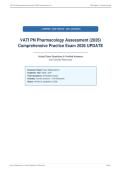
VATI PN Pharmacology Assessment (2026) Comprehensive Pr… 2026 Update • Verified Answers
✓ VERIFIED • 2026 UPDATE • 100% ACCURATE
VATI PN Pharmacology Assessment (2026)
Comprehensive Practice Exam 2026 UPDATE
Actual Exam Questions & Verified Answers
with Detailed Rationales
Document Type: Exam (Elaborations)
Academic Year:
Total Questions: 50 Multiple Choice
Includes: Correct Answers + Full Rationales
Status: Verified & Updated for 2026
Exam (Elaborations) • Actual Questions & Rationales Page 1
,VATI PN Pharmacology Assessment (2026) Comprehensive Pr… 2026 Update • Verified Answers
Questions & Verified Answers
1. A nurse is preparing to administer digoxin to a client with heart failure. Which of the
following findings should indicate to the nurse that the medication should be withheld?
A. Blood pressure of 110/70 mm Hg
B. Potassium level of 4.2 mEq/L
C. Apical heart rate of 52/min
D. Respiratory rate of 18/min
Answer: C
Rationale: Digoxin is a cardiac glycoside that slows the heart rate. It should be withheld if the apical pulse is
less than 60/min in an adult to avoid worsening bradycardia. Applying this knowledge in clinical settings
supports safe, evidence-based practice and improves patient outcomes.
2. A nurse is caring for a client who is receiving a continuous intravenous heparin infusion.
Which of the following laboratory tests should the nurse monitor to adjust the dosage?
A. Activated partial thromboplastin time (aPTT)
B. International Normalized Ratio (INR)
C. Prothrombin time (PT)
D. Platelet count
Answer: A
Rationale: The aPTT is used to monitor the effectiveness of heparin therapy. PT and INR are typically used for
warfarin therapy monitoring. Exam questions often test the ability to distinguish this concept from closely
related distractors, making a clear rationale essential for mastery. Applying this knowledge in clinical settings
supports safe, evidence-based practice and improves patient outcomes.
3. A client is prescribed spironolactone for the treatment of hypertension. Which of the
following electrolyte imbalances should the nurse monitor for?
A. Hypokalemia
B. Hypernatremia
C. Hypocalcemia
D. Hyperkalemia
Answer: D
Rationale: Spironolactone is a potassium-sparing diuretic, which can lead to the retention of potassium and
result in hyperkalemia. Applying this knowledge in clinical settings supports safe, evidence-based practice and
improves patient outcomes. This is an important clinical concept because selecting the correct answer (D)
requires understanding both the pathophysiology and the practical nursing implications.
Exam (Elaborations) • Actual Questions & Rationales Page 2
, VATI PN Pharmacology Assessment (2026) Comprehensive Pr… 2026 Update • Verified Answers
4. A nurse is teaching a client who has a new prescription for albuterol via a metered-dose
inhaler. Which of the following instructions should the nurse include?
A. Rinse your mouth with water immediately after use.
B. Exhale quickly after inhaling the medication.
C. This medication is for long-term maintenance of asthma.
D. Wait 1 minute between puffs if two puffs are prescribed.
Answer: D
Rationale: Waiting 1 minute between puffs allows the first puff to dilate the airways, enabling the second puff to
penetrate deeper into the lungs. Applying this knowledge in clinical settings supports safe, evidence-based
practice and improves patient outcomes. This is an important clinical concept because selecting the correct
answer (D) requires understanding both the pathophysiology and the practical nursing implications.
5. A client is receiving vancomycin for a MRSA infection. The nurse should monitor for which of
the following adverse effects that indicates ‘Red Man Syndrome’?
A. Severe hypertension and bradycardia
B. Localized swelling at the injection site
C. Flushing, rash, and pruritus on the face and neck
D. Yellowing of the sclera and skin
Answer: C
Rationale: Red Man Syndrome is an infusion-related reaction to vancomycin characterized by flushing and a
rash on the upper body, often caused by rapid infusion. Exam questions often test the ability to distinguish this
concept from closely related distractors, making a clear rationale essential for mastery. Applying this knowledge
in clinical settings supports safe, evidence-based practice and improves patient outcomes.
6. A nurse is reviewing the lab results for a client taking furosemide. Which of the following
results should be reported to the provider?
A. Sodium 138 mEq/L
B. Glucose 105 mg/dL
C. Potassium 3.1 mEq/L
D. BUN 18 mg/dL
Answer: C
Rationale: Furosemide is a loop diuretic that causes the excretion of potassium. A level of. Recognizing this
principle allows the nurse to prioritize care, anticipate complications, and provide accurate patient education.
Exam questions often test the ability to distinguish this concept from closely related distractors, making a clear
rationale essential for mastery.
Exam (Elaborations) • Actual Questions & Rationales Page 3
✓ VERIFIED • 2026 UPDATE • 100% ACCURATE
VATI PN Pharmacology Assessment (2026)
Comprehensive Practice Exam 2026 UPDATE
Actual Exam Questions & Verified Answers
with Detailed Rationales
Document Type: Exam (Elaborations)
Academic Year:
Total Questions: 50 Multiple Choice
Includes: Correct Answers + Full Rationales
Status: Verified & Updated for 2026
Exam (Elaborations) • Actual Questions & Rationales Page 1
,VATI PN Pharmacology Assessment (2026) Comprehensive Pr… 2026 Update • Verified Answers
Questions & Verified Answers
1. A nurse is preparing to administer digoxin to a client with heart failure. Which of the
following findings should indicate to the nurse that the medication should be withheld?
A. Blood pressure of 110/70 mm Hg
B. Potassium level of 4.2 mEq/L
C. Apical heart rate of 52/min
D. Respiratory rate of 18/min
Answer: C
Rationale: Digoxin is a cardiac glycoside that slows the heart rate. It should be withheld if the apical pulse is
less than 60/min in an adult to avoid worsening bradycardia. Applying this knowledge in clinical settings
supports safe, evidence-based practice and improves patient outcomes.
2. A nurse is caring for a client who is receiving a continuous intravenous heparin infusion.
Which of the following laboratory tests should the nurse monitor to adjust the dosage?
A. Activated partial thromboplastin time (aPTT)
B. International Normalized Ratio (INR)
C. Prothrombin time (PT)
D. Platelet count
Answer: A
Rationale: The aPTT is used to monitor the effectiveness of heparin therapy. PT and INR are typically used for
warfarin therapy monitoring. Exam questions often test the ability to distinguish this concept from closely
related distractors, making a clear rationale essential for mastery. Applying this knowledge in clinical settings
supports safe, evidence-based practice and improves patient outcomes.
3. A client is prescribed spironolactone for the treatment of hypertension. Which of the
following electrolyte imbalances should the nurse monitor for?
A. Hypokalemia
B. Hypernatremia
C. Hypocalcemia
D. Hyperkalemia
Answer: D
Rationale: Spironolactone is a potassium-sparing diuretic, which can lead to the retention of potassium and
result in hyperkalemia. Applying this knowledge in clinical settings supports safe, evidence-based practice and
improves patient outcomes. This is an important clinical concept because selecting the correct answer (D)
requires understanding both the pathophysiology and the practical nursing implications.
Exam (Elaborations) • Actual Questions & Rationales Page 2
, VATI PN Pharmacology Assessment (2026) Comprehensive Pr… 2026 Update • Verified Answers
4. A nurse is teaching a client who has a new prescription for albuterol via a metered-dose
inhaler. Which of the following instructions should the nurse include?
A. Rinse your mouth with water immediately after use.
B. Exhale quickly after inhaling the medication.
C. This medication is for long-term maintenance of asthma.
D. Wait 1 minute between puffs if two puffs are prescribed.
Answer: D
Rationale: Waiting 1 minute between puffs allows the first puff to dilate the airways, enabling the second puff to
penetrate deeper into the lungs. Applying this knowledge in clinical settings supports safe, evidence-based
practice and improves patient outcomes. This is an important clinical concept because selecting the correct
answer (D) requires understanding both the pathophysiology and the practical nursing implications.
5. A client is receiving vancomycin for a MRSA infection. The nurse should monitor for which of
the following adverse effects that indicates ‘Red Man Syndrome’?
A. Severe hypertension and bradycardia
B. Localized swelling at the injection site
C. Flushing, rash, and pruritus on the face and neck
D. Yellowing of the sclera and skin
Answer: C
Rationale: Red Man Syndrome is an infusion-related reaction to vancomycin characterized by flushing and a
rash on the upper body, often caused by rapid infusion. Exam questions often test the ability to distinguish this
concept from closely related distractors, making a clear rationale essential for mastery. Applying this knowledge
in clinical settings supports safe, evidence-based practice and improves patient outcomes.
6. A nurse is reviewing the lab results for a client taking furosemide. Which of the following
results should be reported to the provider?
A. Sodium 138 mEq/L
B. Glucose 105 mg/dL
C. Potassium 3.1 mEq/L
D. BUN 18 mg/dL
Answer: C
Rationale: Furosemide is a loop diuretic that causes the excretion of potassium. A level of. Recognizing this
principle allows the nurse to prioritize care, anticipate complications, and provide accurate patient education.
Exam questions often test the ability to distinguish this concept from closely related distractors, making a clear
rationale essential for mastery.
Exam (Elaborations) • Actual Questions & Rationales Page 3


