

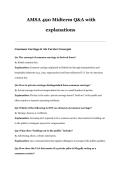
AMSA 490 Midterm Q&A with
explanations
Common Carriage & Air Carrier Concepts
Q1: The concept of common carriage is derived from?
A: British common law.
Explanation: Common carriage originated in British law through transportation and
hospitality industries (e.g., inns, stagecoaches) and later influenced U.S. law via American
common law.
Q2: How is private carriage distinguished from common carriage?
A: Private carriage involves transportation for one or a small number of parties.
Explanation: The key is the scale—private carriage doesn’t “hold out” to the public and
often requires a separate operating certificate.
Q3: Which of the following is NOT an element of common carriage?
A: Having a license or certificate.
Explanation: Licensing isn’t required to be a common carrier; what matters is holding out
to the public to transport anyone for compensation.
Q4: What does “holding out to the public” include?
A: Advertising, flyers, website statements.
Explanation: Any communication that signals willingness to transport the public qualifies.
Q5: How does the FAA determine if a private pilot is illegally acting as a
common carrier?
, A: By using the independent interest test.
Explanation: If the pilot only flies for payment and has no independent interest in the trip,
it may constitute illegal common carriage.
Q6: Can a commercial pilot charge for pipeline patrols?
A: Yes.
Explanation: Certain activities like pipeline patrols are specifically excluded from requiring
an air carrier certificate under 14 CFR 119.1(e)(4)(vi).
FAA Regulations & Air Carrier Operations
Q7: A company must operate under 14 CFR Part 121 if it is?
A: A domestic, flag, or supplemental operation.
Explanation: Part 121 governs larger, scheduled operations, while Part 135 covers
commuter and on-demand operations.
Q8: What certificate is required for a turbo-prop aircraft with 8 seats flying
scheduled trips fewer than 5 per week?
A: Part 135 operating certificate.
Explanation: Part 135 covers smaller, non-turbojet aircraft with fewer than 9 passenger
seats on scheduled or on-demand flights.
Q9: What is the potential penalty for operating without a Part 135 certificate?
A: $11,000 per applicable provision per flight.
Explanation: The FAA treats violations as if the operator held the certificate, applying fines
for each regulatory requirement per flight.
Q10: What is operational control?
A: The carrier is the final authority over initiating, conducting, and terminating a flight.
explanations
Common Carriage & Air Carrier Concepts
Q1: The concept of common carriage is derived from?
A: British common law.
Explanation: Common carriage originated in British law through transportation and
hospitality industries (e.g., inns, stagecoaches) and later influenced U.S. law via American
common law.
Q2: How is private carriage distinguished from common carriage?
A: Private carriage involves transportation for one or a small number of parties.
Explanation: The key is the scale—private carriage doesn’t “hold out” to the public and
often requires a separate operating certificate.
Q3: Which of the following is NOT an element of common carriage?
A: Having a license or certificate.
Explanation: Licensing isn’t required to be a common carrier; what matters is holding out
to the public to transport anyone for compensation.
Q4: What does “holding out to the public” include?
A: Advertising, flyers, website statements.
Explanation: Any communication that signals willingness to transport the public qualifies.
Q5: How does the FAA determine if a private pilot is illegally acting as a
common carrier?
, A: By using the independent interest test.
Explanation: If the pilot only flies for payment and has no independent interest in the trip,
it may constitute illegal common carriage.
Q6: Can a commercial pilot charge for pipeline patrols?
A: Yes.
Explanation: Certain activities like pipeline patrols are specifically excluded from requiring
an air carrier certificate under 14 CFR 119.1(e)(4)(vi).
FAA Regulations & Air Carrier Operations
Q7: A company must operate under 14 CFR Part 121 if it is?
A: A domestic, flag, or supplemental operation.
Explanation: Part 121 governs larger, scheduled operations, while Part 135 covers
commuter and on-demand operations.
Q8: What certificate is required for a turbo-prop aircraft with 8 seats flying
scheduled trips fewer than 5 per week?
A: Part 135 operating certificate.
Explanation: Part 135 covers smaller, non-turbojet aircraft with fewer than 9 passenger
seats on scheduled or on-demand flights.
Q9: What is the potential penalty for operating without a Part 135 certificate?
A: $11,000 per applicable provision per flight.
Explanation: The FAA treats violations as if the operator held the certificate, applying fines
for each regulatory requirement per flight.
Q10: What is operational control?
A: The carrier is the final authority over initiating, conducting, and terminating a flight.


