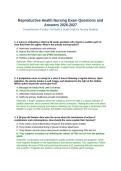
Reproductive Health Nursing Exam Questions and
Answers 2026-2027
Comprehensive Practice Test Bank & Study Guide for Nursing Students
1. A nurse is evaluating a client at 36 weeks gestation who reports a sudden gush of
clear fluid from the vagina. What is the priority nursing action?
A. Administer prophylactic oral antibiotics.
B. Instruct the client to take a warm bath to promote relaxation.
C. Assess the fetal heart rate (FHR) immediately.
D. Perform a sterile vaginal exam to check cervical dilation.
Rationale: When membranes rupture, there is an immediate risk of umbilical cord prolapse.
Checking the fetal heart rate right away helps detect cord compression, which manifests as
severe variable decelerations or bradycardia. A vaginal exam should be avoided until rupture
is confirmed and cord prolapse is ruled out.
2. A postpartum nurse is caring for a client 2 hours following a vaginal delivery. Upon
palpation, the uterine fundus is soft, boggy, and displaced to the right of the midline.
Which action should the nurse take first?
A. Massage the fundus firmly until it contracts.
B. Assist the client to empty her bladder.
C. Administer intramuscular oxytocin as ordered.
D. Notify the primary healthcare provider immediately.
Rationale: A fundus displaced above the umbilicus and to the right is a classic indicator of
bladder distention, which prevents effective uterine contraction. Helping the client void allows
the uterus to contract properly and reduces bleeding risk. Fundal massage is performed if the
bladder is empty or while assisting, but bladder evacuation addresses the root cause.
3. A 28-year-old female client asks the nurse about the mechanism of action of
combination oral contraceptives. How should the nurse explain their function?
A. They create a local inflammatory response that inhibits sperm motility.
B. They thicken endometrial lining to prevent embryo attachment.
C. They thicken cervical mucus and prevent ovulation by suppressing FSH and LH.
D. They suppress ovulation by inhibiting the release of FSH and LH from the pituitary
gland.
Rationale: Combination oral contraceptives supply synthetic estrogen and progestin, which
exert negative feedback on the hypothalamus and anterior pituitary. This suppresses Follicle-
Stimulating Hormone (FSH) and Luteinizing Hormone (LH), preventing follicular maturation
and ovulation. Progestin also thickens cervical mucus to impede sperm passage.
,4. A nurse is monitoring a client receiving an IV oxytocin infusion for labor induction.
Which contraction pattern requires immediate intervention and discontinuation of
oxytocin?
A. Contractions occurring every 90 seconds, lasting 100 seconds with high baseline
uterine tone.
B. Contractions occurring every 3 minutes, lasting 60 seconds with relaxed inter-contraction
interval.
C. Contractions occurring every 4 minutes, lasting 50 seconds.
D. Contractions occurring every 2.5 minutes, lasting 70 seconds.
Rationale: Uterine tachysystole (more than 5 contractions in 10 minutes or contractions
lasting longer than 90 seconds) reduces uteroplacental blood flow, leading to fetal hypoxia.
Stopping oxytocin immediately allows the uterus to rest and restores placental perfusion.
5. A pregnant client at 32 weeks gestation presents with painless, bright red vaginal
bleeding. What condition should the nurse suspect?
A. Abruptio placentae
B. Placenta previa
C. Uterine rupture
D. Cervical incompetence
Rationale: Painless, bright red vaginal bleeding during the third trimester is the hallmark
symptom of placenta previa, where the placenta covers the internal cervical os. Abruptio
placentae typically presents with dark red bleeding accompanied by sharp, severe abdominal
pain.
6. A nurse is providing education to a postpartum client who chooses to formula-feed her
newborn. Which instruction should the nurse include to relieve breast engorgement?
A. Express milk manually three times a day to relieve pressure.
B. Wear a supportive, well-fitting bra continuously for 24 hours a day.
C. Apply warm compresses to the breasts before feedings.
D. Massage the breasts gently from the chest wall toward the nipple.
Rationale: Non-lactating mothers should avoid all breast stimulation, including manual
expression, warm water, and massage, because stimulation triggers prolactin release and
worsens engorgement. Wearing a supportive bra provides comfort and suppresses lactation.
7. A pregnant client at 12 weeks gestation tests positive for Chlamydia trachomatis.
Which medication is recommended as first-line treatment during pregnancy?
A. Oral Azithromycin single dose.
B. Oral Doxycycline twice daily for 7 days.
C. Intramuscular Ceftriaxone single dose.
D. Oral Ciprofloxacin for 5 days.
Rationale: Oral Azithromycin is safe, effective, and considered the preferred first-line
treatment for chlamydia in pregnant clients. Doxycycline is contraindicated during pregnancy
due to potential bone growth suppression and tooth discoloration in the fetus.
, 8. During a routine prenatal visit at 28 weeks gestation, a Rh-negative client has a
negative indirect Coombs test. What action should the nurse anticipate?
A. Withhold Rho(D) immune globulin since sensitization has already occurred.
B. Administer Rho(D) immune globulin (RhoGAM) intramuscularly.
C. Schedule an amniocentesis to evaluate fetal blood type.
D. Recheck the indirect Coombs test at 36 weeks before administering treatment.
Rationale: Rho(D) immune globulin is administered routinely at 28 weeks gestation to
unsensitized (indirect Coombs negative) Rh-negative mothers to prevent maternal antibody
formation against Rh-positive fetal red blood cells.
9. A nurse is caring for a client in second-stage labor. The nurse notes early
decelerations on the fetal heart rate monitor tracing. What is the most likely cause of this
finding?
A. Uteroplacental insufficiency
B. Umbilical cord compression
C. Fetal head compression
D. Maternal hypotension
Rationale: Early decelerations mirror uterine contractions and result from transient vagal
stimulation caused by fetal head compression during labor. They are benign, normal
occurrences that do not indicate fetal distress or require emergency intervention.
10. A female client visiting a reproductive health clinic reports severe lower abdominal
pain, purulent cervical discharge, and painful intercourse. Bimanual examination reveals
severe cervical motion tenderness. Which condition does the nurse suspect?
A. Endometriosis
B. Ovarian cyst rupture
C. Pelvic Inflammatory Disease (PID)
D. Pelvic Inflammatory Disease (PID)
Rationale: Pelvic Inflammatory Disease presents with pelvic/lower abdominal pain, cervical
motion tenderness ("chandelier sign"), and purulent discharge. Prompt antibiotic treatment is
vital to prevent long-term complications like tubal scarring, ectopic pregnancy, and infertility.
11. A nurse is reviewing lab results for a primigravida at 16 weeks gestation. The
maternal serum alpha-fetoprotein (MSAFP) level is elevated. Which diagnostic evaluation
should be scheduled next?
A. An obstetric ultrasound examination.
B. Immediate chorionic villus sampling (CVS).
C. Weekly non-stress testing.
D. Repeat MSAFP level in 4 weeks.
Rationale: An elevated MSAFP suggests neural tube defects or multiple gestations, but false
Answers 2026-2027
Comprehensive Practice Test Bank & Study Guide for Nursing Students
1. A nurse is evaluating a client at 36 weeks gestation who reports a sudden gush of
clear fluid from the vagina. What is the priority nursing action?
A. Administer prophylactic oral antibiotics.
B. Instruct the client to take a warm bath to promote relaxation.
C. Assess the fetal heart rate (FHR) immediately.
D. Perform a sterile vaginal exam to check cervical dilation.
Rationale: When membranes rupture, there is an immediate risk of umbilical cord prolapse.
Checking the fetal heart rate right away helps detect cord compression, which manifests as
severe variable decelerations or bradycardia. A vaginal exam should be avoided until rupture
is confirmed and cord prolapse is ruled out.
2. A postpartum nurse is caring for a client 2 hours following a vaginal delivery. Upon
palpation, the uterine fundus is soft, boggy, and displaced to the right of the midline.
Which action should the nurse take first?
A. Massage the fundus firmly until it contracts.
B. Assist the client to empty her bladder.
C. Administer intramuscular oxytocin as ordered.
D. Notify the primary healthcare provider immediately.
Rationale: A fundus displaced above the umbilicus and to the right is a classic indicator of
bladder distention, which prevents effective uterine contraction. Helping the client void allows
the uterus to contract properly and reduces bleeding risk. Fundal massage is performed if the
bladder is empty or while assisting, but bladder evacuation addresses the root cause.
3. A 28-year-old female client asks the nurse about the mechanism of action of
combination oral contraceptives. How should the nurse explain their function?
A. They create a local inflammatory response that inhibits sperm motility.
B. They thicken endometrial lining to prevent embryo attachment.
C. They thicken cervical mucus and prevent ovulation by suppressing FSH and LH.
D. They suppress ovulation by inhibiting the release of FSH and LH from the pituitary
gland.
Rationale: Combination oral contraceptives supply synthetic estrogen and progestin, which
exert negative feedback on the hypothalamus and anterior pituitary. This suppresses Follicle-
Stimulating Hormone (FSH) and Luteinizing Hormone (LH), preventing follicular maturation
and ovulation. Progestin also thickens cervical mucus to impede sperm passage.
,4. A nurse is monitoring a client receiving an IV oxytocin infusion for labor induction.
Which contraction pattern requires immediate intervention and discontinuation of
oxytocin?
A. Contractions occurring every 90 seconds, lasting 100 seconds with high baseline
uterine tone.
B. Contractions occurring every 3 minutes, lasting 60 seconds with relaxed inter-contraction
interval.
C. Contractions occurring every 4 minutes, lasting 50 seconds.
D. Contractions occurring every 2.5 minutes, lasting 70 seconds.
Rationale: Uterine tachysystole (more than 5 contractions in 10 minutes or contractions
lasting longer than 90 seconds) reduces uteroplacental blood flow, leading to fetal hypoxia.
Stopping oxytocin immediately allows the uterus to rest and restores placental perfusion.
5. A pregnant client at 32 weeks gestation presents with painless, bright red vaginal
bleeding. What condition should the nurse suspect?
A. Abruptio placentae
B. Placenta previa
C. Uterine rupture
D. Cervical incompetence
Rationale: Painless, bright red vaginal bleeding during the third trimester is the hallmark
symptom of placenta previa, where the placenta covers the internal cervical os. Abruptio
placentae typically presents with dark red bleeding accompanied by sharp, severe abdominal
pain.
6. A nurse is providing education to a postpartum client who chooses to formula-feed her
newborn. Which instruction should the nurse include to relieve breast engorgement?
A. Express milk manually three times a day to relieve pressure.
B. Wear a supportive, well-fitting bra continuously for 24 hours a day.
C. Apply warm compresses to the breasts before feedings.
D. Massage the breasts gently from the chest wall toward the nipple.
Rationale: Non-lactating mothers should avoid all breast stimulation, including manual
expression, warm water, and massage, because stimulation triggers prolactin release and
worsens engorgement. Wearing a supportive bra provides comfort and suppresses lactation.
7. A pregnant client at 12 weeks gestation tests positive for Chlamydia trachomatis.
Which medication is recommended as first-line treatment during pregnancy?
A. Oral Azithromycin single dose.
B. Oral Doxycycline twice daily for 7 days.
C. Intramuscular Ceftriaxone single dose.
D. Oral Ciprofloxacin for 5 days.
Rationale: Oral Azithromycin is safe, effective, and considered the preferred first-line
treatment for chlamydia in pregnant clients. Doxycycline is contraindicated during pregnancy
due to potential bone growth suppression and tooth discoloration in the fetus.
, 8. During a routine prenatal visit at 28 weeks gestation, a Rh-negative client has a
negative indirect Coombs test. What action should the nurse anticipate?
A. Withhold Rho(D) immune globulin since sensitization has already occurred.
B. Administer Rho(D) immune globulin (RhoGAM) intramuscularly.
C. Schedule an amniocentesis to evaluate fetal blood type.
D. Recheck the indirect Coombs test at 36 weeks before administering treatment.
Rationale: Rho(D) immune globulin is administered routinely at 28 weeks gestation to
unsensitized (indirect Coombs negative) Rh-negative mothers to prevent maternal antibody
formation against Rh-positive fetal red blood cells.
9. A nurse is caring for a client in second-stage labor. The nurse notes early
decelerations on the fetal heart rate monitor tracing. What is the most likely cause of this
finding?
A. Uteroplacental insufficiency
B. Umbilical cord compression
C. Fetal head compression
D. Maternal hypotension
Rationale: Early decelerations mirror uterine contractions and result from transient vagal
stimulation caused by fetal head compression during labor. They are benign, normal
occurrences that do not indicate fetal distress or require emergency intervention.
10. A female client visiting a reproductive health clinic reports severe lower abdominal
pain, purulent cervical discharge, and painful intercourse. Bimanual examination reveals
severe cervical motion tenderness. Which condition does the nurse suspect?
A. Endometriosis
B. Ovarian cyst rupture
C. Pelvic Inflammatory Disease (PID)
D. Pelvic Inflammatory Disease (PID)
Rationale: Pelvic Inflammatory Disease presents with pelvic/lower abdominal pain, cervical
motion tenderness ("chandelier sign"), and purulent discharge. Prompt antibiotic treatment is
vital to prevent long-term complications like tubal scarring, ectopic pregnancy, and infertility.
11. A nurse is reviewing lab results for a primigravida at 16 weeks gestation. The
maternal serum alpha-fetoprotein (MSAFP) level is elevated. Which diagnostic evaluation
should be scheduled next?
A. An obstetric ultrasound examination.
B. Immediate chorionic villus sampling (CVS).
C. Weekly non-stress testing.
D. Repeat MSAFP level in 4 weeks.
Rationale: An elevated MSAFP suggests neural tube defects or multiple gestations, but false