

Written by students who passed Immediately available after payment Read online or as PDF Wrong document? Swap it for free 4.6 TrustPilot
logo-home
Document preview thumbnail
Preview 3 out of 27 pages
Exam (elaborations)

CSST Asbestos Exam 2026/2027 | 100+ Questions & Correct Answers | AHERA, NESHAP, OSHA, ACM Inspection, Sampling & Respiratory Protection

Document preview thumbnail
Preview 3 out of 27 pages

This CSST Exam 2026/2027 study document contains 100+ exam-style questions and correct answers across 27 pages, providing focused preparation in asbestos identification, inspection, exposure control, regulatory compliance, sampling, respiratory protection and recordkeeping. The material begins with asbestos properties and the three major asbestos types—chrysotile, amosite and crocidolite—before progressing into asbestos-containing materials (ACM), surfacing materials, thermal system insulation (TSI), miscellaneous products, friable versus non-friable materials, occupational exposure and asbestos-related diseases. It also covers AHERA, NESHAP, OSHA asbestos requirements and California-specific regulatory concepts presented in the source. Asbestos identification and health effects are foundational topics throughout the review. The document distinguishes chrysotile as white with long, curly, hollow fibers, amosite as brown or tan with long straight fibers, and crocidolite as blue with long straight fibers. Students review common locations for ACM, including fire doors, roofing and siding felt, laboratory equipment, gaskets, vibration joints and fire-protection materials. Health-related questions address asbestosis, lung cancer and mesothelioma, the 10–40 year latency period stated in the guide, cigarette smoking as an additional lung-cancer risk factor, medical surveillance and the document's position that there is no safe level of asbestos exposure. Federal and California asbestos regulations constitute a major examination area. The material reviews the seven major components of AHERA, accredited versus in-house asbestos training, NESHAP inspection and notification requirements, Regulated Asbestos-Containing Material (RACM), Category I and Category II non-friable materials, and the federal construction asbestos standard identified in the document as 29 CFR 1926.1101. Students also review the permissible exposure limit of 0.1 fibers/cc as an 8-hour TWA and an excursion limit of 1.0 fibers/cc over 30 minutes as stated in the study guide. California-specific material includes the asbestos standard and additional requirements concerning registration, temporary work-site notification, consultant and technician licensing and carcinogen reporting. The four asbestos work classes receive detailed treatment. Class I addresses removal involving TSI, surfacing materials and PACM; Class II addresses removal of other ACM materials described as non-friable and outside TSI or surfacing categories; Class III covers smaller disturbance activities; and Class IV concerns custodial work involving contact with, but not disturbance of, asbestos-containing material. The guide also examines air monitoring, negative exposure assessments and distinctions between monitoring requirements for different work classifications. Building inspection and asbestos assessment are extensively covered. Students review architectural, structural, mechanical, plumbing and electrical drawings; UL fire-resistance ratings; asbestos fireproofing on structural steel; building systems such as boilers, chillers, heat exchangers and air-handling units; and different asbestos survey purposes, including AHERA school surveys, renovation, demolition, regulatory compliance and property transactions. AHERA inspection procedures include visually examining areas, touching suspect materials to evaluate friability, identifying product categories, collecting samples or assuming material contains asbestos, documenting findings and evaluating material condition. The assessment section distinguishes adhesion, cohesion, extent and severity of asbestos-containing building material damage. It defines damaged ACBM in terms of lost cohesion or adhesion and significantly damaged material as damage that is both extensive and severe. The guide further reviews potential damage, potential significant damage, accessibility, exposure, functional spaces and the distinction between periodic and episodic damage. Practical scenarios require candidates to divide buildings into functional spaces and assess how occupants, maintenance activities, physical access and continuing disturbance may influence asbestos-management decisions. Bulk sampling and laboratory analysis are another central component. The document defines homogeneous sampling areas and reviews AHERA sampling quantities for surfacing materials, TSI and miscellaneous materials. For surfacing material, it specifies three samples for areas under 1,000 square feet, five for 1,000–5,000 square feet and seven for areas greater than 5,000 square feet. Students also review sampling tools, amended water, leakproof containers, protective equipment and procedures for identifying homogeneous materials. Laboratory topics include Polarized Light Microscopy (PLM), Transmission Electron Microscopy (TEM), Scanning Electron Microscopy (SEM) and point counting for more precise evaluation of low asbestos concentrations. Respiratory protection is treated in significant depth. The material covers NIOSH-approved respirators, P-100/HEPA filtration, medical approval, facial-hair restrictions, negative-pressure air-purifying respirators, powered air-purifying respirators (PAPR), supplied-air respirators and SCBA. Protection factors presented in the document include 10 for a negative-pressure half mask, 50 or 100 for a negative-pressure full-face respirator depending on the stated fit-testing conditions, 1,000 for PAPR and supplied-air systems, and 10,000 for pressure-demand SCBA. Positive and negative seal checks, qualitative and quantitative fit testing, medical surveillance, respirator maintenance, training and written respiratory-protection procedures are also reviewed. The final portion focuses on asbestos documentation and management planning. Recordkeeping topics include the physical condition of ACM, response actions, employee training and accreditation, medical surveillance, periodic surveillance, cleaning, operations and maintenance activities, fiber-release episodes and laboratory information. AHERA management-plan questions address inspection dates, inspector accreditation, ACM locations and quantities, sampling locations and results, homogeneous areas, laboratory accreditation, assessments, recommended response actions, preventive measures, schedules, reinspection, operations and maintenance and notification activities. Reference alignment: The uploaded document directly references major regulatory and technical sources including AHERA, NESHAP, OSHA 29 CFR 1926.1101, NIOSH respiratory protection concepts and California asbestos requirements. These regulatory frameworks are the most appropriate reference alignment for the material because the file does not provide a conventional bibliography identifying a specific textbook, peer-reviewed journal, DOI or university course. Regulatory details above describe what the uploaded study guide states and should be checked against the current official regulations when used for actual compliance work. Relevant students: CSST exam candidates, Certified Site Surveillance Technician candidates, California asbestos professionals, asbestos building inspector trainees, asbestos consultant trainees, asbestos abatement supervisors, asbestos abatement workers, environmental health and safety students, industrial hygiene students, construction safety students, environmental remediation trainees, AHERA inspector students, asbestos sampling technicians, occupational safety professionals and contractors studying asbestos compliance. Keywords: CSST Exam 2026, CSST Exam 2027, CSST exam questions and answers, CSST asbestos exam, Certified Site Surveillance Technician exam, California CSST exam, asbestos exam questions, asbestos study guide, asbestos inspector exam, asbestos building inspection, asbestos sampling questions, asbestos certification exam, AHERA asbestos, AHERA inspection, AHERA sampling requirements, NESHAP asbestos, OSHA asbestos standard, 29 CFR 1926.1101, California asbestos regulations, asbestos PEL, asbestos excursion limit, asbestos work classes, Class I asbestos work, Class II asbestos work, Class III asbestos work, Class IV asbestos work, ACM inspection, PACM asbestos, RACM asbestos, friable asbestos, non friable asbestos, chrysotile asbestos, amosite asbestos, crocidolite asbestos, asbestos health effects, asbestosis, mesothelioma, asbestos lung cancer, PLM asbestos analysis, TEM asbestos analysis, asbestos point counting, asbestos respiratory protection, P100 respirator, HEPA respirator, PAPR asbestos, asbestos fit testing, asbestos medical surveillance, asbestos management plan, asbestos recordkeeping, CSST certification preparation

Content preview

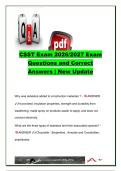
CSST Exam 2026/2027 Exam
Questions and Correct
Answers | New Update


Why was asbestos added to construction materials ? - ANSWER

✔✔It provided: insulation properties, strength and durability from

weathering, made spray on products easier to apply, and does not

conduct electricity.

What are the three types of asbestos and their associated species? -

ANSWER ✔✔Chrysotile : Serpentine , Amosite and Crocidolites :

amphiboles.

,What is the predominant color and structure of Chrysotile asbestos ? -

ANSWER ✔✔white , long , curly , hollow


What is the predominant color and structure of Amosite asbestos ? -

ANSWER ✔✔brown / tan ; long and straight


What is the predominant color and structure of Crocidolite ? -

ANSWER ✔✔blue ; long and straight


What is the definition of a Surfacing material ? - ANSWER ✔✔is a

sprayed on troweled on or otherwise applied to structural surfaces EX:

acoustic / decorative ceilings, fire proofing, textured paints and plasters.


what is the definition of Thermal Systems Insulation? - ANSWER

✔✔applied to pipes, fittings, tanks, other structural, components etc. , to

prevent heat loss or gain. EX: pipe insulation, elbow mud, block

insulation, air cell, asbestos paper wrap, preformed halves, magnesium

silica, etc


what is the definition of Miscellaneous products: - ANSWER

✔✔material that is not TSI or surfacing but applied to structural

components.


Define Friable vs non friable. - ANSWER ✔✔Friable asbestos will

crumble , pulverize or otherwise release dust by applying hand pressure.

, What agency does not use the term friable ? why? - ANSWER

✔✔OSHA - because tools that are used by workers can easily make non

friable materials friable.


Primary type of asbestos used in the U.S ? - ANSWER ✔✔Chrysotile.


List three building materials / locations where ACM is likely to be found -

ANSWER ✔✔fire doors, fume hoods, felt under roofs or siding,

amosite sheeting, kiln bricks and cement, lab equipment, fire safety and

equipment, auditorium curtains, gaskets, vibration joints, etc.

What are the 3 major illnesses related to asbestos exposures ? -

ANSWER ✔✔Asbestosis, Lung Cancer, Mesothelioma.


What is a latency period ? What is the latency period for asbestos

related illnesses ? - ANSWER ✔✔the time between exposure and

symptoms / sign of illness. 10-40 years.

Why does cigarette smoking increase chances of getting an asbestos

related illness ? - ANSWER ✔✔Paralyzes Cillia in lung.


What asbestos related disease normally appears only after long, large,

occupational exposure to asbestos ? - ANSWER ✔✔Asbestosis


3
COPYRIGHT©JOSHCLAY 2025/2026. YEAR PUBLISHED 2026. COMPANY REGISTRATION NUMBER: 619652435. TERMS OF USE. PRIVACY
STATEMENT. ALL RIGHTS RESERVED


Document information

Uploaded on
August 19, 2026
Number of pages
27
Written in
2026/2027
Type
Exam (elaborations)
Contains
Questions & answers
$18.99

Wrong document? Swap it for free Within 14 days of purchase and before downloading, you can choose a different document. You can simply spend the amount again.
Written by students who passed
Immediately available after payment
Read online or as PDF

Seller avatar
Reputation scores are based on the amount of documents a seller has sold for a fee and the reviews they have received for those documents. There are three levels: Bronze, Silver and Gold. The better the reputation, the more your can rely on the quality of the sellers work.
JOSHCLAY
3.5
(83)
Sold
390
Followers
16
Items
20497
Last sold
2 days ago


Why students choose Stuvia

Created by fellow students, verified by reviews

Quality you can trust: written by students who passed their tests and reviewed by others who've used these notes.

Didn't get what you expected? Choose another document

No worries! You can instantly pick a different document that better fits what you're looking for.

Pay as you like, start learning right away

No subscription, no commitments. Pay the way you're used to via credit card and download your PDF document instantly.

Student with book image

“Bought, downloaded, and aced it. It really can be that simple.”

Alisha Student

Working on your references?

Create accurate citations in APA, MLA and Harvard with our free citation generator.

Working on your references?

Frequently asked questions
