

Written by students who passed Immediately available after payment Read online or as PDF Wrong document? Swap it for free 4.6 TrustPilot
logo-home
Document preview thumbnail
Preview 1 out of 2 pages
Exam (elaborations)

BIOL 251 Human Anatomy & Physiology I with Lab 2026/2027 | 7 Exam Questions & Answers | Mitochondria, Ribosomes, ER, Golgi, Peroxisomes & Lysosomes

Document preview thumbnail
Preview 1 out of 2 pages

This BIOL 251 Human Anatomy & Physiology I with Lab 2026/2027 study document contains 7 focused exam questions with answers covering fundamental cell biology and organelle structure and function. The two-page review concentrates on mitochondria, ribosomes, rough endoplasmic reticulum, smooth endoplasmic reticulum, the Golgi complex, peroxisomes, and lysosomes. It is particularly useful for reviewing how cellular organelles contribute to ATP production, protein synthesis and modification, intracellular transport, lipid and steroid synthesis, detoxification, and macromolecule breakdown. The material begins with mitochondria and ribosomes. Mitochondria are described as rod-shaped, double-membrane organelles with inner folds called cristae and as the site of aerobic respiration and ATP energy production. Ribosomes are presented as structures composed of rRNA and protein that perform protein synthesis and can occur freely in the cytoplasm or attached to the endoplasmic reticulum. These concepts establish the relationship between cellular structure, energy metabolism, and protein production. The document then distinguishes the rough and smooth endoplasmic reticulum. Rough ER is described as a membranous tubular system continuous with the nucleus and studded with ribosomes, with functions involving protein modification and transport toward the Golgi apparatus and other destinations. Smooth ER lacks ribosomes and is associated with lipid and steroid synthesis as well as lipid metabolism. The Golgi complex is subsequently reviewed as a polarized stack of flattened membranes involved in modifying and packaging proteins for secretion or placement elsewhere in the cell. The final questions address peroxisomes and lysosomes. Peroxisomes are described as vesicles containing oxidase and catalase enzymes that participate in detoxification and the breakdown of potentially damaging substances, including free radicals and hydrogen peroxide. Lysosomes contain digestive enzymes and break down macromolecules so their monomer components can be recycled. Together, these questions provide a concise review of intracellular processing, cellular maintenance, detoxification, and recycling mechanisms relevant to introductory anatomy and physiology. Reference alignment: The uploaded document identifies the course as BIOL 251 Human Anatomy & Physiology I with Lab and labels the material as 2026/2027 exam questions and answers. Its content focuses specifically on cellular organelles and their functions. No textbook, journal article, author, university, or complete academic reference is identified in the uploaded file, so assigning a specific university or claiming a particular anatomy and physiology textbook as its source would not be supported by the document. Relevant students: BIOL 251 students, Human Anatomy and Physiology I students, Anatomy and Physiology I laboratory students, pre-nursing students, nursing prerequisite students, pre-health students, allied health students, biology students, medical assistant students, and students reviewing cell structure and organelle functions for introductory anatomy and physiology examinations. Keywords: BIOL 251 exam questions, BIOL 251 answers, Human Anatomy and Physiology I exam, Anatomy and Physiology 1 with lab, A&P 1 exam questions, cell organelles questions, cell biology review, mitochondria function, ATP production, ribosome function, protein synthesis, rough endoplasmic reticulum, smooth endoplasmic reticulum, Golgi complex, Golgi apparatus, peroxisomes function, lysosomes function, aerobic respiration, cristae mitochondria, lipid synthesis, steroid synthesis, protein modification, protein transport, cellular detoxification, macromolecule breakdown, anatomy physiology study guide, A&P exam preparation

Content preview

BIOL 251 Human Anatomy &
Physiology I w/Lab 2026/2027
Exam Questions and Answers |
Already Graded A+


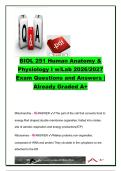
Mitochandria - ANSWER ✔✔The part of the cell that converts food to

energy.Rod shaped.double membrane organelles. folded into cristae.

site of aerobic respriation and energy production(ATP)


Ribosomes - ANSWER ✔✔Makes proteins.non-organelles.

composed of rRNA and protein.They circulate in the cytoplasm or are

attached to the ER

Document information

Uploaded on
August 19, 2026
Number of pages
2
Written in
2026/2027
Type
Exam (elaborations)
Contains
Questions & answers
$18.99

Wrong document? Swap it for free Within 14 days of purchase and before downloading, you can choose a different document. You can simply spend the amount again.
Written by students who passed
Immediately available after payment
Read online or as PDF

Seller avatar
Reputation scores are based on the amount of documents a seller has sold for a fee and the reviews they have received for those documents. There are three levels: Bronze, Silver and Gold. The better the reputation, the more your can rely on the quality of the sellers work.
JOSHCLAY
3.5
(83)
Sold
390
Followers
16
Items
20497
Last sold
1 day ago


Why students choose Stuvia

Created by fellow students, verified by reviews

Quality you can trust: written by students who passed their tests and reviewed by others who've used these notes.

Didn't get what you expected? Choose another document

No worries! You can instantly pick a different document that better fits what you're looking for.

Pay as you like, start learning right away

No subscription, no commitments. Pay the way you're used to via credit card and download your PDF document instantly.

Student with book image

“Bought, downloaded, and aced it. It really can be that simple.”

Alisha Student

Working on your references?

Create accurate citations in APA, MLA and Harvard with our free citation generator.

Working on your references?

Frequently asked questions

