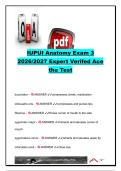
This comprehensive IUPUI Anatomy Exam 3 2026/2027 study resource contains 80+ exam questions and correct answers across 10 pages, with a strong focus on the muscular system, skeletal muscle physiology, facial and neck muscles, trunk musculature, upper and lower extremity muscles, muscle actions, and surface anatomy. The document combines direct identification questions, true/false items, multiple-choice questions, and function-based recall exercises, making it suitable for active revision and preparation for Anatomy Exam 3.
The opening section concentrates on facial, head, and neck muscles and their actions. Students review the buccinator, orbicularis oris, risorius, zygomaticus major and minor, orbicularis oculi, occipitofrontalis, platysma, masseter, temporalis, digastric, omohyoid, sternohyoid, sternothyroid, sternocleidomastoid, splenius, and scalenes. Questions connect each muscle to actions such as mastication, closing the eye, pursing the lips, elevating or depressing the mandible, moving the scalp, flexing or extending the neck, and elevating the ribs.
The document then reviews the muscles of the back, abdomen, thorax, and pectoral girdle. Important topics include the erector spinae group—iliocostalis, longissimus, and spinalis—along with quadratus lumborum, external and internal obliques, transversus abdominis, rectus abdominis, diaphragm, levator scapulae, pectoralis minor, rhomboid major and minor, serratus anterior, subclavius, and trapezius. Their roles in vertebral-column movement, abdominal compression, respiration, rib movement, and scapular stabilization and rotation are repeatedly reinforced.
Upper-extremity anatomy includes deltoid, supraspinatus, infraspinatus, teres minor, teres major, coracobrachialis, triceps brachii, biceps brachii, latissimus dorsi, pectoralis major, brachioradialis, flexor carpi radialis, flexor carpi ulnaris, and abductor digiti minimi. Students distinguish prime movers from synergists and review movements including arm abduction, adduction, medial and lateral rotation, extension, shoulder flexion, and elbow flexion and extension. The resource also tests recognition of the rotator cuff muscles and specifically distinguishes teres major from the rotator cuff group.
An important portion of the study guide covers skeletal muscle structure and contraction physiology. Questions address the perimysium surrounding muscle fascicles, the sarcomere triad, actin as a thin filament, myoglobin and muscle color, myosin-binding sites on actin, calcium binding to troponin, the A band during contraction, motor units, muscle fibers, aponeuroses, fast and slow muscle fibers, and age-related changes in skeletal muscle. Elasticity is also reviewed as the ability of muscle to rebound toward its original length after contraction.
Lower-body questions focus on hip, thigh, knee, and lower-leg musculature. The material reviews the adductors of the thigh, tensor fasciae latae, biceps femoris, sartorius, rectus femoris, vastus medialis, iliopsoas, quadriceps, gluteus maximus, gluteus medius, gastrocnemius, soleus, calcaneal tendon, and tibialis anterior. Students are asked to connect these muscles with actions such as hip extension, hip flexion, knee extension, dorsiflexion, foot inversion, and stabilization of the knee.
The final pages reinforce functional and surface anatomy through application-oriented questions. Topics include the regional approach to surface anatomy, the palmaris longus as a muscle not present in every person, the circular shape of the orbicularis oculi, deltoid as a prime mover of arm abduction, latissimus dorsi in arm extension and adduction, and the linea alba. The document also uses practical questions involving intramuscular injections, muscle bruising, smiling muscles, body positioning, and identifying synergistic muscles.
Overall, this resource functions as a focused IUPUI Anatomy Exam 3 muscular-system question-and-answer study guide for memorizing muscle names, locations, actions, structural terminology, and basic contraction physiology. The uploaded document identifies itself as “IUPUI Anatomy Exam 3 2026/2027 Expert Verified Ace the Test.” A formal course code is not stated in the source, so the title correctly lists the course code as Not Specified rather than inventing one.
Relevant Students: IUPUI anatomy students, anatomy and physiology students, nursing students, pre-nursing students, pre-medical students, health sciences students, biology students, kinesiology students, exercise science students, physical therapy prerequisite students, allied health students, and learners preparing for muscular-system anatomy examinations.
Keywords: IUPUI Anatomy Exam 3, IUPUI Anatomy Exam 3 2026, IUPUI Anatomy Exam 3 2027, anatomy exam questions and answers, anatomy exam 3 study guide, muscular system anatomy, muscle anatomy questions, skeletal muscle physiology, muscle contraction, sarcomere, actin and myosin, calcium and troponin, muscle fiber types, facial muscles, muscles of mastication, neck muscles, back muscles, abdominal muscles, erector spinae, pectoral girdle muscles, rotator cuff muscles, shoulder muscles, upper limb muscles, lower limb muscles, thigh muscles, quadriceps, hamstrings, deltoid, biceps brachii, triceps brachii, latissimus dorsi, pectoralis major, gluteal muscles, gastrocnemius, soleus, tibialis anterior, muscle actions, surface anatomy, anatomy practice questions
Content preview
IUPUI Anatomy Exam 3
2026/2027 Expert Verifed Ace
the Test
buccinator - ANSWER ✔✔compresses cheek, mastication
orbicualris oris - ANSWER ✔✔compresses and purses lips
Risorius - ANSWER ✔✔Draws corner of mouth to the side
zygomatic major - ANSWER ✔✔retracts and elevates corner of
mouth
zygomaticus minor - ANSWER ✔✔retracts and elevates upper lip
orbicularis oculi - ANSWER ✔✔close eye
, Occipitofrontalis - ANSWER ✔✔raises eyebrows, wrinkles forehead
occipital belly - ANSWER ✔✔Tenses and retracts scalp
platysma - ANSWER ✔✔tenses skin of neck, depresses mandible
masseter - ANSWER ✔✔closes jaw and elevates mandible
Temporalis - ANSWER ✔✔closes jaw, elevates and retracts
mandible, mastication
digastric - ANSWER ✔✔depresses mandible, open mouth, elevate
larynx
omohyoid, sternohyoid, sternothyroid - ANSWER ✔✔depresses hyoid
bone and larynx
Sternocleidomastoid - ANSWER ✔✔together: flex the neck, Alone:
bends neck and turn face opposite side
splenius - ANSWER ✔✔Together: extend neck, Alone: move head to
that side
Erractor spinae - ANSWER ✔✔iliocostalis, longissmus, spinalis
spinalis - ANSWER ✔✔extends vertebral column