
• Wrong document? Swap it for free
  • Written by students who passed
  • Immediately available after payment
  • Read online or as PDF
Sell
Where do you study
Your language
Document preview thumbnail
Preview 3 out of 23 pages
Exam (elaborations)

IUPUI Anatomy Exam 2 2026/2027 | 150+ Questions & Correct Answers | Skull, Vertebral Column, Upper & Lower Limbs, Pelvis, Ribs & Joints | Indiana University–Purdue University Indianapolis (IUPUI)

Document preview thumbnail
Preview 3 out of 23 pages

This comprehensive IUPUI Anatomy Exam 2 2026/2027 study resource contains 150+ anatomy questions with correct answers across 23 pages. The material provides focused examination review of the skeletal system and articulations, covering cranial and facial bones, skull sutures and foramina, the vertebral column, thoracic cage, pectoral girdle, upper extremity, pelvic girdle, lower extremity, and classifications and structures of joints. The document uses direct question-and-answer, true/false, matching, fill-in-the-blank, and multiple-choice formats to support active recall and anatomy exam preparation. The opening section concentrates extensively on skull anatomy. Students review the eight cranial bones, paired and unpaired cranial bones, sagittal, lambdoid, coronal and squamous sutures, the foramen magnum, occipital condyles, temporal bone and zygomatic process, sphenoid bone, sella turcica, tuberculum sellae, dorsum sellae, ethmoid bone, perpendicular plate, crista galli, and major openings associated with the sphenoid. Facial anatomy includes the mandible, mandibular condyles and fossa, mental foramina, zygomatic bones, vomer, maxillae, palatine bones, nasal conchae, and hyoid bone. A substantial portion reviews the vertebral column and thoracic cage. Questions cover cervical, thoracic and lumbar vertebrae, C1/atlas and C2/axis, the dens, vertebral bodies and spinous processes, intervertebral discs, primary and secondary spinal curves, sacrum and coccyx, and the movements associated with C1 and C2. Thoracic-cage content includes true, false, and floating ribs; rib articulation with thoracic vertebrae; the sternum, manubrium and xiphoid process; and the sternoclavicular joint as the connection between the axial and appendicular skeletons. The pectoral girdle and upper limb section covers the clavicle, scapula, humerus, radius, ulna, and carpal bones. Important landmarks include the acromial end, conoid tubercle, coracoid process, glenoid cavity, subscapular, supraspinous and infraspinous fossae, anatomical and surgical necks of the humerus, trochlea, capitulum, olecranon, radial and ulnar heads, styloid processes, and radial and ulnar notches. Students also review the proximal carpal row—scaphoid, lunate, triquetrum and pisiform—along with pronation and supination at the proximal radioulnar joint. Lower-extremity coverage begins with the pelvic girdle and os coxa, including the ilium, ischium, pubis, acetabulum, obturator foramen, arcuate line, greater and lesser sciatic notches, ASIS, AIIS, PSIS and PIIS. Femoral anatomy includes the head, fovea capitis, greater and lesser trochanters, and linea aspera. The resource then examines the patella, tibia, fibula, intercondylar eminence, medial and lateral malleoli, talus, calcaneus, Achilles tendon, metatarsals and hallux. Another major topic is joint anatomy and classification. Students review synarthroses, amphiarthroses and diarthroses alongside fibrous, cartilaginous and synovial joints. Specific examples include sutures, gomphoses, syndesmoses, synchondroses and symphyses. The resource also covers synovial fluid, bursae, menisci, intracapsular and extracapsular ligaments, and the ACL, PCL and collateral ligaments of the knee. Questions address the functions of synovial fluid and bursae as well as the stabilizing roles of knee ligaments. The later pages reinforce these topics through exam-style application and identification questions, asking students to match anatomical landmarks to bones and distinguish closely related structures. Examples include identifying the sella turcica with the sphenoid, dens with C2, trochlea with the humerus, coracoid process with the scapula, obturator foramen with the os coxa, and xiphoid process with the sternum. Repeated questions on sutures, the talus, patella, cruciate ligaments, scapular anatomy and vertebral structures provide additional recall practice. The uploaded document itself does not provide a formal course code, so one has not been invented. The title identifies the course as IUPUI Anatomy Exam 2 and the academic period as 2026/2027. Because the source contains a few apparent inconsistencies in its supplied answers, this description reflects the document as written rather than silently correcting its answer key. Relevant Students: IUPUI anatomy students, undergraduate anatomy and physiology students, pre-nursing students, nursing students, pre-medical students, health sciences students, biology students, allied health students, kinesiology students, and learners preparing for Anatomy Exam 2 or reviewing skeletal anatomy and joint structure. Keywords: IUPUI Anatomy Exam 2, IUPUI Anatomy Exam 2 2026, IUPUI Anatomy Exam 2 2027, anatomy exam questions and answers, anatomy exam 2 study guide, skeletal system anatomy, cranial bones, facial bones, skull sutures, skull foramina, sphenoid bone, ethmoid bone, sella turcica, vertebral column anatomy, cervical vertebrae, thoracic vertebrae, lumbar vertebrae, atlas C1, axis C2, ribs and sternum, pectoral girdle, scapula anatomy, humerus anatomy, radius and ulna, carpal bones, pelvic girdle anatomy, os coxa, femur anatomy, tibia and fibula, tarsal bones, joint classifications, synovial joints, knee anatomy, ACL and PCL, anatomical landmarks, appendicular skeleton, axial skeleton, anatomy practice questions, anatomy correct answers

Content preview

Iupui Anatomy Exam 2
2026/2027 Exam Questions and
Correct Answers | New Update


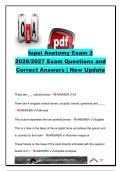
There are ___ cranial bones - ANSWER ✔✔8


There are 4 singular cranial bones, occipital, frontal, sphenoid and ____

- ANSWER ✔✔ethmoid


This suture separates the two parietal bones - ANSWER ✔✔sagittal


This is a hole in the base of the occipital bone and allows the spinal cord

to connect to the brain - ANSWER ✔✔foramen magnum


These facets on the base of the skull directly articulate with the superior

facets of C1 - ANSWER ✔✔occipital condyles

,The zygomatic process is located on which bone - ANSWER

✔✔temporal bone


This suture is located at the back of the head separating the occipital

bone from the parietal bones - ANSWER ✔✔lambdoid suture


This bone sits horizontally within the skull and is commonly referred to

as the bat shaped bone - ANSWER ✔✔sphenoid


This particular feature holds the pituitary gland within the sphenoid bone

- ANSWER ✔✔sella turcica


The anterior border of the sphenoid bone is called the - ANSWER

✔✔tubercullum sellae


Which feature of the ehtmoid bone forms the superior part of the nasal

septum? - ANSWER ✔✔perpendicular plate


This is located at the top of the ethmoid bone and if pressure is exerted

on the nose it can penetrate into the brain - ANSWER ✔✔crista galli


Which suture is responsible for separating the frontal bone from parietal

bones - ANSWER ✔✔coronal suture


This is a small hole located on the front of the mandible - ANSWER

✔✔mental foramina

, Which part of the mandible articulates with the temporal bones -

ANSWER ✔✔mandibular condyles


These are also known as our cheek bones - ANSWER ✔✔zygomatic

bones

This singular facial bone creates the inferior and posterior portion of the

nasal septum - ANSWER ✔✔vomer


These two conchae are attached to the ethmoid bone - ANSWER

✔✔superior and middle nasal conchae


This bone does not articulate with any other bone - ANSWER

✔✔hyoid bone


This section of the vertebral column is made up of 7 vertebrae -

ANSWER ✔✔cervical


The vertebrae within this region of the spine are shaped like moose -

ANSWER ✔✔lumbar


There are 12 of these vertebrae and they are shaped like giraffes -

ANSWER ✔✔thoracic


This is composed of 3-5 fused bones - ANSWER ✔✔sacrum


COPYRIGHT©NINJANERD 2025/2026. YEAR PUBLISHED 2026. COMPANY REGISTRATION NUMBER: 619652435. TERMS OF USE. PRIVACY
STATEMENT. ALL RIGHTS RESERVED
3

Document information

Uploaded on
August 19, 2026
Number of pages
23
Written in
2026/2027
Type
Exam (elaborations)
Contains
Questions & answers
$18.99

Wrong document? Swap it for free Within 14 days of purchase and before downloading, you can choose a different document. You can simply spend the amount again.
Written by students who passed
Immediately available after payment
Read online or as PDF

Seller avatar
Reputation scores are based on the amount of documents a seller has sold for a fee and the reviews they have received for those documents. There are three levels: Bronze, Silver and Gold. The better the reputation, the more your can rely on the quality of the sellers work.
NinjaNerd
3.4
(79)
Sold
437
Followers
6
Items
15969
Last sold
4 days ago


Why students choose Stuvia

Created by fellow students, verified by reviews

Quality you can trust: written by students who passed their tests and reviewed by others who've used these notes.

Didn't get what you expected? Choose another document

No worries! You can instantly pick a different document that better fits what you're looking for.

Pay as you like, start learning right away

No subscription, no commitments. Pay the way you're used to via credit card and download your PDF document instantly.

Student with book image

“Bought, downloaded, and aced it. It really can be that simple.”

Alisha Student

Working on your references?

Create accurate citations in APA, MLA and Harvard with our free citation generator.

Working on your references?

Frequently asked questions
