

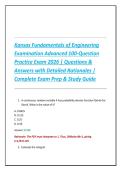
Kansas Fundamentals of Engineering
Examination Advanced 100-Question
Practice Exam 2026 | Questions &
Answers with Detailed Rationales |
Complete Exam Prep & Study Guide
1. A continuous random variable X has probability density function f(x)=kx for
0≤x≤4. What is the value of k?
A. 0.0625
B. 0.125
C. 0.25
D. 0.50
Answer: 0.125
Rationale: The PDF must integrate to 1. Thus, ∫04kxdx=8k=1, giving
k=1/8=0.125.
2. Evaluate the integral:
,∫02(3x2−4x+5)dx
A. 8
B. 10
C. 12
D. 14
Answer: 10
Rationale: The antiderivative is x3−2x2+5x. Evaluating from 0 to 2 gives
8−8+10=10.
3. A matrix is
A=[2413]
What is its determinant?
A. 1
B. 2
C. 3
D. 6
Answer: 2
Rationale: The determinant is ad−bc=(2)(3)−(1)(4)=2.
4. Solve the differential equation dy/dx=3y, given y(0)=4.
A. y=3e4x
B. y=4e3x
C. y=4+3x
D. y=3+4ex
Answer: y=4e3x
Rationale: Separating variables gives dy/y=3dx, so y=Ce3x. Applying y(0)=4
gives C=4.
, 5. A vector is A=3i−4j+12k. What is its magnitude?
A. 11
B. 12
C. 13
D. 15
Answer: 13
Rationale: The magnitude is 32+(−4)2+122=169=13.
6. What is the Laplace transform of e−3t?
A. 1/(s+3)
B. 1/(s−3)
C. s/(s+3)
D. 3/(s+3)
Answer: 1/(s+3)
Rationale: The standard transform L{eat}=1/(s−a). With a=−3, the result is
1/(s+3).
7. Newton's method is applied to f(x)=x2−10, starting with x0=3. What is x1?
A. 3.00
B. 3.125
C. 3.1667
D. 3.3333
Answer: 3.1667
Rationale: Newton's method gives x1=x0−f(x0)/f′(x0)=3−(9−10)/6=3.1667.
8. If z=5−12i, what is ∣z∣?
A. 7
B. 12
, C. 13
D. 17
Answer: 13
Rationale: The complex magnitude is 52+(−12)2=169=13.
9. The eigenvalues of a matrix are most directly related to which equation?
A. A+B=0
B. Ax=b
C. det(A−λI)=0
D. A−1=0
Answer: det(A−λI)=0
Rationale: Eigenvalues satisfy Av=λv, which rearranges to (A−λI)v=0. A nonzero
eigenvector requires the determinant to be zero.
10.A numerical integration method uses equally spaced points and polynomial
approximations over pairs of intervals. Which method is this?
A. Trapezoidal rule
B. Simpson's 1/3 rule
C. Euler method
D. Newton iteration
Answer: Simpson's 1/3 rule
Rationale: Simpson's 1/3 rule uses quadratic interpolation and requires an even
number of equal-width subintervals.
Probability and Statistics
11.A machine produces components with a mean diameter of 20 mm and
standard deviation of 0.4 mm. Assuming normality, approximately what
percentage falls within 19.2 to 20.8 mm?
Examination Advanced 100-Question
Practice Exam 2026 | Questions &
Answers with Detailed Rationales |
Complete Exam Prep & Study Guide
1. A continuous random variable X has probability density function f(x)=kx for
0≤x≤4. What is the value of k?
A. 0.0625
B. 0.125
C. 0.25
D. 0.50
Answer: 0.125
Rationale: The PDF must integrate to 1. Thus, ∫04kxdx=8k=1, giving
k=1/8=0.125.
2. Evaluate the integral:
,∫02(3x2−4x+5)dx
A. 8
B. 10
C. 12
D. 14
Answer: 10
Rationale: The antiderivative is x3−2x2+5x. Evaluating from 0 to 2 gives
8−8+10=10.
3. A matrix is
A=[2413]
What is its determinant?
A. 1
B. 2
C. 3
D. 6
Answer: 2
Rationale: The determinant is ad−bc=(2)(3)−(1)(4)=2.
4. Solve the differential equation dy/dx=3y, given y(0)=4.
A. y=3e4x
B. y=4e3x
C. y=4+3x
D. y=3+4ex
Answer: y=4e3x
Rationale: Separating variables gives dy/y=3dx, so y=Ce3x. Applying y(0)=4
gives C=4.
, 5. A vector is A=3i−4j+12k. What is its magnitude?
A. 11
B. 12
C. 13
D. 15
Answer: 13
Rationale: The magnitude is 32+(−4)2+122=169=13.
6. What is the Laplace transform of e−3t?
A. 1/(s+3)
B. 1/(s−3)
C. s/(s+3)
D. 3/(s+3)
Answer: 1/(s+3)
Rationale: The standard transform L{eat}=1/(s−a). With a=−3, the result is
1/(s+3).
7. Newton's method is applied to f(x)=x2−10, starting with x0=3. What is x1?
A. 3.00
B. 3.125
C. 3.1667
D. 3.3333
Answer: 3.1667
Rationale: Newton's method gives x1=x0−f(x0)/f′(x0)=3−(9−10)/6=3.1667.
8. If z=5−12i, what is ∣z∣?
A. 7
B. 12
, C. 13
D. 17
Answer: 13
Rationale: The complex magnitude is 52+(−12)2=169=13.
9. The eigenvalues of a matrix are most directly related to which equation?
A. A+B=0
B. Ax=b
C. det(A−λI)=0
D. A−1=0
Answer: det(A−λI)=0
Rationale: Eigenvalues satisfy Av=λv, which rearranges to (A−λI)v=0. A nonzero
eigenvector requires the determinant to be zero.
10.A numerical integration method uses equally spaced points and polynomial
approximations over pairs of intervals. Which method is this?
A. Trapezoidal rule
B. Simpson's 1/3 rule
C. Euler method
D. Newton iteration
Answer: Simpson's 1/3 rule
Rationale: Simpson's 1/3 rule uses quadratic interpolation and requires an even
number of equal-width subintervals.
Probability and Statistics
11.A machine produces components with a mean diameter of 20 mm and
standard deviation of 0.4 mm. Assuming normality, approximately what
percentage falls within 19.2 to 20.8 mm?


