

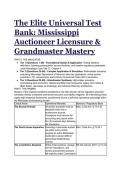
The Elite Universal Test
Bank: Mississippi
Auctioneer Licensure &
Grandmaster Mastery
PART 0: THE NAVIGATOR
● Tier 1 (Questions 1–28) - Foundational Syntax & Application: Testing statutory
definitions, licensing prerequisites, escrow timelines, and baseline regulatory parameters
under Mississippi Code Title 73, Chapter 4.
● Tier 2 (Questions 29–58) - Complex Application & Simulation: Multivariable scenarios
evaluating Mississippi Department of Revenue sales tax applications, online auction
jurisdiction, FFL requirements, and Uniform Commercial Code (UCC) mechanics.
● Tier 3 (Questions 59–88) - Grandmaster Synthesis: High-stakes scenarios
synthesizing land economics, Highest and Best Use frameworks, legacy UCC Article 6
(Bulk Sales), real estate co-brokerage, and advanced fiduciary architecture.
PART I: THE PRIMER
Mastery of this material transforms practitioners into elite scholars whose regulatory precision
translates directly to flawless commercial execution and liability mitigation. By internalizing these
eighty-eight analytical frameworks, practitioners secure a definitive operational advantage within
the Mississippi auctioneering domain.
Critical Axiom Operational Mandate Statutory / Regulatory Basis
The Escrow Firewall All auction proceeds must be Miss. Code Ann. § 73-4-35
deposited intact into a
trust/escrow account.
Consignors must receive full
accounting and payout within
five (5) business days following
the transaction.
The Dual-License Imperative Executing a real estate auction Miss. Code Ann. § 73-35-1
via public outcry strictly
requires an active Mississippi
Auctioneer License AND an
active Real Estate Broker
License.
The Jurisdiction Absolute Online timed auctions, storage MS AG Opinion 2019 / § 73-4-5
unit lien liquidations, and
reverse procurement auctions
fall explicitly under Commission
,Critical Axiom Operational Mandate Statutory / Regulatory Basis
jurisdiction; licensure is
non-negotiable.
The Sales Tax Baseline A 7% retail tax applies to the MS Dept. of Revenue Subpart
gross proceeds (including 13
buyer's premiums) of tangible
personal property sales, with
zero deductions permitted for
auctioneer commissions.
The Highest & Best Use Elite land valuation relies on Land Economics Principles
Sequence four chronological tests: legally
permissible, physically
possible, financially feasible,
and maximally productive.
PART II: THE ELITE TEST BANK
Q1: An applicant submits their paperwork to the Mississippi Auctioneer Commission. The
individual is seventeen years old, holds a high school diploma, and graduated from an approved
auction school. Based on Mississippi Code Title 73, Chapter 4, which action is MOST
ACCURATE? A) The application is approved with a minor waiver. B) The application is
approved pending a co-signer. C) The application is unequivocally denied due to the age
requirement. D) The application is approved with a provisional apprentice license.
● The Answer: C (The application is unequivocally denied due to the age requirement.)
● Distractor Analysis:
○ A is incorrect: Statutory age limits do not contain waiver provisions for minors.
○ B is incorrect: Co-signers do not override statutory age prerequisites for licensure.
○ D is incorrect: The Mississippi regulatory framework does not issue provisional or
apprentice licenses.
The Mentor's Analysis: Licensure requires the applicant to be at least eighteen years of age by
the issuance date. When evaluating prerequisites, statutory age floors act as absolute barriers
to entry. By recognizing this, the practitioner bypasses the common trap of assuming apprentice
exemptions exist. Professional/Academic Intuition: Statutory age floors are absolute; age
eighteen is the hard deck.
Q2: An auctioneer secures a $10,000 surety bond and submits the documentation ten days
prior to their scheduled licensing examination. Based on Commission regulations, which
outcome is MOST ACCURATE? A) The applicant is cleared to sit for the examination. B) The
applicant is delayed; evidence of the bond must be furnished thirty days prior. C) The bond
amount is insufficient; $20,000 is the statutory requirement. D) Bonds are strictly required
post-examination, not prior.
● The Answer: B (The applicant is delayed; evidence of the bond must be furnished thirty
days prior.)
● Distractor Analysis:
○ A is incorrect: The submission violates the strict pre-examination statutory timeline.
○ C is incorrect: The required surety bond minimum is exactly $10,000.
○ D is incorrect: Evidence of the bond must predate the examination.
The Mentor's Analysis: Applicants must furnish evidence of a $10,000 surety bond at least thirty
days prior to the examination date. When preparing for licensure, strict adherence to
chronological filing deadlines is mandatory. Professional/Academic Intuition: Financial security
, instruments must precede the examination by a full thirty days.
Q3: A licensee realizes their credential expires on March 1 of an even-numbered year. They
urgently submit twelve hours of Continuing Education (CE) credits to the Commission. Based on
Mississippi licensing law, which conclusion is MOST ACCURATE? A) The CE is accepted, but a
late submission fee applies. B) The license is suspended because CE must be filed in an
odd-numbered year. C) Licenses expire March 1 of odd-numbered years, and zero CE is
required for renewal. D) CE submissions must total twenty-four hours to be considered valid.
● The Answer: C (Licenses expire March 1 of odd-numbered years, and zero CE is required
for renewal.)
● Distractor Analysis:
○ A is incorrect: Continuing Education is statutorily not required for renewal in
Mississippi.
○ B is incorrect: The premise of an even-year expiration is statutorily false.
○ D is incorrect: This hallucinates a non-existent regulatory requirement.
The Mentor's Analysis: Mississippi operates on a biennial renewal cycle ending on March 1 of
odd-numbered years and explicitly does not mandate continuing education. By internalizing
renewal mechanics, practitioners avoid unnecessary compliance expenditures.
Professional/Academic Intuition: Biennial renewals fall on odd years and require zero
continuing education.
Q4: A licensed auctioneer conducts a successful estate liquidation on a Monday. Based on
Section 73-4-35, what is the LATEST acceptable day to provide an accounting and payout to the
consignor? A) Wednesday of the same week. B) The following Monday. C) Within thirty calendar
days of the sale. D) When the buyer's payment clears, regardless of the timeline.
● The Answer: B (The following Monday.)
● Distractor Analysis:
○ A is incorrect: The statute permits five business days, not two.
○ C is incorrect: Thirty days violently breaches the strict fiduciary payout rule.
○ D is incorrect: The statute dictates a fixed, non-contingent timeline.
The Mentor's Analysis: Licensees must account for and pay over all monies within five (5)
business days after the sale transaction. When handling client funds, the immediate priority is
executing the payout within the statutory window. Professional/Academic Intuition: Five
business days is the absolute fiduciary limit for post-sale disbursements.
Q5: An auctioneer places a print advertisement for an upcoming farm equipment liquidation. To
comply with regulatory standards, which elements MUST be explicitly included in the
advertisement? A) The auctioneer's photograph and the firm's logo. B) The auctioneer's name
and state-issued license number. C) The exact physical address of the licensee's escrow bank.
D) A legal disclaimer regarding legacy UCC Article 6 provisions.
● The Answer: B (The auctioneer's name and state-issued license number.)
● Distractor Analysis:
○ A is incorrect: Photographs are arbitrary marketing choices, not legal requirements.
○ C is incorrect: Escrow banking details are private operational data.
○ D is incorrect: Bulk sales disclaimers are not required in standard consumer
advertising.
The Mentor's Analysis: Public accountability requires complete transparency. All advertising
must prominently display the licensee's name and state-issued number. By utilizing transparent
marketing, practitioners bypass the common trap of anonymous, non-compliant promotion.
Professional/Academic Intuition: If the auction is advertised, the state license number must
be visible.
Bank: Mississippi
Auctioneer Licensure &
Grandmaster Mastery
PART 0: THE NAVIGATOR
● Tier 1 (Questions 1–28) - Foundational Syntax & Application: Testing statutory
definitions, licensing prerequisites, escrow timelines, and baseline regulatory parameters
under Mississippi Code Title 73, Chapter 4.
● Tier 2 (Questions 29–58) - Complex Application & Simulation: Multivariable scenarios
evaluating Mississippi Department of Revenue sales tax applications, online auction
jurisdiction, FFL requirements, and Uniform Commercial Code (UCC) mechanics.
● Tier 3 (Questions 59–88) - Grandmaster Synthesis: High-stakes scenarios
synthesizing land economics, Highest and Best Use frameworks, legacy UCC Article 6
(Bulk Sales), real estate co-brokerage, and advanced fiduciary architecture.
PART I: THE PRIMER
Mastery of this material transforms practitioners into elite scholars whose regulatory precision
translates directly to flawless commercial execution and liability mitigation. By internalizing these
eighty-eight analytical frameworks, practitioners secure a definitive operational advantage within
the Mississippi auctioneering domain.
Critical Axiom Operational Mandate Statutory / Regulatory Basis
The Escrow Firewall All auction proceeds must be Miss. Code Ann. § 73-4-35
deposited intact into a
trust/escrow account.
Consignors must receive full
accounting and payout within
five (5) business days following
the transaction.
The Dual-License Imperative Executing a real estate auction Miss. Code Ann. § 73-35-1
via public outcry strictly
requires an active Mississippi
Auctioneer License AND an
active Real Estate Broker
License.
The Jurisdiction Absolute Online timed auctions, storage MS AG Opinion 2019 / § 73-4-5
unit lien liquidations, and
reverse procurement auctions
fall explicitly under Commission
,Critical Axiom Operational Mandate Statutory / Regulatory Basis
jurisdiction; licensure is
non-negotiable.
The Sales Tax Baseline A 7% retail tax applies to the MS Dept. of Revenue Subpart
gross proceeds (including 13
buyer's premiums) of tangible
personal property sales, with
zero deductions permitted for
auctioneer commissions.
The Highest & Best Use Elite land valuation relies on Land Economics Principles
Sequence four chronological tests: legally
permissible, physically
possible, financially feasible,
and maximally productive.
PART II: THE ELITE TEST BANK
Q1: An applicant submits their paperwork to the Mississippi Auctioneer Commission. The
individual is seventeen years old, holds a high school diploma, and graduated from an approved
auction school. Based on Mississippi Code Title 73, Chapter 4, which action is MOST
ACCURATE? A) The application is approved with a minor waiver. B) The application is
approved pending a co-signer. C) The application is unequivocally denied due to the age
requirement. D) The application is approved with a provisional apprentice license.
● The Answer: C (The application is unequivocally denied due to the age requirement.)
● Distractor Analysis:
○ A is incorrect: Statutory age limits do not contain waiver provisions for minors.
○ B is incorrect: Co-signers do not override statutory age prerequisites for licensure.
○ D is incorrect: The Mississippi regulatory framework does not issue provisional or
apprentice licenses.
The Mentor's Analysis: Licensure requires the applicant to be at least eighteen years of age by
the issuance date. When evaluating prerequisites, statutory age floors act as absolute barriers
to entry. By recognizing this, the practitioner bypasses the common trap of assuming apprentice
exemptions exist. Professional/Academic Intuition: Statutory age floors are absolute; age
eighteen is the hard deck.
Q2: An auctioneer secures a $10,000 surety bond and submits the documentation ten days
prior to their scheduled licensing examination. Based on Commission regulations, which
outcome is MOST ACCURATE? A) The applicant is cleared to sit for the examination. B) The
applicant is delayed; evidence of the bond must be furnished thirty days prior. C) The bond
amount is insufficient; $20,000 is the statutory requirement. D) Bonds are strictly required
post-examination, not prior.
● The Answer: B (The applicant is delayed; evidence of the bond must be furnished thirty
days prior.)
● Distractor Analysis:
○ A is incorrect: The submission violates the strict pre-examination statutory timeline.
○ C is incorrect: The required surety bond minimum is exactly $10,000.
○ D is incorrect: Evidence of the bond must predate the examination.
The Mentor's Analysis: Applicants must furnish evidence of a $10,000 surety bond at least thirty
days prior to the examination date. When preparing for licensure, strict adherence to
chronological filing deadlines is mandatory. Professional/Academic Intuition: Financial security
, instruments must precede the examination by a full thirty days.
Q3: A licensee realizes their credential expires on March 1 of an even-numbered year. They
urgently submit twelve hours of Continuing Education (CE) credits to the Commission. Based on
Mississippi licensing law, which conclusion is MOST ACCURATE? A) The CE is accepted, but a
late submission fee applies. B) The license is suspended because CE must be filed in an
odd-numbered year. C) Licenses expire March 1 of odd-numbered years, and zero CE is
required for renewal. D) CE submissions must total twenty-four hours to be considered valid.
● The Answer: C (Licenses expire March 1 of odd-numbered years, and zero CE is required
for renewal.)
● Distractor Analysis:
○ A is incorrect: Continuing Education is statutorily not required for renewal in
Mississippi.
○ B is incorrect: The premise of an even-year expiration is statutorily false.
○ D is incorrect: This hallucinates a non-existent regulatory requirement.
The Mentor's Analysis: Mississippi operates on a biennial renewal cycle ending on March 1 of
odd-numbered years and explicitly does not mandate continuing education. By internalizing
renewal mechanics, practitioners avoid unnecessary compliance expenditures.
Professional/Academic Intuition: Biennial renewals fall on odd years and require zero
continuing education.
Q4: A licensed auctioneer conducts a successful estate liquidation on a Monday. Based on
Section 73-4-35, what is the LATEST acceptable day to provide an accounting and payout to the
consignor? A) Wednesday of the same week. B) The following Monday. C) Within thirty calendar
days of the sale. D) When the buyer's payment clears, regardless of the timeline.
● The Answer: B (The following Monday.)
● Distractor Analysis:
○ A is incorrect: The statute permits five business days, not two.
○ C is incorrect: Thirty days violently breaches the strict fiduciary payout rule.
○ D is incorrect: The statute dictates a fixed, non-contingent timeline.
The Mentor's Analysis: Licensees must account for and pay over all monies within five (5)
business days after the sale transaction. When handling client funds, the immediate priority is
executing the payout within the statutory window. Professional/Academic Intuition: Five
business days is the absolute fiduciary limit for post-sale disbursements.
Q5: An auctioneer places a print advertisement for an upcoming farm equipment liquidation. To
comply with regulatory standards, which elements MUST be explicitly included in the
advertisement? A) The auctioneer's photograph and the firm's logo. B) The auctioneer's name
and state-issued license number. C) The exact physical address of the licensee's escrow bank.
D) A legal disclaimer regarding legacy UCC Article 6 provisions.
● The Answer: B (The auctioneer's name and state-issued license number.)
● Distractor Analysis:
○ A is incorrect: Photographs are arbitrary marketing choices, not legal requirements.
○ C is incorrect: Escrow banking details are private operational data.
○ D is incorrect: Bulk sales disclaimers are not required in standard consumer
advertising.
The Mentor's Analysis: Public accountability requires complete transparency. All advertising
must prominently display the licensee's name and state-issued number. By utilizing transparent
marketing, practitioners bypass the common trap of anonymous, non-compliant promotion.
Professional/Academic Intuition: If the auction is advertised, the state license number must
be visible.


