

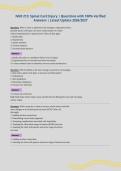
NUR 213: Spinal Cord Injury | Questions with 100% Verified
Answers | Latest Update 2026/2027
Question: When a client is admitted to the emergency department with a
possible spinal cord injury, the nurse would monitor for which
clinical manifestations of spinal shock? Select all that apply.
1. Bradycardia
2. Hypotension
3. Spastic paralysis
4. Urinary retention
5. Increased pulse pressure
Answer:
1. Bradycardia (due to vasodilation below level of injury)
2. Hypotension (loss of vascular tone below the injury)
4. Urinary retention (due to autonomic nervous system dysfunction)
Question: Which problem is the nurse trying to prevent by encouraging
a client with a spinal cord injury to increase oral fluid intake?
1. Dehydration
2. Skin breakdown
3. Electrolyte imbalances
4. Urinary tract infections
Answer:
4. Urinary tract infections
High fluid intake limits urinary stasis and infection by diluting the urine and increasing
urinary output.
Question: While caring for a client in traction, which action would the
nurse delegate to a licensed practical nurse (LPN)? Select all
that apply.
1. Padding traction connections
2. Determining correct body alignment
3. Assessing complications associated with immobility
4. Teaching the client about range-of-motion (ROM) exercises
5. Assisting the client with passive and active range-of-motion
exercises
Answer:
1. Padding traction connections
5. Assisting the client with passive and active range-of-motion exercises
, Question: Which intervention would the nurse perform first for a client
with a spinal cord injury who is experiencing autonomic
dysreflexia?
1. Assess for the cause.
2. Place the client in sitting position.
3. Check the client for fecal impaction.
4. Give an alpha blocker prophylactically.
Answer:
2. Place the client in sitting position
Clients with autonomic dysreflexia would immediately be placed in a sitting position
because the condition may cause involuntary nervous system reaction and dangerous
spikes in blood pressure.
Question: A client with a cervical injury reports the sudden onset of a
severe headache and nasal congestion. For which clinical
manifestations would the nurse assess?
1. Suprapubic distention
2. Increased spinal reflexes
3. Adventitious breath sounds
4. Imminent development of shock
Answer:
1. Suprapubic distention
Suprapubic distention is a symptom of autonomic dysreflexia, which is commonly
precipitated by a distended bladder. Blood pressure increases suddenly with AE causing
the severe headache and nasal congestion.
Question: In which position would the nurse place a client with a spinal
cord injury experiencing autonomic dysreflexia?
1. High Fowler
2. Left side-lying
3. Right side-lying
4. Flat on the back
Answer:
1. High Fowler
A client experiencing AE would immediately be placed sitting up to lower blood
pressure.
Answers | Latest Update 2026/2027
Question: When a client is admitted to the emergency department with a
possible spinal cord injury, the nurse would monitor for which
clinical manifestations of spinal shock? Select all that apply.
1. Bradycardia
2. Hypotension
3. Spastic paralysis
4. Urinary retention
5. Increased pulse pressure
Answer:
1. Bradycardia (due to vasodilation below level of injury)
2. Hypotension (loss of vascular tone below the injury)
4. Urinary retention (due to autonomic nervous system dysfunction)
Question: Which problem is the nurse trying to prevent by encouraging
a client with a spinal cord injury to increase oral fluid intake?
1. Dehydration
2. Skin breakdown
3. Electrolyte imbalances
4. Urinary tract infections
Answer:
4. Urinary tract infections
High fluid intake limits urinary stasis and infection by diluting the urine and increasing
urinary output.
Question: While caring for a client in traction, which action would the
nurse delegate to a licensed practical nurse (LPN)? Select all
that apply.
1. Padding traction connections
2. Determining correct body alignment
3. Assessing complications associated with immobility
4. Teaching the client about range-of-motion (ROM) exercises
5. Assisting the client with passive and active range-of-motion
exercises
Answer:
1. Padding traction connections
5. Assisting the client with passive and active range-of-motion exercises
, Question: Which intervention would the nurse perform first for a client
with a spinal cord injury who is experiencing autonomic
dysreflexia?
1. Assess for the cause.
2. Place the client in sitting position.
3. Check the client for fecal impaction.
4. Give an alpha blocker prophylactically.
Answer:
2. Place the client in sitting position
Clients with autonomic dysreflexia would immediately be placed in a sitting position
because the condition may cause involuntary nervous system reaction and dangerous
spikes in blood pressure.
Question: A client with a cervical injury reports the sudden onset of a
severe headache and nasal congestion. For which clinical
manifestations would the nurse assess?
1. Suprapubic distention
2. Increased spinal reflexes
3. Adventitious breath sounds
4. Imminent development of shock
Answer:
1. Suprapubic distention
Suprapubic distention is a symptom of autonomic dysreflexia, which is commonly
precipitated by a distended bladder. Blood pressure increases suddenly with AE causing
the severe headache and nasal congestion.
Question: In which position would the nurse place a client with a spinal
cord injury experiencing autonomic dysreflexia?
1. High Fowler
2. Left side-lying
3. Right side-lying
4. Flat on the back
Answer:
1. High Fowler
A client experiencing AE would immediately be placed sitting up to lower blood
pressure.


