

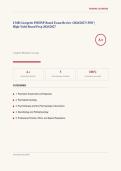
NURSING LICENSURE
LMR Georgette PMHNP Board Exam Review (2026/2027) PDF |
High-Yield Board Prep 2026/2027
A+
Complete Blueprint Coverage
A+ 5 100%
QUESTIONS VERIFIED CORE DOMAINS COVERED RATIONALES INCLUDED
CATEGORIES
1. Psychiatric Assessment and Diagnosis
2. Psychopharmacology
3. Psychotherapy and Non-Pharmacologic Interventions
4. Neurobiology and Pathophysiology
5. Professional Practice, Ethics, and Special Populations
STUVIAACTUALEXAM
,1. Psychiatric Assessment and Diagnosis
Q1
A 34-year-old client presents to the outpatient clinic reporting persistent low mood, anhedonia, and insomnia for the
past 6 weeks. The PMHNP conducts a structured diagnostic interview and reviews the DSM-5-TR criteria. The client
also describes recurrent thoughts of death without a specific plan. Which assessment finding most strongly supports a
diagnosis of major depressive disorder rather than persistent depressive disorder?
A. Presence of a discrete 6-week episode meeting full symptom criteria with clear functional impairment.
B. Continuous depressive symptoms lasting more than 2 years with no symptom-free intervals longer than 2 months.
C. Predominant irritability and mood reactivity without sustained depressed mood.
D. Depressive symptoms occurring exclusively in the context of a medical illness such as hypothyroidism.
Correct Answer: A
Rationale:
Major depressive disorder requires a discrete episode of at least 2 weeks meeting full criteria, whereas persistent depressive disorder
is characterized by a more chronic course lasting 2 years or longer. The 6-week duration with full criteria and functional impairment
aligns with MDD. Medical illness exclusion would point toward a different diagnostic pathway.
Q2
During an initial evaluation, a 28-year-old client describes periods of elevated mood lasting 4–5 days, decreased need
for sleep, pressured speech, and increased goal-directed activity that have caused interpersonal conflict at work. The
episodes are not severe enough to require hospitalization. The PMHNP is differentiating bipolar I from bipolar II
disorder. Which feature is most decisive for the bipolar II diagnosis?
A. History of hypomanic episodes without any full manic episode that caused marked impairment or hospitalization.
B. Presence of psychotic features during periods of elevated mood lasting longer than 1 week.
C. Rapid cycling of mood states occurring four or more times within a 12-month period.
D. A single manic episode lasting more than 7 days with significant occupational impairment.
Correct Answer: A
Rationale:
Bipolar II disorder is defined by at least one hypomanic episode and one major depressive episode without any history of mania. Full
manic episodes with marked impairment or psychosis define bipolar I. Rapid cycling is a course specifier, not a distinguishing
diagnostic criterion between the two.
Q3
A 45-year-old client is referred for evaluation of anxiety symptoms that include excessive worry about multiple life
domains, restlessness, and muscle tension lasting over 8 months. The client also reports occasional panic attacks that
are unexpected and not limited to specific situations. The PMHNP must determine the primary diagnosis. Which clinical
distinction is most important?
A. Generalized anxiety disorder is characterized by chronic excessive worry across domains, whereas panic disorder
centers on recurrent unexpected panic attacks and anticipatory anxiety about future attacks.
B. Panic disorder always includes agoraphobia, while generalized anxiety disorder does not involve physical
symptoms.
C. Generalized anxiety disorder requires the presence of obsessions and compulsions to meet diagnostic criteria.
D. Panic attacks occurring within generalized anxiety disorder automatically convert the diagnosis to panic disorder.
Correct Answer: A
Rationale:
GAD is defined by persistent, excessive anxiety and worry about multiple events or activities. Panic disorder is defined by recurrent
unexpected panic attacks plus persistent concern or maladaptive behavior related to the attacks. Panic attacks can occur in GAD
without changing the primary diagnosis if they are not the focus of the clinical picture.
, Q4
A 22-year-old college student is brought by roommates after expressing beliefs that the government is monitoring her
through her laptop camera. She has become increasingly isolated, stopped attending classes, and reports hearing a
voice commenting on her actions. Onset was gradual over 4 months. The PMHNP considers the differential between
schizophreniform disorder and schizophrenia. Which time-based criterion is critical?
A. Schizophreniform disorder requires continuous signs of disturbance lasting at least 1 month but less than 6
months, whereas schizophrenia requires at least 6 months including prodromal or residual phases.
B. Schizophrenia can be diagnosed after only 2 weeks of active symptoms if functional impairment is severe.
C. Schizophreniform disorder always includes a full recovery within 3 months of onset.
D. The presence of negative symptoms automatically excludes schizophreniform disorder.
Correct Answer: A
Rationale:
Duration is the primary distinction: schizophreniform disorder lasts 1–6 months, while schizophrenia requires a continuous disturbance
of at least 6 months. Both can include positive and negative symptoms; recovery is not required for the schizophreniform diagnosis.
Q5
A 19-year-old client presents with recurrent binge-eating episodes followed by self-induced vomiting at least twice
weekly for the past 4 months. Body mass index is 21.5. The client expresses intense fear of weight gain and places
undue influence of body shape on self-evaluation. The PMHNP is differentiating bulimia nervosa from binge-eating
disorder. Which feature is most diagnostic of bulimia nervosa?
A. Recurrent inappropriate compensatory behaviors such as self-induced vomiting to prevent weight gain.
B. Absence of any compensatory behaviors after binge episodes.
C. Body mass index below 17.5 with amenorrhea lasting more than 3 months.
D. Restriction of energy intake leading to significantly low body weight.
Correct Answer: A
Rationale:
Bulimia nervosa requires recurrent binge eating plus recurrent inappropriate compensatory behaviors (purging, fasting, or excessive
exercise). Binge-eating disorder involves binge episodes without regular compensatory behaviors. Significantly low weight is
characteristic of anorexia nervosa.
Q6
A 55-year-old client with a long history of alcohol use is admitted after a fall. On day 2 of admission the client develops
tremor, diaphoresis, tachycardia, and visual hallucinations of insects. The PMHNP is called to evaluate. Which
diagnosis best accounts for this presentation?
A. Alcohol withdrawal delirium (delirium tremens) characterized by autonomic hyperactivity and fluctuating
hallucinations.
B. Wernicke encephalopathy presenting primarily with ophthalmoplegia and ataxia without autonomic signs.
C. Major depressive disorder with psychotic features emerging after brief abstinence.
D. Neuroleptic malignant syndrome secondary to a newly started antipsychotic medication.
Correct Answer: A
Rationale:
Alcohol withdrawal delirium typically appears 48–72 hours after the last drink and features severe autonomic instability, tremor, and
vivid hallucinations. Wernicke encephalopathy presents with the classic triad of ophthalmoplegia, ataxia, and confusion and is related
to thiamine deficiency rather than withdrawal per se.
LMR Georgette PMHNP Board Exam Review (2026/2027) PDF | High-Yield Board Pr... Page 3
LMR Georgette PMHNP Board Exam Review (2026/2027) PDF |
High-Yield Board Prep 2026/2027
A+
Complete Blueprint Coverage
A+ 5 100%
QUESTIONS VERIFIED CORE DOMAINS COVERED RATIONALES INCLUDED
CATEGORIES
1. Psychiatric Assessment and Diagnosis
2. Psychopharmacology
3. Psychotherapy and Non-Pharmacologic Interventions
4. Neurobiology and Pathophysiology
5. Professional Practice, Ethics, and Special Populations
STUVIAACTUALEXAM
,1. Psychiatric Assessment and Diagnosis
Q1
A 34-year-old client presents to the outpatient clinic reporting persistent low mood, anhedonia, and insomnia for the
past 6 weeks. The PMHNP conducts a structured diagnostic interview and reviews the DSM-5-TR criteria. The client
also describes recurrent thoughts of death without a specific plan. Which assessment finding most strongly supports a
diagnosis of major depressive disorder rather than persistent depressive disorder?
A. Presence of a discrete 6-week episode meeting full symptom criteria with clear functional impairment.
B. Continuous depressive symptoms lasting more than 2 years with no symptom-free intervals longer than 2 months.
C. Predominant irritability and mood reactivity without sustained depressed mood.
D. Depressive symptoms occurring exclusively in the context of a medical illness such as hypothyroidism.
Correct Answer: A
Rationale:
Major depressive disorder requires a discrete episode of at least 2 weeks meeting full criteria, whereas persistent depressive disorder
is characterized by a more chronic course lasting 2 years or longer. The 6-week duration with full criteria and functional impairment
aligns with MDD. Medical illness exclusion would point toward a different diagnostic pathway.
Q2
During an initial evaluation, a 28-year-old client describes periods of elevated mood lasting 4–5 days, decreased need
for sleep, pressured speech, and increased goal-directed activity that have caused interpersonal conflict at work. The
episodes are not severe enough to require hospitalization. The PMHNP is differentiating bipolar I from bipolar II
disorder. Which feature is most decisive for the bipolar II diagnosis?
A. History of hypomanic episodes without any full manic episode that caused marked impairment or hospitalization.
B. Presence of psychotic features during periods of elevated mood lasting longer than 1 week.
C. Rapid cycling of mood states occurring four or more times within a 12-month period.
D. A single manic episode lasting more than 7 days with significant occupational impairment.
Correct Answer: A
Rationale:
Bipolar II disorder is defined by at least one hypomanic episode and one major depressive episode without any history of mania. Full
manic episodes with marked impairment or psychosis define bipolar I. Rapid cycling is a course specifier, not a distinguishing
diagnostic criterion between the two.
Q3
A 45-year-old client is referred for evaluation of anxiety symptoms that include excessive worry about multiple life
domains, restlessness, and muscle tension lasting over 8 months. The client also reports occasional panic attacks that
are unexpected and not limited to specific situations. The PMHNP must determine the primary diagnosis. Which clinical
distinction is most important?
A. Generalized anxiety disorder is characterized by chronic excessive worry across domains, whereas panic disorder
centers on recurrent unexpected panic attacks and anticipatory anxiety about future attacks.
B. Panic disorder always includes agoraphobia, while generalized anxiety disorder does not involve physical
symptoms.
C. Generalized anxiety disorder requires the presence of obsessions and compulsions to meet diagnostic criteria.
D. Panic attacks occurring within generalized anxiety disorder automatically convert the diagnosis to panic disorder.
Correct Answer: A
Rationale:
GAD is defined by persistent, excessive anxiety and worry about multiple events or activities. Panic disorder is defined by recurrent
unexpected panic attacks plus persistent concern or maladaptive behavior related to the attacks. Panic attacks can occur in GAD
without changing the primary diagnosis if they are not the focus of the clinical picture.
, Q4
A 22-year-old college student is brought by roommates after expressing beliefs that the government is monitoring her
through her laptop camera. She has become increasingly isolated, stopped attending classes, and reports hearing a
voice commenting on her actions. Onset was gradual over 4 months. The PMHNP considers the differential between
schizophreniform disorder and schizophrenia. Which time-based criterion is critical?
A. Schizophreniform disorder requires continuous signs of disturbance lasting at least 1 month but less than 6
months, whereas schizophrenia requires at least 6 months including prodromal or residual phases.
B. Schizophrenia can be diagnosed after only 2 weeks of active symptoms if functional impairment is severe.
C. Schizophreniform disorder always includes a full recovery within 3 months of onset.
D. The presence of negative symptoms automatically excludes schizophreniform disorder.
Correct Answer: A
Rationale:
Duration is the primary distinction: schizophreniform disorder lasts 1–6 months, while schizophrenia requires a continuous disturbance
of at least 6 months. Both can include positive and negative symptoms; recovery is not required for the schizophreniform diagnosis.
Q5
A 19-year-old client presents with recurrent binge-eating episodes followed by self-induced vomiting at least twice
weekly for the past 4 months. Body mass index is 21.5. The client expresses intense fear of weight gain and places
undue influence of body shape on self-evaluation. The PMHNP is differentiating bulimia nervosa from binge-eating
disorder. Which feature is most diagnostic of bulimia nervosa?
A. Recurrent inappropriate compensatory behaviors such as self-induced vomiting to prevent weight gain.
B. Absence of any compensatory behaviors after binge episodes.
C. Body mass index below 17.5 with amenorrhea lasting more than 3 months.
D. Restriction of energy intake leading to significantly low body weight.
Correct Answer: A
Rationale:
Bulimia nervosa requires recurrent binge eating plus recurrent inappropriate compensatory behaviors (purging, fasting, or excessive
exercise). Binge-eating disorder involves binge episodes without regular compensatory behaviors. Significantly low weight is
characteristic of anorexia nervosa.
Q6
A 55-year-old client with a long history of alcohol use is admitted after a fall. On day 2 of admission the client develops
tremor, diaphoresis, tachycardia, and visual hallucinations of insects. The PMHNP is called to evaluate. Which
diagnosis best accounts for this presentation?
A. Alcohol withdrawal delirium (delirium tremens) characterized by autonomic hyperactivity and fluctuating
hallucinations.
B. Wernicke encephalopathy presenting primarily with ophthalmoplegia and ataxia without autonomic signs.
C. Major depressive disorder with psychotic features emerging after brief abstinence.
D. Neuroleptic malignant syndrome secondary to a newly started antipsychotic medication.
Correct Answer: A
Rationale:
Alcohol withdrawal delirium typically appears 48–72 hours after the last drink and features severe autonomic instability, tremor, and
vivid hallucinations. Wernicke encephalopathy presents with the classic triad of ophthalmoplegia, ataxia, and confusion and is related
to thiamine deficiency rather than withdrawal per se.
LMR Georgette PMHNP Board Exam Review (2026/2027) PDF | High-Yield Board Pr... Page 3


