

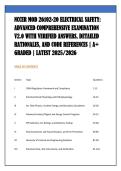
NCCER MOD 26102-20 ELECTRICAL SAFETY:
ADVANCED COMPREHENSIVE EXAMINATION
V2.0 WITH VERIFIED ANSWERS, DETAILED
RATIONALES, AND CODE REFERENCES | A+
GRADED | LATEST 2025/2026
TABLE OF CONTENTS
Section Topic Questions
I OSHA Regulatory Framework and Compliance 1-15
II Electrical Shock Physiology and Pathophysiology 16-25
III Arc Flash Physics, Incident Energy, and Boundary Calculations 26-38
IV Advanced Lockout/Tagout and Energy Control Programs 39-52
V PPE Selection, Arc Ratings, and Dielectric Testing 53-68
VI Risk Assessment, Job Hazard Analysis, and Error Prevention 69-80
VII Hierarchy of Controls and Engineering Solutions 81-90
VIII Electrical Tools, Test Instruments, and Verification 91-102
,Section Topic Questions
IX Working at Heights, Scaffolding, and Fall Protection 103-112
X Confined Space Entry and Rescue Operations 113-120
Hazardous Materials, PCB, Asbestos, and Environmental
XI 121-128
Compliance
XII Emergency Response, First Aid, and AED Protocols 129-138
XIII NFPA 70E, NEC, and Industry Standards Integration 139-150
SECTION I: OSHA REGULATORY FRAMEWORK AND COMPLIANCE
QUESTION 1: Under 29 CFR 1910.332, which category of employees must receive
electrical safety training?
A) Only employees working on voltages above 600 volts
B) Only maintenance personnel
C) All employees who face a risk of electric shock or other electrical hazards that are not
reduced to a safe level by the installation requirements of 1910.303 through 1910.308
D) Only qualified electrical workers with journeyman status
Rationale: 29 CFR 1910.332(a) requires training for all employees who face a risk of electric
shock or other electrical hazards that are not reduced to a safe level by the installation
requirements. This includes both qualified and unqualified persons.
QUESTION 2: According to OSHA, the distinction between a "qualified person" and an
"unqualified person" under 1910.331-.335 is primarily based on:
A) Years of experience in the electrical trade
B) Whether the person holds a valid electrical license
, C) Whether the person has received training in avoiding the electrical hazards of working
on or near exposed energized parts
D) Whether the person works for a union or non-union contractor
Rationale: The distinction is based on training. A qualified person has demonstrated skills and
knowledge related to construction and operation of electrical equipment and has received
safety training to identify and avoid hazards.
QUESTION 3: Which of the following correctly identifies the OSHA standard that
addresses the control of hazardous energy (lockout/tagout)?
A) 29 CFR 1910.331
B) 29 CFR 1910.147
C) 29 CFR 1926.500
D) 29 CFR 1910.1200
Rationale: 29 CFR 1910.147 is the OSHA standard for The Control of Hazardous Energy
(Lockout/Tagout) . It establishes employer responsibility to protect employees from
hazardous energy sources including electrical, mechanical, hydraulic, pneumatic, chemical, and
thermal energy.
QUESTION 4: Under OSHA's Hazard Communication Standard (29 CFR 1910.1200), which
of the following is a required element of a written hazard communication program?
A) A list of all employees who handle chemicals
B) Annual medical examinations for all chemical handlers
C) A list of hazardous chemicals present in the workplace, methods to inform employees
of hazards, and a description of the labeling system used
D) Material Safety Data Sheets for all products used in the last five years
Rationale: The written program must include a list of hazardous chemicals, methods used to
inform employees of hazards (labels, SDS, training), and a description of the labeling system
used. Medical exams are not a required element of the written program.
, QUESTION 5: OSHA's "General Duty Clause" (Section 5(a)(1) of the OSH Act) requires
employers to:
A) Provide health insurance to all employees
B) Maintain records of all workplace injuries for 30 years
C) Furnish to each employee employment and a place of employment which are free
from recognized hazards that are causing or are likely to cause death or serious physical harm
D) Conduct safety training on a quarterly basis
Rationale: The General Duty Clause is the foundational requirement of OSHA, mandating that
employers provide a workplace free from recognized hazards. It applies even when no specific
OSHA standard covers a particular hazard.
QUESTION 6: Under OSHA regulations, when can an employer use a tagout system
instead of a lockout system?
A) Never—locks must always be used
B) Only for electrical equipment
C) Only when the equipment is less than 240 volts
D) When the tagout system provides full employee protection, or when the employer
can demonstrate that a tagout system provides protection equivalent to a lockout system
Rationale: OSHA allows tagout systems only when they provide protection equivalent to
lockout, or when the employer can demonstrate that a tagout system provides full employee
protection. Tags alone do not physically prevent operation.
QUESTION 7: Under 29 CFR 1910.147, lockout/tagout devices must be:
A) Color-coded based on voltage level
B) Made of non-conductive material only
C) Durable, standardized, and substantial
D) Reusable for at least five years
Rationale: The standard requires that lockout/tagout devices be durable, standardized, and
substantial. They must be authorized for the particular equipment and identifiable to the
individual worker.
ADVANCED COMPREHENSIVE EXAMINATION
V2.0 WITH VERIFIED ANSWERS, DETAILED
RATIONALES, AND CODE REFERENCES | A+
GRADED | LATEST 2025/2026
TABLE OF CONTENTS
Section Topic Questions
I OSHA Regulatory Framework and Compliance 1-15
II Electrical Shock Physiology and Pathophysiology 16-25
III Arc Flash Physics, Incident Energy, and Boundary Calculations 26-38
IV Advanced Lockout/Tagout and Energy Control Programs 39-52
V PPE Selection, Arc Ratings, and Dielectric Testing 53-68
VI Risk Assessment, Job Hazard Analysis, and Error Prevention 69-80
VII Hierarchy of Controls and Engineering Solutions 81-90
VIII Electrical Tools, Test Instruments, and Verification 91-102
,Section Topic Questions
IX Working at Heights, Scaffolding, and Fall Protection 103-112
X Confined Space Entry and Rescue Operations 113-120
Hazardous Materials, PCB, Asbestos, and Environmental
XI 121-128
Compliance
XII Emergency Response, First Aid, and AED Protocols 129-138
XIII NFPA 70E, NEC, and Industry Standards Integration 139-150
SECTION I: OSHA REGULATORY FRAMEWORK AND COMPLIANCE
QUESTION 1: Under 29 CFR 1910.332, which category of employees must receive
electrical safety training?
A) Only employees working on voltages above 600 volts
B) Only maintenance personnel
C) All employees who face a risk of electric shock or other electrical hazards that are not
reduced to a safe level by the installation requirements of 1910.303 through 1910.308
D) Only qualified electrical workers with journeyman status
Rationale: 29 CFR 1910.332(a) requires training for all employees who face a risk of electric
shock or other electrical hazards that are not reduced to a safe level by the installation
requirements. This includes both qualified and unqualified persons.
QUESTION 2: According to OSHA, the distinction between a "qualified person" and an
"unqualified person" under 1910.331-.335 is primarily based on:
A) Years of experience in the electrical trade
B) Whether the person holds a valid electrical license
, C) Whether the person has received training in avoiding the electrical hazards of working
on or near exposed energized parts
D) Whether the person works for a union or non-union contractor
Rationale: The distinction is based on training. A qualified person has demonstrated skills and
knowledge related to construction and operation of electrical equipment and has received
safety training to identify and avoid hazards.
QUESTION 3: Which of the following correctly identifies the OSHA standard that
addresses the control of hazardous energy (lockout/tagout)?
A) 29 CFR 1910.331
B) 29 CFR 1910.147
C) 29 CFR 1926.500
D) 29 CFR 1910.1200
Rationale: 29 CFR 1910.147 is the OSHA standard for The Control of Hazardous Energy
(Lockout/Tagout) . It establishes employer responsibility to protect employees from
hazardous energy sources including electrical, mechanical, hydraulic, pneumatic, chemical, and
thermal energy.
QUESTION 4: Under OSHA's Hazard Communication Standard (29 CFR 1910.1200), which
of the following is a required element of a written hazard communication program?
A) A list of all employees who handle chemicals
B) Annual medical examinations for all chemical handlers
C) A list of hazardous chemicals present in the workplace, methods to inform employees
of hazards, and a description of the labeling system used
D) Material Safety Data Sheets for all products used in the last five years
Rationale: The written program must include a list of hazardous chemicals, methods used to
inform employees of hazards (labels, SDS, training), and a description of the labeling system
used. Medical exams are not a required element of the written program.
, QUESTION 5: OSHA's "General Duty Clause" (Section 5(a)(1) of the OSH Act) requires
employers to:
A) Provide health insurance to all employees
B) Maintain records of all workplace injuries for 30 years
C) Furnish to each employee employment and a place of employment which are free
from recognized hazards that are causing or are likely to cause death or serious physical harm
D) Conduct safety training on a quarterly basis
Rationale: The General Duty Clause is the foundational requirement of OSHA, mandating that
employers provide a workplace free from recognized hazards. It applies even when no specific
OSHA standard covers a particular hazard.
QUESTION 6: Under OSHA regulations, when can an employer use a tagout system
instead of a lockout system?
A) Never—locks must always be used
B) Only for electrical equipment
C) Only when the equipment is less than 240 volts
D) When the tagout system provides full employee protection, or when the employer
can demonstrate that a tagout system provides protection equivalent to a lockout system
Rationale: OSHA allows tagout systems only when they provide protection equivalent to
lockout, or when the employer can demonstrate that a tagout system provides full employee
protection. Tags alone do not physically prevent operation.
QUESTION 7: Under 29 CFR 1910.147, lockout/tagout devices must be:
A) Color-coded based on voltage level
B) Made of non-conductive material only
C) Durable, standardized, and substantial
D) Reusable for at least five years
Rationale: The standard requires that lockout/tagout devices be durable, standardized, and
substantial. They must be authorized for the particular equipment and identifiable to the
individual worker.


