

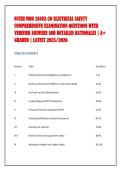
NCCER MOD 26102-20 ELECTRICAL SAFETY
COMPREHENSIVE EXAMINATION QUESTIONS WITH
VERIFIED ANSWERS AND DETAILED RATIONALES | A+
GRADED | LATEST 2025/2026
TABLE OF CONTENTS
Section Topic Questions
I OSHA Standards and Regulatory Compliance 1-15
II Electrical Shock and Its Effects on the Human Body 16-25
III Arc Flash and Arc Blast Hazards 26-35
IV Lockout/Tagout (LOTO) Procedures 36-50
V Personal Protective Equipment (PPE) 51-65
VI Hazard Identification and Risk Assessment 66-75
VII Hierarchy of Controls 76-85
VIII Electrical Tools and Equipment Safety 86-95
IX Working at Heights and Ladder Safety 96-105
,Section Topic Questions
X Confined Space Entry 106-112
XI Hazardous Materials and Environmental Safety 113-120
XII Emergency Response and First Aid 121-130
XIII Electrical Safety Standards (NFPA 70E, NEC) 131-140
XIV General Safety Practices and Incident Prevention 141-150
SECTION I: OSHA STANDARDS AND REGULATORY COMPLIANCE
QUESTION 1: OSHA CFR 1910 is the standard for which of the following industry sectors?
A) Construction Industry
B) General Industry
C) Maritime Industry
D) Agricultural Industry
Rationale: OSHA CFR 1910 covers general industry standards, while CFR 1926 covers
construction. The distinction is critical for electricians working in different environments.
QUESTION 2: According to OSHA, any employee who is exposed to high-voltage hazards
must wear which class of hard hat?
A) Class A hard hat
B) Class G hard hat
C) Class E hard hat
D) Class C hard hat
,Rationale: Class E (Electrical) hard hats are rated for up to 20,000 volts and are required for
workers exposed to high-voltage hazards. Class G is general use (2,200 volts), and Class C
provides no electrical protection.
QUESTION 3: The primary purpose of electrical safety procedures, as mandated by OSHA,
is to:
A) Increase work speed and productivity
B) Prevent shock, injury, and fire hazards
C) Reduce operational costs
D) Improve lighting conditions
Rationale: Electrical safety procedures are fundamentally designed to protect workers from
electrical shock, arc flash, arc blast, and fire hazards. While productivity and cost are
considerations, they are secondary to worker safety.
QUESTION 4: Which of the following best describes the OSHA-mandated responsibility of
an employer regarding workplace safety?
A) Provide safety training only upon employee request
B) Ensure that employees work at maximum efficiency
C) Ensure that employers maintain a safe workplace
D) Provide safety equipment only when hazards are identified
Rationale: OSHA's General Duty Clause requires employers to provide a workplace free from
recognized hazards. This includes maintaining safe conditions, providing training, and ensuring
proper safety equipment is available and used.
QUESTION 5: The OSHA lockout/tagout rule (29 CFR 1910.147) protects workers primarily
from:
A) Exposure to harmful chemicals
B) System shutdown procedures
C) Exposure to hazardous energy sources
D) Unauthorized equipment use
, Rationale: The LOTO standard specifically addresses the control of hazardous energy—
electrical, mechanical, hydraulic, pneumatic, chemical, thermal, and other energy sources that
could cause injury during servicing and maintenance.
QUESTION 6: According to OSHA regulations, insulating gloves must be inspected by the
user:
A) Before each use
B) Weekly
C) Monthly
D) Yearly
Rationale: OSHA requires that insulating gloves be visually inspected before each use for any
signs of damage, including cuts, punctures, abrasions, or ozone deterioration. This pre-use
inspection is critical for worker safety.
QUESTION 7: Which of the following is the threshold at which a power source is
considered high voltage in the context of OSHA safety regulations?
A) Over 120 volts
B) Over 240 volts
C) Over 480 volts
D) Over 600 volts
Rationale: In the context of electrical safety, high voltage is generally defined as exceeding 600
volts. This classification triggers additional safety requirements, including specialized PPE and
approach distance restrictions.
QUESTION 8: If you observe a safety violation at your job site, the appropriate action is
to:
A) Ignore it if it does not affect you personally
B) Report it to your supervisor immediately
C) Wait until the end of the day to report it
D) Handle it yourself without telling anyone
COMPREHENSIVE EXAMINATION QUESTIONS WITH
VERIFIED ANSWERS AND DETAILED RATIONALES | A+
GRADED | LATEST 2025/2026
TABLE OF CONTENTS
Section Topic Questions
I OSHA Standards and Regulatory Compliance 1-15
II Electrical Shock and Its Effects on the Human Body 16-25
III Arc Flash and Arc Blast Hazards 26-35
IV Lockout/Tagout (LOTO) Procedures 36-50
V Personal Protective Equipment (PPE) 51-65
VI Hazard Identification and Risk Assessment 66-75
VII Hierarchy of Controls 76-85
VIII Electrical Tools and Equipment Safety 86-95
IX Working at Heights and Ladder Safety 96-105
,Section Topic Questions
X Confined Space Entry 106-112
XI Hazardous Materials and Environmental Safety 113-120
XII Emergency Response and First Aid 121-130
XIII Electrical Safety Standards (NFPA 70E, NEC) 131-140
XIV General Safety Practices and Incident Prevention 141-150
SECTION I: OSHA STANDARDS AND REGULATORY COMPLIANCE
QUESTION 1: OSHA CFR 1910 is the standard for which of the following industry sectors?
A) Construction Industry
B) General Industry
C) Maritime Industry
D) Agricultural Industry
Rationale: OSHA CFR 1910 covers general industry standards, while CFR 1926 covers
construction. The distinction is critical for electricians working in different environments.
QUESTION 2: According to OSHA, any employee who is exposed to high-voltage hazards
must wear which class of hard hat?
A) Class A hard hat
B) Class G hard hat
C) Class E hard hat
D) Class C hard hat
,Rationale: Class E (Electrical) hard hats are rated for up to 20,000 volts and are required for
workers exposed to high-voltage hazards. Class G is general use (2,200 volts), and Class C
provides no electrical protection.
QUESTION 3: The primary purpose of electrical safety procedures, as mandated by OSHA,
is to:
A) Increase work speed and productivity
B) Prevent shock, injury, and fire hazards
C) Reduce operational costs
D) Improve lighting conditions
Rationale: Electrical safety procedures are fundamentally designed to protect workers from
electrical shock, arc flash, arc blast, and fire hazards. While productivity and cost are
considerations, they are secondary to worker safety.
QUESTION 4: Which of the following best describes the OSHA-mandated responsibility of
an employer regarding workplace safety?
A) Provide safety training only upon employee request
B) Ensure that employees work at maximum efficiency
C) Ensure that employers maintain a safe workplace
D) Provide safety equipment only when hazards are identified
Rationale: OSHA's General Duty Clause requires employers to provide a workplace free from
recognized hazards. This includes maintaining safe conditions, providing training, and ensuring
proper safety equipment is available and used.
QUESTION 5: The OSHA lockout/tagout rule (29 CFR 1910.147) protects workers primarily
from:
A) Exposure to harmful chemicals
B) System shutdown procedures
C) Exposure to hazardous energy sources
D) Unauthorized equipment use
, Rationale: The LOTO standard specifically addresses the control of hazardous energy—
electrical, mechanical, hydraulic, pneumatic, chemical, thermal, and other energy sources that
could cause injury during servicing and maintenance.
QUESTION 6: According to OSHA regulations, insulating gloves must be inspected by the
user:
A) Before each use
B) Weekly
C) Monthly
D) Yearly
Rationale: OSHA requires that insulating gloves be visually inspected before each use for any
signs of damage, including cuts, punctures, abrasions, or ozone deterioration. This pre-use
inspection is critical for worker safety.
QUESTION 7: Which of the following is the threshold at which a power source is
considered high voltage in the context of OSHA safety regulations?
A) Over 120 volts
B) Over 240 volts
C) Over 480 volts
D) Over 600 volts
Rationale: In the context of electrical safety, high voltage is generally defined as exceeding 600
volts. This classification triggers additional safety requirements, including specialized PPE and
approach distance restrictions.
QUESTION 8: If you observe a safety violation at your job site, the appropriate action is
to:
A) Ignore it if it does not affect you personally
B) Report it to your supervisor immediately
C) Wait until the end of the day to report it
D) Handle it yourself without telling anyone


